Revisiting This Week’s Natural Gas Hearings
This week, the U.S. Senate Committee on Energy and Natural Resources held a series of roundtables to discuss natural gas and its role in the American economy. From infrastructure and LNG exports to environmental protection and best practices, the committee gathered an array of stakeholders to discuss all facets of development. As to be expected, shale was a major focal point throughout the hearings.
Dana
Staff Geologist
This week, the U.S. Senate Committee on Energy and Natural Resources held a series of roundtables to discuss natural gas and its role in the American economy. From infrastructure and LNG exports to environmental protection and best practices, the committee gathered an array of stakeholders to discuss all facets of development. As to be expected, shale was a major focal point throughout the hearings.
Like any event on Capitol Hill, the discussions brought up perspectives from all sides. Experts from industry sat across from state and federal regulators, environmentalists, and lawmakers alike, debating and sharing their thoughts on the development, extent, and end use of our abundant natural gas supplies.
Here we take a quick look back on the week with some highlights, with some much-needed fact checks along the way.
May 21, 2013: Domestic Supply and Exports
Tuesday’s roundtable focused on America’s natural gas supply and liquefied natural gas (LNG) exports. Panelists included American Chemistry Council President Cal Dooley, Harry Vidas of ICF International, and Charles Ebinger of the Brookings Institution, among others. One outlier on the panel, however, was Deborah Rogers, Executive Director of Energy Policy Forum and a longtime critic of shale development and hydraulic fracturing. Ms. Rogers, who landed a starring role in Gasland Part II and is affiliated with the aggressively anti-fracking group Earthworks, called into question the size of America’s natural gas resources, a claim for which she has become famous (or, perhaps, infamous).
From her testimony:
“Exportation of shale gas opens up many interesting, critically important questions. It is precisely for this reason that sensible and reasonable debate should occur before we commit billions of dollars and years of investment in an energy policy that will serve few of us. Unfortunately, debate has been subsumed by the cacophony of voices that would have us believe that shale gas is abundant, long lived and will defy pricing pressures for decades to come. This is simply not true.”
Ms. Rogers presumes that America’s natural gas supply is overstated, even grossly so. Her reasoning hinges upon an inherent distrust in shale development more generally, as Rogers believes that shale itself is actually unsustainable, and that rapid production declines from shale wells undercut the “abundance” argument.
It’s an interesting position to take, especially in the wake of the International Energy Agency’s (IEA) recent report, which found that North America’s shale supply is altering the entire global energy equation, and even – potentially – altering OPEC’s future activities. The findings reaffirm previous reports from IEA and the Energy Information Administration (EIA) touting our vast energy supply. In fact, IEA chief economist Fatih Birol recently referred to shale as the “the biggest change in the energy world since World War II.” If that’s not enough, another report from the Potential Gas Committee earlier this spring showed a massive increase in available natural gas – at least 110-years’ worth, to be more specific.
More from Ms. Rogers’ testimony:
“Shale wells deplete alarmingly. …Moreover, every shale gas play in the U.S., with the exception of the Marcellus, has already peaked and is in decline. Some have gone through almost a complete life cycle in a matter of a mere five years or so, negating entirely the notion of plentiful supply for 30, 40 or even 50 years.”
First of all, Ms. Rogers’ comments fail to acknowledge the expanse of America’s shale plays. As EIA’s Sam Gorgen told Business Insider, “The long-term outlook for shale/tight oil and gas production is supported by the large area extent of the plays and hence the number of wells that can be drilled.”
Yes, depletion does occur, but not quite as Ms. Rogers explains. Individual wells do have a well-understood depletion rate, with the largest amount of production occurring in the early stages of a well. But those same wells can still produce for decades – which is exactly why literally every credible voice on this subject is acknowledging America’s vast supply of natural gas. Moreover, the reason for “declines” in certain shale plays isn’t because of some sort of technological failing; it’s because America is so awash in natural gas that we’re trying to find new sources of demand, and thereby leverage this resource even further. As it stands right now, the federal government has constraints on the available markets for natural gas, one of which is the restriction on exports.
In essence, by opposing exports, Ms. Rogers is trying to create a self-fulfilling prophecy: limit markets for natural gas, and then blame the industry for not having enough available markets.
Unfortunately, Ms. Rogers continued:
“The collateral damage in the form of air toxics, ground water depletion, encroachment, road damages and potential aquifer ruination in the United States could be immense and will only continue to rise as more and more wells need to be drilled. None of these externalities are at present fiscally covered. In other words, profits are to be privatized while costs and negative impacts will be socialized.”
Ah, here we get into the real source of Ms. Rogers’ beef: claims of upstream environmental impacts, the same ones that have been debunked time and again.
“Collateral damage” may be exciting rhetoric, but it isn’t reality. Recent reports from the Pennsylvania Department of Environmental Protection (DEP) have found that natural gas development is actually reducing air pollution. As the Breakthrough Institute describes, increased hydraulic fracturing and deployment of natural gas-fired power plants
“…have dramatically reduced emissions across the State, emissions of every sort – deadly particulates, heavy metals, and the NOx and SOx which are those nasty components of smog that also cause acid rain and a lot of health problems.”
As far as “groundwater depletion” goes – yes, hydraulic fracturing requires water, but so does almost everything else. The real question is, does shale development use too much water, and how does it compare to other industries? The reality is that water required for hydraulic fracturing is typically a fraction of a percent of any particular state’s total water demand. As such, claims of hydraulic fracturing “depleting water resources” are not supported by the facts.
Like any industry, there are environmental risks associated with development. But Ms. Rogers’ assertion that these risks cannot be mitigated and that they exceed any or all benefits is demonstrably false. As a report from Yale Graduate Energy Study Group found, when comparing benefits and costs, the former exceeds the latter by a factor of 400 to 1.
May 23rd, 2013: Shale Development: Best Practices and Environmental Concerns
Thursday’s hearing focused on the technology and best practices surrounding the development of America’s shale supply, with experts such as XTO Energy president Jack Williams, Anadarko’s Clay Bretches, Chairman of the Texas Railroad Commission (TRC) Barry Smitherman, Environmental Defense Fund’s (EDF) Mark Brownstein, and many others adding to the discussion. A dynamic and well-rounded conversation, panelists and U.S. Senators alike shared their opinions on how our nation can best develop its extensive natural gas supply.
But perhaps the most notable moment in the series of forums was an exchange between Senator Mary Landrieu (D-La.) and two environmental groups who are critical of hydraulic fracturing.
Following a comment from Halliburton’s Marc Edwards on the proven safety record of hydraulic fracturing, Senator Landrieu asked the panel (1:25:26) if anyone disagreed with Mr. Edwards and knew of any documented cases of hydraulic fracturing contaminating groundwater supplies.
Upon Senator Landrieu’s question, the Sierra Club’s Deb Nardone, Director of the Beyond Natural Gas Campaign, quickly responded with a “yes.” The Senator asked Ms. Nardone to follow up with a specific example, to which Nardone launched into a series of talking points about “public trust” and other things that did not answer the Senator’s question. Landrieu pressed her, again, for something specific, to which Nardone blurted out “methane contamination in Dimock, Pennsylvania.”
Edwards responded by saying that the issue was the “chemistry pumped into [shale] formations,” which are typically a mile below where groundwater aquifers are. “Under scientific rigor, it’s hard to understand how the chemistry can migrate through a significant volume of rock to contaminate groundwater aquifers,” Edwards added.
Landrieu’s response: “I keep hearing from environmental groups that there are many examples of contamination of groundwater.” She added that industry consistently says the opposite (as do state regulators and other experts, by the way), and then reiterated her request for the environmental groups to name a specific example – and avoid generalities. “Please do not give me theories,” Landrieu added.
Amy Mall from NRDC responded with a non sequitur. She cited a Scranton Times-Tribune story that alleged 161 cases of water impacts due to oil and gas development – a large majority of which were determined to be unfounded. Yes, that’s right: Asked for a specific case of hydraulic fracturing contaminating water, and the NRDC points to a list of impacts, most of which had sources not attributable to oil and gas, and many of which don’t even refer to shale wells.
It’s telling that, when pressed for actual evidence of hydraulic fracturing contaminating drinking water, neither the NRDC nor the Sierra Club could do it. All they could do was speak in talking points and generalities.
Earlier in the hearing, the Sierra Club’s Deb Nardone suggested “there are no ‘best practices’ that can fully address” the impacts of shale development (clearly ignoring the actual safety record of the industry), and that continued development would ultimately lead to environmental “disaster.” She raised the issue of methane leaks, even though EPA data contradict the claim that leaks are massive, and spoke of how we need to reduce carbon dioxide emissions in the United States by transitioning to “zero-carbon energy.” Ms. Nardone must have missed the fact that, according to pretty much anyone who is paying attention, carbon dioxide emissions are at a twenty-year low, thanks in large part to the increased use of natural gas.
It’s also odd that Ms. Nardone would try to pit natural gas against renewables, when in reality renewables need natural gas to grow. Even Sen. Wyden said in his opening remarks that natural gas is the “first stage of a lower carbon future.”
Amy Mall with NRDC also provided some whoppers in her testimony:
“…natural gas development is a major industrial activity that uses toxic chemicals, produces massive amounts of hazardous waste, releases heat-trapping methane and other dangerous air pollutants, and has contaminated water and air in communities across the country.”
This is classic rhetoric from critics of shale development: squeeze in as many scary terms as possible into each statement, thereby magnifying risk and ignoring context.
Yes, shale development does involve risk, but it simply does not have the impact that Ms. Mall is suggesting. As we stated earlier, reports have found that clean-burning natural gas development is actually reducing toxic air pollution. As for “toxic chemicals,” they make up only 0.5 percent of the fluid used, and many of them include every day materials you would find in ice cream or dish detergent. Oilfield service companies that actually perform hydraulic fracturing are also investing increasing amounts of R&D dollars into other types of additives, including food-based products.
Finally, as this hearing once again confirmed, there has never been a documented instance of groundwater contamination as a result of the hydraulic fracturing process, and neither the Sierra Club nor the NRDC could list any specific examples to prove otherwise.
Ms. Mall also suggested that oil and gas development is essentially an unregulated free for all (a claim the NRDC takes great pleasure in promoting):
“…what is the rationale for leaving natural gas production exempt from critical provisions of federal laws that have applied for decades to virtually every other industrial activity – laws that have proven to be effective, affordable and workable? …And where is the evidence that states have proven equal to the task?”
First of all, natural gas production is heavily regulated at both the federal and state level. An operator can’t even begin thinking about drilling a well without filing a stack of paperwork and completing numerous environmental tests, all in accordance with dozens of laws. Suggesting that oil and gas development is somehow “exempt” from regulations that keep the public safe is a deliberate attempt to misinform.
As for the evidence of states being up to the task, how about we ask the U.S. EPA – the agency that the NRDC wants to put in charge of regulating hydraulic fracturing?
Former EPA administrator (and President Obama appointee) Lisa Jackson has strongly defended, on numerous occasions, state regulation of oil and gas development. “We have no data right now,” Jackson said in 2011, “that lead us to believe one way or the other that there needs to be specific federal regulation of the fracking process.” She added: “States are stepping up and doing a good job. It doesn’t have to be EPA that regulates the 10,000 wells that might go in.”
The director of EPA’s Drinking Water Division also says states are doing a “good job” regulating hydraulic fracturing.
So, if Ms. Mall is truly interested in evidence – and not just making sure a favorite talking point is entered into the public record – hopefully repeated assurances from the EPA will suffice.
A few of the other highlights of the hearing (which you can also see on EID’s Twitter page):
- FracFocus: Anadarko, XTO, Noble and other operators at the hearing said they report all wells to FracFocus in every state where they are operating, even if the particular state doesn’t mandate it. Senator Wyden noted that FracFocus is a “constructive effort,” and EDF’s Brownstein also shared his support for the program.
- Flaring: Panelists noted how industry is investing “over $4 billion” in new infrastructure to reduce the need for flaring. EDF’s Brownstein noted that flaring is better than venting, but would like to see green completions applied to associated gas to insure that achieve a combustion efficiency of 98 percent or greater. (For more information on flaring, check out our previous post on the subject.)
- Manufacturing: Sen. Joe Manchin (D-W.Va.) observed the benefits natural gas from shale in both his state and the rest of the nation’s chemical industry, a fact also highlighted in a recent study by the American Chemistry Council (ACC). Earlier in the week, ACC’s Cal Dooley explained to the Committee that affordable and domestic natural gas supplies have “transformed the U.S. chemical industry from the world’s high-cost producer five years ago, to among the world’s lowest-cost producers today.”
All in all, this week’s roundtable discussions provided valuable insight on natural gas issues, especially the safety and promise of future shale development. Though there were some notable deviations, the Committee hearings were largely an adult conversation about best practices, improving performance, and recognizing the importance of future shale development – a welcome respite from the all-too-typical public onslaught of fear mongering and inflammatory headlines.
In other words, it was nice to see conversations occurring within the confines of reality. For once.
New Report: HF Does Not Pose Credible Health Risk
A new, comprehensive report from Gradient examines the risk of hydraulic fracturing impacting human health. Even by taking a conservative approach that by design overestimates risk, the report concludes that hydraulic fracturing fluids “are not expected to pose an adverse risk to human health” and that, in the event of a spill, natural processes would dilute fluids to “below levels of human health concerns.”
Steve
Team Lead
A new, comprehensive report from Gradient examines two potential exposure pathways for hydraulic fracturing fluids to impact human health: upward migration from the shale formation itself, and surface incidents such as spills or other releases. Even by taking a conservative approach (which by design overestimates risk) the report concludes that hydraulic fracturing fluids “are not expected to pose an adverse risk to human health” and that, in the event of a spill, natural processes would dilute fluids to “below levels of human health concerns.”
The upshot? All of those scary stories we’ve heard about hydraulic fracturing supposedly threatening public health – and the alleged reason behind New York Governor Andrew Cuomo delaying approval of shale development – are not based on a credible examination of risk.
Let’s take a closer look at each of the potential pathways for health impacts, as examined by Gradient.
Upward Fluid Migration
We’ve all seen that image that so-called “green” groups use to describe hydraulic fracturing, the one where the fractures and chemicals are migrating upward from the shale formation and into groundwater (it’s sourced back to the discredited Gasland movie page). In this bizarre interpretation of reality, the fluids injected at depth are not confined to the formation, and the thousands of feet (and literally billions of tons) of impermeable rock above the shale zone – which have kept oil and gas deposits sealed at depth for millions of years – somehow provide pathways for chemicals to migrate against gravity and into groundwater.
On that claim, Gradient has what can only be described as a devastating refutation:
“[I]t is implausible that the fluids pumped into the target formation would migrate from the target formation through overlying bedrock to reach shallow aquifers.”
Put differently: Folks suggesting that hydraulic fracturing threatens water aquifers are literally arguing the “implausible.”
Need more concrete language? Gradient delivers:
“[T]here is no scientific basis for significant upward migration of HF fluid or brine from tight target formations in sedimentary basins.”
Got that? “No scientific basis.” Keep that in mind whenever you hear opponents try to claim the mantle of “science” in suggesting the hydraulic fracturing process will pollute drinking water.
The report adds that even if upward migration were somehow to occur, the dilution of fluids and additives would be enormous, and by the time anything ever reached drinking water supplies – remember, such migration would have to go through thousands of feet of various rock formations – the concentrations would be “well below health-based standards.”
Risks from Surface Releases
It’s obviously reassuring to know that the hydraulic fracturing process is safe – even if most of us already knew that, thanks to consistent affirmation from state regulatory agencies. But what happens if there’s a surface release on the wellpad? What if the waste water – the handling and transport of which is tightly regulated – spills onto the ground or roadway? What’s the risk to underground supplies of drinking water?
In short: insignificant. Here’s why.
Gradient used data from flowback samples (as well as produced water) from the Marcellus Shale in Pennsylvania and West Virginia to form the basis for its risk assessment. The report assumed zero containment measures, and that, in the event of a spill, 100 percent of the fluid would leach into groundwater. Due to a variety of geological factors, this is essentially impossible – but it was used to create an upper bound of risk for such an incident.
Those same geological factors, however, cannot be ignored in terms of assessing how spilled fluids would eventually migrate to a water aquifer. Here’s Gradient’s conclusion:
“Human health risks associated with potential surface spills of fluids containing HF constituents are expected to be insignificant with respect to both impacts to USDWs [underground sources of drinking water] and impacts to surface waters due to dilution mechanisms which are expected to reduce concentrations in potable aquifers and surface waters to levels below health-based drinking water concentrations in the event of surface spills.” (emphasis added)
So even if, somehow, all of the fluid from a spill were to reach drinking water, the natural dilution mechanisms between the spill site and point of contact with the aquifer would shrink the health-risk to below established thresholds.
To be sure, this doesn’t mean that development poses zero risks. All types of energy development involve certain risks. But the focus should not be on whether there are risks, but whether those risks can be managed — and whether those risks are large enough to warrant banning the processes involved.
In the case of shale development – and hydraulic fracturing specifically – the verdict is clear: the risks from such activity are exceedingly low, and pushing for bans or additional restrictions based on inflated fears of risks is simply not a fact-based position.
Climate Central Report Highlights Decline in Methane Emissions
This week, a climate research organization, Climate Central, released a report, “Natural Gas and Climate Change” which comes to a somewhat obvious conclusion: we need more data on methane emissions. But if hydraulic fracturing opponents were hoping for a report that would support their dubious claim that methane emissions from natural gas are “massive,” they will be sorely disappointed.
Katie
Researcher
This week, a climate research organization, Climate Central, released a report, “Natural Gas and Climate Change” which comes to a somewhat obvious conclusion: we need more data on methane emissions. But if hydraulic fracturing opponents were hoping for a report that would support their dubious claim that methane emissions from natural gas are “massive,” they will be sorely disappointed. Indeed, the report mostly kept activist advocacy at an arm’s length and focused on real-world facts. As the report states:
“The EPA’s 2012 annual greenhouse gas emissions inventory estimate [of methane leakage] was 2.2 percent. Its 2013 inventory estimate made a large adjustment that reduced the estimate to 1.5 percent. The degree of methane leakage is uncertain, but it is likely to be reduced in the future since it also represents lost profits for gas companies.” (emphasis added)
So, even Climate Central is acknowledging that methane emissions are on a downward trajectory. (To be fair, Climate Central also mentions other studies on methane “leaks,” many of which have been thoroughly debunked.) The key thrust of its report, however, is to evaluate whether or not the use of natural gas would provide a reduction in greenhouse gas emissions sufficient to meet particular targets. From the report:
“The EPA recently estimated methane leaks in the natural gas system at 1.5 percent. A 1.5 percent leak rate would achieve an immediate 50 percent reduction in greenhouse gas (GHG) emissions, at the individual power plant level. However, EPA’s estimate contains significant uncertainly, and like all estimates available in the peer-reviewed literature, lacks sufficient real-world measurements to guide decision-making at the national level. Climate Central found that the ongoing shift from coal to gas in power generation in the U.S. is unlikely to provide the 50 percent reduction in GHG emissions typically attributed to it over the next three to four decades, unless gas leakage is maintained at the lowest estimated rates (1 to 1.5 percent) and the coal replacement rate is maintained at recent high levels (greater than 5 percent per year).” (emphasis added)
So, Climate Central acknowledges EPA’s estimate of 1.5 percent, and that the leakage rate is “likely to be reduced in the future” as well – and yet they presume a lack of GHG benefit “unless” the leakage rate is maintained at or below the level they acknowledged. Sounds like things are already on track!
Yes, there are problems with EPA’s estimates, but the reality is that EPA’s emissions data are overestimates. The uncertainty is not whether the leakage rate is actually higher, but rather how much lower it is in practice.
EPA’s 1.5 percent estimate is actually far too high because it is based on assumptions that grossly misinterpret actual industry practice. One of the biggest problems with EPA’s estimate is that it assumes companies that are not required to capture methane during well completions are simply venting that methane into the air. It also assumes that flaring, a process that burns off the methane before it is released, isn’t really happening unless the authorities explicitly mandate it. Both of these assumptions are simply wrong, and they produce estimates that are by no means reflective of industry operations.
Interestingly, the American Gas Association also released a report today that evaluates EPA’s revisions to its methane estimates, observing that “the long-term trend for methane emissions from natural gas systems is downward.” The report states that “absolute methane emissions have declined 10 percent [since 1990], even as production increased 32 percent. In 2007 emissions hit their all-time peak. Since then, emissions have fallen 14 percent as natural gas production climbed 15 percent.” It also points out that EPA air regulations coming down the pike (the ones justified by the agency’s own inflated emissions estimates) will require companies to capture methane at the wellhead by 2015, which the Climate Central report also mentions:
“Starting in 2015, all hydraulically fractured wells will be required to use ‘green completion’ technologies to capture the methane. The EPA estimates that methane leakage is reduced by 95 percent with a green completion compared with venting of the methane.”
Climate Central begins its report citing EPA’s greatly-reduced emissions estimates, then states that emissions will continue to decrease, and finally claims that forthcoming EPA regulations will reduce methane emissions by 95 percent beginning in 2015.
Regardless of how it hedges its claims amidst an aura of “uncertainty,” the Climate Central report acknowledges that, based on EPA data, methane emissions are going down, and will continue to do so.
Financing the Seeds of Doubt on Shale
A review of funding provided to groups opposing hydraulic fracturing shows that NGOs and Foundations provided over $35 million in 2012 to groups working to block shale development which includes $100,000 for the creation of Gasland III before the second iteration of the pathos-driven film series is even released on HBO.

John, EID Communications Director
Tom, EID Marcellus Campaign Manager
The scientific consensus concerning the safety of hydraulic fracturing and shale gas development is well established. After all, state regulators, officials in the Clinton, Bush and Obama administrations, Democratic and Republican governors and independent reviews – including one spearheaded by the current Secretary of Energy – have all affirmed the process doesn’t pose a credible risk to the nation’s water and air. In fact, experience shows increased natural gas utilization brought about by shale development is ridding our nation’s air of greenhouse gases and toxic pollutants, and even helping increase renewable energy utilization in the United States. That’s one reason President Obama noted in his 2012 State of the Union Address that the nation’s abundance of natural gas means “we don’t have to choose between our environment and our economy.”
It goes without saying this is great news for most Americans. That good news is also a terribly inconvenient and credibility-decimating narrative for anti-shale activists such as Josh Fox. And yet, faced with overwhelming evidence that contradicts their public statements, critics are sparing no expense to prevent the public from recognizing such broad scientific agreement. It’s what happened with the launch of Gasland, and it’s looking ever more likely that this is what the marginalized activist community is gearing up to do again.
To wit: Months before the HBO premiere of Gasland Part II, Josh Fox has already secured $100,000 for the next iteration of his pathos-driven film series — whose original offering was widely panned by independent observers as being “fundamentally dishonest” and a “polemic.” It’s also why the Park Foundation, the organization funding Fox and just about every other anti-natural gas initiative, just committed over 11 percent of its 2013 grant awards to organizations working overtime to block hydraulic fracturing’s continued advance.
A review of the Park Foundation’s 2013 grants show that it’s increasingly worried about Americans recognizing that oil and gas production technology is not nearly as risky or tumultuous as the organization would like them to believe. Take for example, just a few of the group’s most recent contributions:
$100,000 to the International WOW Company for Gasland, Part 3
$125,000 to Food and Water Watch (one of the most aggressive anti-fracking groups in the United States) to “protect and conserve the nation’s water resources”
$40,000 to Catskill Mountainkeeper, Inc. “for its on-going comprehensive campaign against fracking”
$50,000 to Physicians Scientists and Engineers for Sustainable and Healthy Energy for general operating support
$60,000 to the Public Policy and Education Fund of New York for “its campaign against fracking in New York and related organizing work in the Southern Tier.”
$110,000 to the Sustainable Markets Foundation to help “coordinate a broad movement of opposition to shale gas drilling”
$20,000 to the Delaware Valley Arts Alliance for an anti-hydraulic fracturing web based talk show, and
$50,000 to 350.org for the advancement of their fossil fuel divestment campaign
Of course, the Park Foundation isn’t alone in its efforts to steadily feed misinformation into the public sphere. A recent report – titled “Fracking Survey 2012: Report on NGO and Philanthropic Efforts to Address Impacts of Hydraulic Fracturing” – declares bluntly:
“Engagement of NGOs and foundations on this issue [hydraulic fracturing] is growing rapidly. The NGOs surveyed reported spending a total of $17.4 million in 2012; they hope to expand that investment of effort to more than double that figure in 2013.” (emphasis added)
The report also notes that “foundations surveyed reported investing a combined total of $18.3 million in fracking related grants in 2012.”
For those keeping track at home, that means opponents of hydraulic fracturing spent more than $35 million to further their cause – in 2012 alone. And they have the temerity to claim that they’re just the “little guys” standing up to Big Oil? Please.
Almost as important as the amount of funding being levied at the issue are the priorities that funding is being directed towards. Here, too, the report provides some clear evidence that, like the Gasland series, much of this funding is earmarked to disseminate largely false information, rather than informing and advancing the scientific discussion.
Revealingly, when asked what strategies this funding went to support, respondents overwhelmingly indicated it wasn’t being directed at advancing increased scientific understanding or research. Instead, as the report observes: “The NGO respondents gave highest priority to communications work and raising public awareness,” while 68 percent of NGO expenditures and 83 percent of foundation expenditures were dedicated towards efforts to influence activities at the state and local level. The graph below shows this in very clear terms.
That’s right: An internal survey of NGOs and foundations working to influence the public’s perception on hydraulic fracturingshows that, in their own words, they are pumping millions of dollars into states and local communities to advance talking points that don’t align with the scientific and regulatory consensus. As if it could get any worse, the study found a clear majority of this funding is being directed towards regions where supposedly “grassroots” groups and NGOs (think Catskill Mountainkeeper, as an example) are using talking points that are completely unhinged from reality. That region, of course, is the Marcellus Shale, to which NGOs and foundations funneled nearly $20 million in 2012. 
As EID has noted time and again, this is a region where NGOs that appear in the “mainstream” have blatantly attempted to mislead the public with little concern for accuracy, much less a well-reasoned and informed debate. A few noteworthy examples:
Penn Environment’s attempt to claim water contamination in Pennsylvania with a picture of a flooded rig, which a review later showed to be located in Pakistan.
NRDC’s claims of “poisoned” drinking water in Northeastern Pennsylvania, which both the Pennsylvania Department of Environmental Protection and the U.S. Environmental Protection Agency declared was safe.
The Sustainable Markets Foundation support for, and mailing of, publications to over 140,000 residents in New York claiming that gruesome scenes of environmental destruction were attributable to natural gas development when, in fact, they were not.
Activists funding an ongoing legal campaign to compel communities to ban hydraulic fracturing due to unfounded claims of health impacts.
Josh Fox’s claims that shale development resulted in increased rates of breast cancer, which was later refuted by an Associated Press investigation titled “Some Fracking Critics Use Bad Science.”
And yet, despite being rebuffed at literally every turn, they’re going to avoid any sense of reflection on Gasland Part II and move full speed ahead with Gasland Part III? Remember, the Park Foundation gave Josh Fox’s production company, International WOW, some $150,000 for Gasland, and now they’re going to throw another $100,000 at him – on top of all the grants he’s received from various city, state and national arts organizations at taxpayer expense? You’ve got to hand it the guy – he knows how to hustle. As the Playgoer blog noted regarding the original Gasland, “what does a downtown director have to do to get on national TV? Make an HBO muckraking documentary, of course!” Apparently, making several such documentaries is the best path toward fame – or, perhaps, infamy.
Neither the Park Foundation nor Fox has learned there is a law of diminishing returns that applies to such antics. Gasland Part II is a pitiful rehash that led Fox into the cardinal sin of film-making – being boring. What will Gasland Part III be? We can only guess, but one suspects they’re venturing into Jaws III territory where things move from being boring to being a joke. The fact that they’re steamrolling ahead without any concern about the pushback against Gasland Part II shows that engaging in legitimate debate isn’t the goal here; it’s about flooding the zone, and things like facts or accuracy only delay that process.
The irony is that all of this money is being spent to oppose a process that has been proven safe, is improving our national economy, and increasing the quality of life for middle class Americans nationwide. Even more interesting is that these funds are presumably for environmental activism, and yet it’s natural gas – largely developed with the help of responsible hydraulic fracturing – that is helping the United States reduce greenhouse gas emissions and bring increased quantities of renewable energy into our nation’s power grid.
But if your work to date has not been based on facts and science, why stop now?
Anti-Shale Activists Trying to Upset Democratic Process
On Tuesday of this week (May 21), lawmakers in Springfield will be considering a historic compromise on hydraulic fracturing, which will pave the way for responsible development in Illinois and establish some of the strongest regulations in the country. Yet, despite an unprecedented level of support, a small yet vocal minority of ideological activists continues to think that the rules are inadequate and have somehow been “rushed.”
Kyna
Midwest Field Director
On Tuesday of this week (May 21), lawmakers in Springfield, Ill., will be considering a historic compromise on hydraulic fracturing, which will pave the way for responsible development in Illinois and establish some of the strongest regulations in the country. This legislation – filed as Amendment 1 to SB 1715, and which was the product of more than a year of discussions, compromise, and in-depth reviews of science and facts – was designed to address concerns specific to Illinois, and it enjoys support from an impressive coalition: environmental groups (including the Sierra Club, the NRDC, and the Illinois Environmental Council), labor (including the AFL-CIO), the business community, the oil and gas industry, and agriculture groups, among many others.
Yet, despite this unprecedented level of support, a small yet vocal minority of ideological activists continues to think that the rules are inadequate and have somehow been “rushed.” They’re planning to meet at the Capitol in Springfield on Tuesday, during which time they’ll hold a press conference and likely try to make as much noise as possible. The headliner will be Sandra Steingraber, a well-known activist who has likened hydraulic fracturing to a “tornado on the horizon” and disgracefully advanced the alarmist narrative that fracking causes cancer – even though actual scientists disagree.
The goal? Make a ruckus and prevent the Illinois legislature from passing the agreed-upon regulatory bill.
To be sure, we’ve examined in depth the claims that Illinois activists have made about hydraulic fracturing, and – lo and behold – they’ve been thoroughly debunked. But because ideologues don’t typically bother with self-reflection or legitimate research, these same groups continue to repeat their talking points, as if scientific and regulatory consensus mean nothing.
More alarming, however, is that the debate here in Illinois over hydraulic fracturing has taken place in a variety of forms. There have been public hearings and forums. We’ve read countless letters to the editor and op-eds. News stories and editorials from every major newspaper have tackled topics ranging from environmental issues to economic benefits. Lawmakers in Springfield have been occupied for months on end examining data, scientific reports, and studies from across the country regarding hydraulic fracturing and shale development. Social media and blogs are overrun with points and counterpoints about potential impacts, good and bad.
This is the essence of compromise, something that our legislature seems unable to do with almost anything else. It’s long, it’s arduous, it’s frustrating, and yes, it often results in outcomes that some people are not 100 percent satisfied with. The agreed-upon regulatory bill is no exception. Each constituency within the large and diverse group of supporters has stated that it’s not a perfect bill, and that there are things they wish were different. But they also recognize that the benefits of development are too big to ignore (as an example, look at North Dakota’s 3.2 percent unemployment rate), and ensuring safety is a superior goal to just sticking our heads in the sand, denying jobs to Illinois citizens, and preventing a responsible path forward.
What opponents are trying to do is frankly a fundamental disruption of democracy. The public debate has played out in a variety of channels throughout the past year, and a large and diverse majority of Illinois interests have united to support a path forward for shale development. The legislation is based on science, and it has been carefully crafted to address the needs and concerns of folks across our state. Those facts, among others, demonstrate why the legislation enjoys enormous bipartisan support.
Simply put: Just because anti-fracking activists don’t like the results of the democratic process should not give them license to upend it.
Responsible shale development in Illinois would create tens of thousands of jobs for a state suffering from an unemployment rate exceeding nine percent. It would encourage investment in a state with the worst bond rating in the country, and would generate new tax revenue that could address an out of control budget deficit and fund vital public services. At a time when businesses are fleeing our state, shale development would lead to an influx of much-needed new investment.
It’s bad enough that anti-fracking activists oppose new economic growth for Illinois. The fact that they’re willing to hamstring a historic compromise to do so is just shameful.
EPA’s Methane Assumptions Still Way Too High
Last month, the EPA released its latest Greenhouse Gas Inventory, in which the agency significantly lowered its estimate of the amount of methane emissions from natural gas systems. But even with those dramatic revisions, EPA still has a long way to go to get this right.
Katie
Researcher
Last month, the EPA released its latest Greenhouse Gas Inventory, in which the agency significantly lowered its estimate of the amount of methane emissions from natural gas systems. But even with those dramatic revisions, EPA still has a long way to go to get this right.
In its fact sheet about its changes to methane emissions estimates, EPA admits that at least some of its prior methods for collecting emissions data were flawed:
“The study data show that there is more widespread use of emissions control technologies than had been assumed in the previous Inventory. It also demonstrated that duration of emissions from liquids unloading activities is shorter than had been assumed in the previous Inventory.”
The key word here is “assumed.” While EPA’s current revisions are certainly an improvement and bring its estimates closer to accuracy, there are still a number of assumptions that are simply wrong. Digging deeper, and frankly speaking, it’s difficult to ascertain anything other than a fundamental lack of understanding of the actual development process.
One of the biggest problems with EPA’s latest report is that it still grossly overestimates emissions from well completions, based an inappropriate interpretation of data from its own Natural Gas STAR program. EPA assumes that the amount of methane that is captured from a “green completion” is the same amount of methane that is released in operations without green completions. Put differently, EPA assumes that operators not using a particular technology or process are just venting methane into the air that would have been captured by it. These faulty estimates have long been criticized, as a report by IHS CERA from 2011 made clear:
“EPA derives its new emissions factor from two slide presentations at Natural Gas STAR technology transfer workshops, one in 2004 and one in 2007. These two presentations primarily describe methane that was captured during ‘green’ well completions, not methane emissions. EPA assumes that all methane captured during these green completions would have been emitted in all other completions. This does not reflect industry practice.” (emphasis added)
Got that? EPA is using data on captured methane to estimate how much methane is being emitted into the air. Try to wrap your head around that one!
EPA also does not properly assess the role of flaring, a process that burns off methane instead of releasing it directly into the air. Since EPA’s Natural Gas STAR program does not consider flaring a recommended technology, it does not provide any data on the process – therefore, EPA simply assumes it isn’t happening. This assumption wholly misrepresents industry practice. Although states are rapidly moving toward reducing its usage (opting instead for methane capture), flaring is actually used for a whole host of reasons that the EPA is either unaware of or refuses to acknowledge. “Flaring is used not exclusively to limit potential greenhouse gas emissions from completions, but it is also often used due to safety concerns for the protection of industry employees,” according to Devon Energy, which – last we checked – is certainly no stranger to this whole shale development business.
Essentially, EPA assumes that, in states where flaring is not mandated, it’s never used there. This is like assuming that, in states that don’t mandate the use of hybrid vehicles, there are no hybrid cars on the road.
Furthermore, EPA’s prior estimate assumes that flowback duration is twice as long as it actually is in field practice, which in turn greatly distorted EPA’s estimates (again). More specifically, EPA asserts that the flowback periods for wells that utilize green completions are identical to wells that vent or flare the gas. But according to a report by URS Corporation (see Appendix A in here), the average flowback duration from a well with green completion is 7.7 days, while wells whose emissions are flared or vented take an average of only 3.5 days. That means the EPA assumes the duration of emissions (and, by extension, the total amount of emissions) from certain wells is more than double what it actually is.
According to EPA, well completions are the largest methane emission source within natural gas systems, which means EPA’s entire data set for this segment of the economy is not only inflated, but perhaps wildly so.
The worst part, however, is that future public policy decisions could be – and perhaps already are – based on EPA’s irresponsible use of data. By extension, the EPA has even justified costly regulations based on emissions that are not even occurring. For example, here’s what the EPA said in its overview of the New Source Performance Standard rule last year:
“In addition, the reductions would yield a significant environmental co-benefit by reducing methane emissions from new and modified wells. Methane, the primary constituent of natural gas, is a potent greenhouse gas – more than 20 times as potent as carbon dioxide when emitted directly to the atmosphere. Oil and natural gas production and processing accounts for nearly 40 percent of all U.S. methane emissions, making the industry the nation’s single largest methane source.” (emphasis added)
And yet, even with one small revision, in which the EPA adjusted its estimates based on better data, the agency was forced to recognize that methane emissions since 1990 have not been increasing, but have actually decreased – even as natural gas production grew exponentially. One can only imagine how significant of a downward revision would be made if the EPA actually corrected all of its errors.
As long as the EPA continues to rely on assumptions about industry activity that are not, in fact, based on actual industry activity, their estimates for methane emissions will remain wrong. The fact that those assumptions result in inflated emissions estimates makes the agency’s conscious decision not to adjust its methods even more troubling.
Bending the Natural Gas Polling Curve Down
A recent story in NPR's State Impact focused on the results of one poorly phrased and misleading question out of several in a poll that ended up showing broad public support for natural gas development. One question suggested citizens of both Michigan and Pennsylvania desired moratoria on hydraulic fracturing, but other survey results contrasted sharply with this conclusion.
Kyna, EID Midwest Field Director
Tom, EID Marcellus Campaign Manager
A recent story in NPR’s State Impact focused on the results of one poorly phrased and misleading question out of several in a poll that ended up showing broad public support for natural gas development. One question suggested citizens of both Michigan and Pennsylvania desired moratoria on hydraulic fracturing, but other survey results contrasted sharply with this conclusion.
When polling results don’t fit the template, some media sources try bending the polling curve to suit their storyline. When the poll itself is also designed to deliver a particular result, we get headlines like this one from State Impact :
“Poll Shows Support for a Drilling Moratorium in Pennsylvania”
The poll in question was one conducted by the National Surveys on Energy and Environment (NSEE), and was entitled Public Opinion on Fracking: Perspectives from Michigan and Pennsylvania.
State Impact’s headline, unfortunately, reflects the answer to a single (poorly phrased) question among a total of more than two dozen – and an equally poor understanding of how phrasing can alter the results. (More on that later.)
Nonetheless, given the actual results throughout the poll, a far more accurate headline – and one that actually describes the overarching results – would have been:
“Poll Shows Residents Strongly Support Shale Development”
NSEE doesn’t offer a copy of its survey instrument, so we don’t know exactly what prefaced the questions asked in this phone survey. But we do know that the results were, by anyone’s judgment, extremely favorable toward natural gas development. Consider this finding among Pennsylvania residents, who were asked whether natural gas development “will provide more benefits or problems”:
Pennsylvania residents, by nearly a two to one ratio, said there were more benefits than problems from the natural gas development they had experienced so far. The results were nearly identical for those Michigan residents surveyed, and this is only the beginning of the good news from the poll.
Astoundingly, some 82 percent of Michigan residents said natural gas development was either somewhat important or very important to the overall condition of their state economy.
As for overall public support, the numbers are again revealing. By a nine point margin, more Pennsylvanians support shale gas than oppose it, and a clear majority of Michiganders supports development.
The poll also confirmed what so many in the media keep claiming to be an “industry position” is, in reality, the position of the general public. Consider, too, this question:
“When it comes to regulating where drilling sites can be located, which level of government do you think should have the primary control, if any? Do you think the federal government, state government, or local government should have primary control for regulating where drilling sites can be located, or should this decision be made solely by private land owners without any government influence?”
The results, depicted below, indicate that in both Michigan and Pennsylvania, state regulation is preferred over either federal control or “home rule” by local government.
It’s worth repeating: Pennsylvanians and Michiganders both say they prefer state regulation over any other. Only about a quarter of respondents suggesting local regulation is appropriate. Michigan residents, in fact, preferred no regulation over local control — perhaps a wise decision given the ludicrous nature of some local regulations adopted in New York.
The reason is simple: States are, unquestionably, the best equipped to regulate oil and gas development. They have the most expertise, the longest history in regulating the industry, and they have proven themselves fit at separating fact from fiction when it comes to issues that arise. You can read more about all of this by clicking here.
Another interesting finding from the survey was that some 26 percent of respondents said any tax revenue from natural gas development should first go to reducing local property taxes. That’s good news, especially when you consider that Pennsylvania’s Act 13 put over $110 million in the hands of local government last year.
Moratorium?
So, if the survey shows all this support for natural gas development and not so much opposition, how is it that State Impact put out that headline suggesting everyone was ready to halt development and impose a moratorium? Well, as with any poll, it’s all in the way the questions are phrased. Here is the question regarding a moratorium:
“Some states have imposed a ‘moratorium’ on hydraulic fracturing until there is a fuller understanding of the possible risks. Do you strongly agree, somewhat agree, somewhat disagree, or strongly disagree that Michigan/Pennsylvania should establish a moratorium on hydraulic fracturing, or not?”
The wording of the question plants the false idea that there are risks that are not fully understood. Given six decades of experience and over one million wells hydraulically fractured, this is a little like warning an accountant of the “risks” of working with pencils. It also violates a best practice of survey methodology; namely, avoiding “loaded, leading, emotional, or evocative language as it can bias responses.”
The poll includes no mention of how many times hydraulic fracturing has been used, and certainly no discussion of what a moratorium would actually do. Do the respondents realize that shale development, which they strongly support, could be entirely undermined by imposing a moratorium? Were they informed about how investment decisions in oil and gas are complex, and cannot – indeed will not – be made amidst constant whims and vacillations of lawmakers? Was it explained to the respondents that a “temporary pause” on drilling would destroy jobs and drive out investment?
It appears the ones in charge of formulating these questions believe shale development can be turned on and off like a light switch. One has to wonder if they think electricity is produced in the same manner.
Incredibly, the pollster, Barry Rabe, had this to say about the moratorium question:
“A moratorium is not a ban… A moratorium is taking some time out and taking some time to develop a policy and process as opposed to completely prohibiting. So if there is a mixture of possible benefits and risks, support for a moratorium might be viewed as a way to view all those risks and minimize them before going forward.”
Promoting the thought that a moratorium is anything but a prohibition is as intellectually dishonest as it gets. A moratorium would be an industry shutdown, period. The industry must continually develop wells to meet production commitments, as well as to adhere to contracts with property owners. Halting production and blocking the development of new wells, even for a short period, means that the very shale development that the respondents overwhelmingly support would actually be completely hamstrung.
Nonetheless, the poll still shows significant support for natural gas development and hydraulic fracturing. Despite years of fear mongering and promoting false talking points in the media, people realize that shale development is spurring enormous economic activity, and they understand the benefits far exceed risks. The fact that “support” for a moratorium required a misleading question intended to pull respondents in one direction is also indicative in its own right, though we wish those who reported on the poll would have given their readers the full story.
Shale “Exempt” From Federal Laws? Um, Not Even Close.
For years, opponents of hydraulic fracturing have perpetuated the claim that shale development is somehow “exempt” from federal laws. Far from being “exempt,” shale producers have been held to even higher standards, complying with overlapping federal and state regulations, and held accountable by state regulators who are far better equipped to oversee the process.
For years, opponents of hydraulic fracturing have perpetuated the claim that shale development is somehow “exempt” from federal laws. One of the most persistent exponents of this talking point is Amy Mall of the Natural Resources Defense Council (NRDC), who constantly pushes the fallacious assertion that oil and gas corporations “enjoy exemptions from critical protective environmental provisions in the Safe Drinking Water Act and Clean Water Act.” Dr. George Peridas of the NRDC, in opening remarks at last year’s SXSW Eco Conference, echoed Mall’s sentiments, characterizing shale development as “an unregulated free for all,” claiming that the “industry is exempt from RCRA, the Clean Air Act, the Clean Water Act, the Safe Drinking Water Act.”
First of all, the idea that any industry would be allowed to run amok as an “unregulated free for all” is just absurd. Second, while states have (and have always had) primary regulatory authority over hydraulic fracturing, oil and gas producers also have to abide by a whole host of federal laws – in fact, every step of the way they are regulated at the federal, state, and local levels, often at multiple levels simultaneously.
A report released by the Government Accountability Office (GAO) in September 2012 should finally set the record straight on opponents’ claims. In it, the independent agency makes clear that oil and gas developers are required to comply with no fewer than eight federal regulations. From that report:
As with conventional oil and gas development, requirements from eight federal environmental and public health laws apply to unconventional oil and gas development. For example, the Clean Water Act (CWA) regulates discharges of pollutants into surface waters. Among other things, CWA requires oil and gas well site operators to obtain permits for discharges of produced water – which includes fluids used for hydraulic fracturing, as well as water the occurs naturally in oil- or gas-bearing formations – to surface waters. In addition, the Resource Conservation and Recovery Act (RCRA) governs the management and disposal of hazardous wastes, among other things.
The report goes on to cite the specific federal environmental and public health laws that govern the development of oil and gas, which include: the Safe Drinking Water Act (SDWA) (for disposal wells); Clean Water Act (CWA); Clean Air Act (CAA); Resources Conservation and Recovery Act (RCRA); Comprehensive Environmental Response, Compensation, and Liability Act (CERCLA); Emergency Planning and Community Right-to-Know Act (EPCRA); Toxic Substances Control Act (TSCA); and Federal Insecticide, Fungicide and Rodenticide Act (FIFRA) – all laws that opponents continually claim are, somehow, “exemptions.”
So, not only do oil and gas producers have to comply with overarching federal laws, they must do so on top of a slew of stringent state regulations. To cite one example, let’s look at Ohio: after going through the process required to obtain the initial permit from the Ohio Department of Natural Resources (ODNR), companies must then acquire a number of additional federal and state permits before they can even think about drilling the well. Our EID colleague in Ohio, Shawn Bennett, has the full story, but just to summarize a few points here:
First, operators must be approved by the Army Corps of Engineers and the U.S. EPA for Clean Water Act 401 and 404 permits for wetlands and water quality. If they receive the green light on these permits, then ODNR begins a technical review of the drilling permit to ensure the cementing plan is sufficient. If this plan is approved, water testing is completed for all homes within 1,500-feet of the wellhead, with results distributed to the landowners, ODNR and the company. Next, the company must work with the U.S. EPA and the Ohio EPA to file a Spill, Prevention, Control and Countermeasure (SPCC) plan. Then, companies must also file a permit to install and operate (PTIO) with the Ohio EPA for their production facilities that will be onsite. The PTIO regulates emissions from a production site under the Clean Air Act. Only after companies jump through all these hoops successfully can they begin to think about actually drilling a well.
Of course, since opponents’ claims about the Clean Air Act and the Clean Water Act have turned out to be a pretty hard sell, they continue to recite their talking points on the Safe Drinking Water Act ad nauseum. So let’s clear the air one more time on that: hydraulic fracturing was not “exempted” from the Safe Drinking Water Act. The SDWA became the law of the land in 1974, long after the first use of hydraulic fracturing, which occurred in the 1940s. Since then, the Act has been amended and updated more than a half-dozen times – and still has very little to say about hydraulic fracturing. How can a process be “exempt” from something that never covered — and was not designed to cover — it in the first place? Your guess is as good as ours.
This fracturing process is, however, aggressively regulated by the states, and this regulatory framework has resulted in a successful record of enforcement for over sixty years. Even officials from the Obama administration have admitted that state regulators are far more capable in this task than the federal government. As Carol Browner, President Clinton’s EPA Administrator said in 1995, “EPA does not regulate – and does not believe it is legally required to regulate – the hydraulic fracturing of methane gas production wells…” President Obama’s former EPA chief Lisa Jackson has also recognized the effectiveness of states taking the lead. As she said in 2011, “We have no data right now that lead us to believe one way or the other that there needs to be specific federal regulation of the fracking process” – and in February last year, she reaffirmed this position saying, “Let me speak really plainly: There is no EPA setup that allows us to oversee each and every well that’s drilled.”
What have been the results? Going back to our example of Ohio, of the 329 wells that have already been developed in the Utica shale, there hasn’t been a single environmental violation. Ohio is simply building on the record of success that has been repeated throughout the country for decades.
So, far from being “exempt,” shale producers have been held to even higher standards, complying with overlapping federal and state regulations, and held accountable by state regulators who are far better equipped to oversee the process.
On Shale and NPR, All Things Considered
As issues like “local control” gain more media attention, it’s important we all recognize not just THAT states are the primary regulators of oil and gas development, but WHY that is and remains the case. It’s not because the federal government has skirted its responsibilities, and it’s not because of some grand conspiracy to keep local municipalities shut out of the process. It’s because, when it comes to oil and gas, experience matters.
Earlier this week, I participated in a great conversation as a guest on NPR’s Diane Rehm Show, where I was joined by Coral Davenport of National Journal and Michael Brune, the executive director of the Sierra Club. The topic, as you might expect, was hydraulic fracturing, with heavy emphasis on so-called “local control” and zoning ordinances aimed at restricting shale development on private land.
The segment began with a point-counterpoint format between a lawyer from Earthjustice (arguing on behalf of using local control to stifle development) and a representative from the Joint Landowners Coalition of New York (JLCNY). The lady from Earthjustice recited the same talking points we hear so often from opponents, most notably the suggestion that local entities should be empowered to regulate land use, which apparently includes hydraulic fracturing. Her statement was a defense of a recent New York appeals court decision.
It’s worth noting right now, though, that the push for “local control” is essentially a ruse. Remember, the same groups who have been pushing relentlessly for the federal government, via U.S. EPA, to regulate hydraulic fracturing are now claiming that authority should instead rest with city councils and township commissioners.
How is such a clear contradiction possible?
Break down the “local control” issue, reduce it to its irreducible parts, and what you find is that it’s not really about local control at all. Opponents of shale development haven’t all of a sudden dropped their philosophy that the federal government knows best. They’ve simply recalibrated their approach: taking their message to every level and authority of government that exists (even school boards!) to find the one that’s most hostile to oil and gas. Once identified, they then worked backwards from there to argue why that level – in this case, the county or city government – is the ideal place for regulating oil and gas, irrespective of whatever experience (or lack thereof) that particular office may have.
Of course, the one level of government in the United States that actually has demonstrated leadership and expertise in the realm of oil and gas regulation is the states. They’re the ones that have more than a hundred years’ worth of experience, which is why even federal agencies typically grant states primacy to apply and enforce applicable federal laws. It’s also why the head of EPA’s drinking water division was quoted suggesting that states are doing a “good job” regulating hydraulic fracturing.
But the problem for opponents is that these same state regulatory agencies — no doubt because they are actually experienced in this field — have roundly and near-categorically rejected their claims and allegations. From hysterical accusations of hydraulic fracturing contaminating groundwater, to the suggestion that emissions from shale development are unregulated and uncontrolled, state regulators have investigated every aspect of development and found the reality to be completely different from what opponents have alleged.
Undaunted by the push-back from state regulatory agencies, activist groups have decided to take a page directly from the playbook used by some in the legal community: “venue shopping.” Activists can’t get the federal government to ban fracking; they can’t get the states to ban it; and they can’t get local communities that actually exist in proximity to oil and gas wells to ban it either.
Their recourse? Get places like Vermont to ban the practice, even though there’s zero oil and gas activity in the state. Send attorneys in from back east to Mora Co., N.M. to do the same. Sure, there’s not a single well operating in that county – and no shale either. But folks in the media don’t know that – hey, it’s New Mexico, after all! For activists, that’s mission accomplished, even though their efforts stopped not one single well from being drilled.
On her show this week, Ms. Rehm asked National Journal correspondent Coral Davenport if she believes we will see more attention on bans and “local control” in the coming months. Davenport’s response:
“We will if the federal government doesn’t step forth on this.”
In other words, according to Davenport, the only thing that can prevent environmental groups from venue shopping anti-fracking resolutions to local governments is if the federal government itself decides to regulate hydraulic fracturing?
Of course, to suggest that only the feds can prevent local bans from advancing is to suggest those who are not equipped to regulate the process in any conceivable way are somehow destined to regulate it anyway. Federal regulation would also be contrary to literally decades of established law, premised on the fact that state regulatory agenices are, in fact, the best equipped.
This raises a series of questions.
First of all: who do we want as regulators: governments that actually have the history and expertise to do so, or governments that do not? Remember: it was none other than former EPA administrator Lisa Jackson – appointed by President Obama in 2009 – who said:
“Let me speak really plainly…There is no EPA setup that allows us to oversee each and every well that’s drilled.”
Is that who we want in charge of regulating hydraulic fracturing? Will that solve anything?
Jackson has also said:
“We have no data right now that lead us to believe one way or the other that there needs to be specific federal regulation of the fracking process.”
Second of all, let’s revisit what “local control” is really all about: halting development. The groups behind it — Food & Water Watch, NRDC, Sierra Club, Earthjustice, Earthworks, et al. – have been working for years to stop energy production. They know that a patchwork of regulations – and the prospect that a handful of commissioners or town council members can decide on a whim (aka “at the urging of air dropped activists in that region”) to ban or restrict drilling – would prevent the industry from having any investment certainty. Sold as a “local control” issue, the so-called “greens” are pushing for a ban under a different name.
Lest you think this is just about preserving simplicity for the industry, the reality is that all states have to provide some level of consistency for any commercial or industrial process. To give just one analogy, should each county – indeed each town – be empowered to create its own driver’s license? Its own driving tests, its own specific rules and requirements? Its own uniquely frustrating DMV? Heck, maybe even its own vehicle permitting requirements, including emissions tests and safety inspections? Just to drive across the state you’d need a wallet bigger than George Costanza’s, not to mention an investment of time and energy that I doubt anyone legitimately has.
The argument for federal regulation of hydraulic fracturing, at its core, rests on the assumption that the states are not doing their jobs, and that those failures are significant enough to warrant an additional layer of regulation on top of everything else. That argument is not a factual one, but rather an emotional one designed to secure talking points. It’s a position of convenience, not one of seeking to improve any existing system.
If anything, by placing authority in the hands of officials who do not have as much expertise, we would likely be making the situation worse.
As issues like “local control” gain more media attention, it’s important we all recognize not just THAT states are the primary regulators of oil and gas development, but WHY that is and remains the case. It’s not because the federal government has skirted its responsibilities, and it’s not because of some grand conspiracy to keep local municipalities shut out of the process. It’s because, when it comes to oil and gas, experience matters.
*UPDATE* EPA’s Massive, Downward Revision of Methane Emissions
One of the subjects that seems to have captivated the welter of reporters and bloggers now writing on shale, natural gas and climate on a fairly regularly basis is the infamous “methane leak” issue. How much of it is “leaking” from natural gas systems? At what rate does natural gas lose its greenhouse gas advantages under a scenario in which fugitive emissions continue to increase? New data from the U.S. Environmental Protection Agency may not answer all of those questions in a comprehensive fashion, but they do strongly suggest that activists’ arguments about “the methane problem” for natural gas development are without merit.
Steve
Team Lead
UPDATE (4/28/2013; 6:56 pm ET): The Associated Press reports that the EPA has “dramatically lowered its estimate of how much of a potent heat-trapping gas leaks during natural gas production,” based on data in the agency’s latest GHG Inventory. The AP further notes:
The scope of the EPA’s revision was vast. In a mid-April report on greenhouse emissions, the agency now says that tighter pollution controls instituted by the industry resulted in an average annual decrease of 41.6 million metric tons of methane emissions from 1990 through 2010, or more than 850 million metric tons overall. That’s about a 20 percent reduction from previous estimates. The agency converts the methane emissions into their equivalent in carbon dioxide, following standard scientific practice.
The EPA revisions came even though natural gas production has grown by nearly 40 percent since 1990. The industry has boomed in recent years, thanks to a stunning expansion of drilling in previously untapped areas because of the use of hydraulic fracturing, or fracking, which injects sand, water and chemicals to break apart rock and free the gas inside.
Discredited Cornell professor Bob Howarth is cited in the story as saying, “I think EPA is wrong,” an ironic shift — especially considering how the Howarth/Ingraffea paper relied so heavily on data from the EPA. He also seemed puzzled that more people aren’t extrapolating larger meaning from NOAA’s research on emissions — the same research from which the Environmental Defense Fund said “conclusions should not be drawn,” and which has been categorically debunked.
Surprise, surprise. The more data that come out, the less accurate the Howarth thesis on “leakage” becomes.
—Original post, April 16, 2013—
One of the subjects that seems to have captivated the welter of reporters and bloggers now writing on shale, natural gas and climate on a fairly regularly basis is the infamous “methane leak” issue. Namely: How much of it is “leaking” from natural gas systems? And at what rate does natural gas lose its greenhouse gas advantages under a scenario in which fugitive emissions continue to increase?
New data from the U.S. Environmental Protection Agency may not answer all of those questions in a comprehensive fashion, but they do strongly suggest that activists’ arguments about “the methane problem” for natural gas development are without merit. They also suggest that methane emissions aren’t increasing it all. They’re decreasing, actually — even as more wells and greater production come online.
The new data come from the EPA’s latest Greenhouse Gas Inventory, which was released earlier this week. You can read EPA’s release here and the full report here. The most notable part of the Inventory – in addition to the admission that, thanks to natural gas, U.S. GHGs declined once again – was the downward, post-hoc adjustment of the agency’s previous methane emission estimates from natural gas systems.
The chart below details what EPA found with respect to methane emissions from natural gas systems in this year’s report compared to the figures it used in last year’s report:
1990 2007 2008 2009 2010
2012 report: 189.6 205.3 212.7 220.9 215.4
2013 report: 161.2 168.4 163.4 150.7 143.6Diff. (raw): 28.4 36.9 49.3 70.2 71.8
Diff. (%): 15% 18% 23% 32% 33%(All raw numbers listed in million metric tons of CO2 equivalent)
So, then: what do all these data mean? Three things jump out immediately.
The first is that EPA’s 2012 report attempted to argue that methane emissions had increased every single year from 1990 through 2009, with a slight decline in 2010. But revised data issued in 2013 demonstrate precisely the opposite: in fact, there has been a significant and consistent decline in total methane emissions since 1990. Last year’s report suggested an increase in methane emissions of 14 percent since 1990. EPA’s new data show a decline of 11 percent.
The second is that EPA’s 2013 data show an increasing gap between agency estimates in 2012 and what it released this year – and always in the direction of fewer emissions. This suggests, at a minimum, that EPA’s original data set was deeply flawed (more on that in a moment).
The third point is that methane emissions are falling even as natural gas production continues to increase dramatically. Since 1990, U.S. natural gas production has increased by 38 percent. Since 2007, it has increased by 26 percent. There is simply no credible explanation for this divergence – more wells, greater production, fewer emissions – other than the role that significantly and consistently improving technologies continue to play in making the development process safer, cleaner and more efficient.
Indeed, for the narrative to be true that natural gas systems have a “leakage” problem in the United States, we have to exit the realm of fact-based reality and enter the world of baseless assumptions: We have to assume, for example, that the same technologies that reduced emissions by 11 percent even as production expanded by 38 percent are also somehow mysteriously leaking like uncontrolled sieves across the country. But, looking at this data, can anyone really believe that?
So, then: what explains EPA’s downward adjustment of estimated emissions?
The answer lies in a fact sheet that EPA released yesterday summarizing its latest report. Among other things, EPA cites a study from URS Corporation released last year as having better data for the “liquids unloading” stage. From the fact sheet:
“The [URS] study data show that there is more widespread use of emissions control technologies than had been assumed in the previous Inventory. It also demonstrated that duration of emissions from liquids unloading activities is shorter than had been assumed in the previous Inventory.” (emphasis added)
So, in essence, updated and more accurate data reveal significantly smaller amounts of methane being emitted by natural gas systems.
But wait, there’s more.
The URS Corporation study that EPA cited as having better data than its own prior estimates is the same study that Cornell activists Robert Howarth and Anthony Ingraffea trashed as “fatally flawed.” Howarth and Ingraffea said the study was “almost useless,” but clearly the U.S. EPA disagrees.
So, to whom should we ascribe more credibility: two activists whose funding comes from an entity trying to “fuel an army” to oppose fracking (and whose research has been debunked throughout the academic community), or the U.S. Environmental Protection Agency?
Of course, Howarth and Ingraffea also leaned heavily on EPA’s prior data in an attempt to validate their own research as it was continuously being called into question by their peers. In their response to Cornell colleague Lawrence Cathles, who comprehensively debunked their report, Howarth and Ingraffea cited EPA’s 2011 Greenhouse Gas Inventory as having data that fell “within our estimated range” of methane emissions from shale gas. Howarth and Ingraffea also admitted: “Our high-end methane estimates for both conventional gas and shale gas are substantially higher than EPA,” comparing once again their results to EPA’s 2011 inventory.
EPA’s 2011 estimates for methane emissions from natural gas systems were almost identical to the numbers released in the 2012 Inventory – the same numbers that EPA has now dramatically revised downward based on better data. That means Howarth and Ingraffea’s emissions estimates have been even further marginalized, if such a thing is even possible.
And remember: Howarth said that NOAA’s leakage estimates (from a study conducted last year) “are coming in very close to ours, maybe a little higher.” If that’s the case, then Michael Levi’s critique of the NOAA study is at the very least supported – if not entirely validated – by EPA’s latest Inventory.
What this all boils down to is both simple and significant: the “scholarly” argument against the climate benefits of natural gas – which was always premised on the Howarth and Ingraffea research, and then supposedly supplemented by NOAA’s findings – has now been rejected by EPA. And as technologies continue to improve, it’s hard to imagine those methane numbers going anywhere but down as we eagerly await the next installment of this EPA report.
Debunking Gasland, Part II
Three years after the release of Gasland – a film panned by independent observers as “fundamentally dishonest” and a “polemic” – the main challenge for director Josh Fox in releasing Gasland Part II was manifest: Regain the public’s trust by discarding hyperbole and laying out the challenges and opportunities of shale development as they actually exist in the actual world. In short, do everything he did not do in Gasland. Unfortunately, Josh eschewed that path entirely with Gasland Part II, doubling down on the same old, tired talking points, and playing to his narrow base at the exclusion of all others.
Three years after the release of Gasland – a film panned by independent observers as “fundamentally dishonest” and a “polemic” – the main challenge for director Josh Fox in releasing Gasland Part II was manifest: Regain the public’s trust by discarding hyperbole and laying out the challenges and opportunities of shale development as they actually exist in the actual world. In short, do everything a documentary filmmaker should do, but which he chose not to do in Gasland.
Unfortunately for those who attended the premiere of Gasland Part II this past weekend (we were there), Josh eschewed that path entirely, doubling down on the same old, tired talking points, and playing to his narrow base at the exclusion of all others. The Parker County case? It’s in there. Dimock? Probably receives more focus than anything else. Pavillion and EPA? You bet. And yes, that damned banjo of his makes an appearance or two as well.
This isn’t Gasland Part II, folks. It’s Gasland Too.
Sure, the sequel has some new cast members and a few new claims. Somehow, Fox discovers that shale is actually worse than he previously thought: Earthquakes. Methane leaks. Well failures. Hurricanes. Heck, viewers were probably waiting for swarms of locusts to appear – fracking locusts, to be sure.
And there was plenty of spectacle, too. Yoko Ono was in the audience. So was former Rep. Maurice Hinchey (D-N.Y.), the congressman who lent his name to the infamous “FRAC Act” that Josh so desperately wants to become law. After the movie, they joined him on stage, along with the Lipskys, John Fenton, Calvin Tillman, and the rest of the “cast.”
But the emotion-filled remarks afterwards – including a plea to push for Mark Jacobson’s “100% renewables” plan as the way to stop natural gas development – were also the perfect bookend to a movement that was always based on sensationalism over substance (Jacobson’s plan is, quite simply, pure fairy tale). The call to action was more of a cry of desperation (“Please, keep us relevant!”) by a filmmaker, and indeed an entire ideology, whose time has come and gone. As an early review of the film puts it, Gasland Part II “runs longer than the earlier installment, but ultimately it has less to say.”
So, beyond the bigger picture about the waning credibility of the anti-fracking movement, what was in Gasland Part II? Where did Fox travel, and with whom did he speak? Given that issues relating to Dimock have been explained ad nauseum over the past several years, we won’t go into detail explaining why opponents’ claims about that town are untrue. If you want the real story about Dimock, please go here, here, here, here, here, here, here, here, here, here, here, here, here, here, here, here, and here.
Similarly, the Lipsky case in Parker County, Tex., has been in the news for years, and most of it deals with fraud on the part of local activists, who strategized for months on how to deceive the public and get the EPA involved. The EPA dropped its case, too – not because of election year politics or industry pressure (as Fox alleges), but because real scientific evidence disproved any link between natural gas development and the methane in the Lipsky water well. In fact, most of what Fox tried to spin out of the case paralleled what several media outlets previously tried to manufacture as a story line, and each one has been completely debunked. It’s unclear why Fox would rest his laurels so heavily on a case that the public has moved past, but when you’re desperate to remain relevant, you often have to grasp at straws.
However, let’s look at some of the case studies and subjects that appeared in the film, and a full discussion about why reality, once again, tells a completely different story.
—
John Fenton (Pavillion, Wyo.)
Summary: Mr. Fenton was also featured in Gasland, providing clarity from the beginning that Gasland Part II is little more than a retread of the same themes explored in the first movie. Fenton has said: “When we turn on the tap, the water reeks of hydrocarbons and chemicals,” which he blames on nearby hydraulic fracturing. The town of Pavillion itself has become a flashpoint in the debate over shale development in the United States, premised chiefly on an unreviewed, draft EPA report from December 2011 that theorized a link between hydraulic fracturing and test results from two deep monitoring wells the agency drilled. In Gasland Part II, the EPA report is presented as proof that hydraulic fracturing causes water contamination, and Fenton (along with a curse word-laden scene with Louis Meeks) is the vehicle through which Fox presents it.
The Facts: Since at least the 1960s, the U.S. Geological Survey has documented poor water quality in the Wind River Formation, over which Pavillion sits. The reasons vary from naturally-occurring compounds to pesticide and agriculture runoff. Here are a few examples:
- USGS (1992): “Water quality is variable in the Wind River Formation because this unit has highly variable lithology, permeability, and recharge conditions. Dissolved-solids concentrations in water samples from this formation ranged from 211 to 5,110 mg/L.” (page 82)
- USGS (1991): “Dissolved-solids concentrations varied greatly for water samples collected from the 34 geologic units inventoried. Dissolved-solids concentrations in all water samples … were 2 to 14 times greater than the Secondary Maximum Contaminant Level of 500 mg/L set by the EPA.” (page 103; emphasis added)
- USGS (1989): “The ground water in Fremont County was ranked the fourth most vulnerable to pesticide contamination in Wyoming. … Six of the 18 focal pesticides and 1 non-focal pesticide were detected in Fremont County. At least one pesticide was detected in 13 of the 20 wells sampled in Fremont County.” (USGS fact sheet; emphasis added)
- USGS (1969): “Poor drainage resulting in salt accumulation has been a problem in many irrigated areas on the [Wind River] Reservation. McGreevy and others (1969, p. I58-I66) reported numerous drainage problems associated with the [Wind River aquifer], and Peterson and others (1991, p. 10) reported that seepage and salt accumulation became apparent in the Riverton Reclamation Project area shortly after irrigation started in the 1920s. (page 8; emphasis added)
Fenton is described in the movie as a person fighting back against the oil and gas industry, a cause he asked the viewers at the premiere to take up themselves. According to Bloomberg News, Fenton receives about $2,000 per year for each of the 24 gas wells on his property – a fact that neither Josh nor Fenton gave nary a mention.
Meanwhile, EPA’s report on water quality in Pavillion has been exposed as flawed by Wyoming state regulators, the U.S. Bureau of Land Management, and the U.S. Geological Survey. Don Simpson, a high ranking official for BLM, pointed to the possibility of “bias in the samples” from EPA’s research. In fact, Simpson says that EPA’s findings
“…should not be prematurely used as a line of evidence that supports EPA’s suggestion that gas has migrated into the shallow subsurface due to hydraulic fracturing or improper well completion until more data is collected and analyzed.”
Due to concerns over the EPA’s methods, the agency agreed to retest the wells, and the U.S. Geological Survey was brought in to do its own sampling. When the USGS completed its tests, the EPA prematurely declared that USGS’s findings were “generally consistent” with its own. The only problem? More than 50 of the EPA’s measurements were discredited by the findings of the USGS. In fact, the USGS effectively disqualified one of the EPA’s two monitoring wells due to low flow rates and poor construction.
These mistakes are critically important, because they show the EPA may have contaminated the very water the agency was trying to sample. For example, the Wyoming Department of Environmental Quality observed mineral accumulation within one of EPA’s monitoring wells, which “indicates the well casing was not constructed of stainless steel as originally reported by EPA. This has been confirmed by EPA.” Using the wrong material for well casing can introduce new compounds into groundwater, which will then register in the samples taken from that well.
A Wyoming DEQ geologist added:
“You have low flow rates that increase the time water is in contact with those drilling materials [from the construction of EPA’s monitoring well], and materials used in drilling mud can affect groundwater quality. You don’t know if it’s biasing the results up or down.”
Indeed, photos and video from the Wyoming DEQ actually show some of the mineral accumulation and drilling materials found inside the monitoring well, which contributed to the refusal by USGS to take water quality samples from it.
Then there’s the issue of the depth of the EPA’s monitoring wells themselves. Pavillion’s drinking water wells are typically less than 300 feet deep, because state officials have known for decades that drilling deeper could result in striking one of the area’s shallow hydrocarbon deposits. But EPA officials drilled two monitoring wells to almost 1,000 feet. That’s important for at least two reasons.
First, EPA’s theory absolutely hinges upon on the detection of hydrocarbons in those monitoring wells — but you would expect to find hydrocarbons in a monitoring well that was drilled below the aquifer and into a hydrocarbon reservoir. Second, the test results from the area’s shallow drinking water wells simply don’t match what the EPA says it found in the deep monitoring wells. That means the EPA’s test results from the deep monitoring wells, however flawed, don’t have any connection to the shallow wells that actually provide people with drinking water.
Unsurprisingly, when the draft Pavillion report became public in late 2011, then-EPA Administrator Lisa Jackson said: “We have absolutely no indication right now that drinking water is at risk.” And several months later, Jackson told reporters, “In no case have we made a definitive determination that the fracking process has caused chemicals to enter groundwater.”
Furthermore, in response to the criticism of its methods, the EPA announced in January 2013 yet another delay in starting the peer-review process for the draft Pavillion report. The announcement of the eight-month postponement also noted: “This draft research report is not final … and should not be construed to represent Agency policy or views.”
Read More:
- Casper Star-Tribune: EPA agrees to more testing of water wells near Pavillion to ‘clarify questions’
- S.S. Papadopulos & Associates, Inc.: Review of U.S. EPA’s December 2011 Draft Report
- EID: Enormous Differences between USGS and EPA on Pavillion
- EID: Six – Actually, Seven – Questions for EPA on Pavillion
—
The Parr Family (Wise County, Tex.)
Summary: Bob Parr moved into his home in Wise County, Tex., in 2001. In 2008, Bob and Lisa Parr were married, after which Lisa and her daughter moved into Bob’s house. Shortly thereafter, the Parrs claimed to experience health impacts, including nosebleeds, nausea, headaches, and breathing difficulties. In Gasland Part II, several photos of the Parrs are shown for dramatic effect, including their daughter’s nosebleed and Lisa’s skin welts. The Parrs filed complaints with the Texas Commission on Environmental Quality (TCEQ) in 2010, which investigated and took air samples in the area. The Parrs, meanwhile, relocated to live in Bob’s office in Denton. The Parrs also filed a lawsuit against local operators, seeking punitive damages for environmental and health impacts.
The Facts: Since at least 2010, the Parrs have been working closely with Earthworks, an environmental organization known for its intense and ideologically-driven opposition to oil and gas development. Unsurprisingly, Earthworks has an entire page devoted to publicizing the Parrs’ story, and Lisa Parr was even a featured speaker at an Earthworks event. Sharon Wilson, a north Texas organizer for Earthworks (who also played a role in “educating” former EPA regional administrator Al Armendariz), flew to the U.S. EPA’s North Carolina office to present the Parrs’ story as one of four “case studies of health impacts caused by natural gas extraction in the Barnett Shale.” Wilson also paid a visit to the Parrs’ hometown (and blogged about the same company that the Parrs would later complain about) around the time the Parrs notified TCEQ of their problems.
Earthworks links to air sampling from TCEQ to support the Parrs’ case, which was completed in July 2010 (the group also referenced that test in a report submitted to the U.S. Department of Energy during a public hearing). Earthworks claims an outside environmental specialist’s tests “detected chemicals in [Lisa’s] blood and lungs that match the results of TCEQ’s air sampling.” For some reason, the Parrs’ own lawyer declined to identify the specialist who conducted the blood tests, although Earthworks identified him as William Rae from Dallas.
Of course, Earthworks did not include the full TCEQ sampling report in its write-up of the case study — just the table of measurements. Earthworks also omits any mention that TCEQ completed followup tests a few months later. It was a critical omission, because in the July 2010 results, TCEQ states the following:
“Preliminary review of the available literature indicates that short-term adverse health effects such as respiratory irritation and central nervous system depression related to these chemicals usually occur at concentrations greater than those reported. However, based on the observed adverse health effects experienced by the citizen and the regional investigator, the Toxicology Division (TD) strongly advises emission reduction from this facility.”
TCEQ went on to mention that it ordered the company “to reduce emissions” and requested a “follow-up sampling event to monitor ambient air near this facility.” Two months later, Earthworks claimed the exact opposite, alleging that TCEQ’s response was limited only to “laughably small fines” and no requirements to compensate the Parrs. A few days after Earthworks’ baseless critique, TCEQ released its followup sampling. From that TCEQ report:
“Reported concentrations of target volatile organic compounds (VOCs) were either not detected or were detected below levels of short-term health and/or welfare concern.”
To recap: A citizen complaint to TCEQ resulted in an investigation of local activity, and regulators ordered the company to reduce emissions. Two months later, all measurements were below any threshold that would trigger public health impacts.
Of course, Earthworks also cites TCEQ testing done on behalf of the Ruggiero family (who live near the Parrs) as evidence of high VOCs and other emissions in the area. More specifically, Earthworks references a January 20, 2010 test; one from February 5, 2010; and a test from March 16, 2010. Once again, Earthworks decided only to post the raw sampling data — not TCEQ’s conclusions and interpretations, which tell a completely different story.
In the January and February tests, TCEQ detected certain compounds, but added this statement (which Earthworks failed to mention):
“None of the reported concentrations would be expected to cause adverse health effects.”
For the March test, TCEQ came to an even more benign conclusion:
“Reported concentrations of target volatile organic compounds (VOCs) were either not detected or were detected below levels of short-term health and/or welfare concern.”
TCEQ also mentioned in all three tests that benzene concentrations were below health thresholds.
Read More:
- Powell Shale Digest: Parr Petition against Aruba Petroleum, et al.
- Tex. Comm. on Env. Quality: Follow-up Air Sampling from Parr Complaint
- Tex. Comm. on Env. Quality: Wise County Air and Health Tests
- EID: EPA Official: ‘Crucify’ Operators to ‘Make Examples’ of Them
—
Calvin Tillman (DISH, Tex.)
Summary: Mr. Tillman, a former mayor of DISH, Texas, played a prominent role in Gasland, and regularly tours the country to recite talking points about the supposed dangers of shale. Tillman claims that natural gas development in his community created a range of health problems for local residents, and that those impacts will affect residents in other parts of the country where development is or will be occurring. Tillman decided to get active on the issue after a series of natural gas compressor stations were built near DISH, and he most frequently cites benzene concentrations as the key problem. In Gasland Part II, Tillman’s story was retold as if it were new, and he is shown driving around his (former) community, pointing out houses of residents who are suing the natural gas industry.
The Facts: The Texas Commission on Environmental Quality (TCEQ) – which is responsible for regulating air emissions in the state – evaluated Tillman’s claims, specifically a report from Wolf Eagle Environmental that supposedly found harmful levels of benzene concentrations in DISH. As mayor of DISH, Tillman had contracted Wolf Eagle to conduct that test.
TCEQ’s investigation, however, found that the “highest potential 1-hour maximum benzene concentration is below the health effects level,” although the agency did stress the need for additional research. The problem was that the Wolf Eagle team measured benzene over an incredibly short period of time, which led TCEQ to conclude that it “was not possible to determine if residents were exposed” to the concentrations that Tillman had claimed.
In other words, Tillman’s consultants took a snapshot measurement and suggested it was what residents were being exposed to over a long period of time. That’s just not how credible scientific air sampling and analysis works.
It’s worth noting, too, that Wolf Eagle Environmental used to go by the name Wolf Eagle Environmental Engineers and Consultants, but later shortened its name after it was revealed that the company did not actually employ a single licensed professional engineer on staff. Wolf Eagle Environmental is also the firm that, through its employee Alisa Rich, helped devise a “strategy” with Parker County, Texas activists to get the EPA involved in a now-infamous water contamination case in 2010 – a strategy that involved creating a deceptive video to make regulators think a landowner’s water was on fire, which they blamed on nearby shale development.
In addition to the TCEQ’s findings, the Texas Department of State Health Services (DSHS) later collected blood and urine samples from residents in and around the town of DISH to assess whether Tillman’s claims were accurate. DSHS concluded:
“Although a number of VOCs [volatile organic compounds] were detected in some of the blood samples, the pattern of VOC values was not consistent with a community-wide exposure to airborne contaminants, such as those that might be associated with natural gas drilling operations.”
DSHS added that the sources of exposure were likely tobacco (those who registered elevated levels of benzene were smokers), public drinking water systems, which include disinfectant byproducts, and even household products like cleaners and lubricants. Although there were limitations to DSHS’s review (VOCs are only present in blood for a short period of time), the agency nonetheless stated that its findings “did not indicate that community-wide exposures from gas wells or compressor stations were occurring in the sample population.”
In early 2013, Tillman’s organization – ShaleTest – claimed to have found high levels of benzene in DISH once again, and cited a TCEQ report that found elevated benzene levels in Fort Worth. TCEQ, however, explained that neither reading crossed the threshold for health impacts. Tillman was once again guilty of using short-term readings to suggest a long-term exposure problem, a decision that TCEQ said was “not scientifically appropriate.”
Read More:
- Tex. Comm. on Env. Quality: Health Effects Review of Ambient Air Monitoring Data Collected by Wolf Eagle Environmental Engineers and Consultants
- Tex. Dept. of State Health Services: Final Report: DISH, Texas Exposure Investigation (May 2010)
- Fort Worth Star-Telegram: “Benzene levels at Fort Worth, Dish gas compressor stations questioned”
- EID: Public Health and Hydraulic Fracturing: Get the Facts
- EID: Seven Questions for the Mayor of DISH
- EID: Gasland Star Sees His Shadow in Michigan; Good News for Shale?
—
Deborah Rogers (Fort Worth, Tex.)
Summary: Ms. Rogers resides in Fort Worth, Tex., and she previously managed investments for Prudential Bache, Merrill Lynch and Smith Barney. She currently owns a business of her own (Deborah’s Farmstead). This combined experience led to a three-year appointment to the Small Business and Agricultural Advisory Council of the Federal Reserve Bank’s Eleventh District in Dallas. This experience also got her into Gasland Part II, where she discusses the industry’s plan to export natural gas.
The Facts: Gasland Part II suggests exporting a portion of America’s abundant natural gas supplies is a conspiracy: get consumers “hooked” on natural gas with rhetoric about “energy independence,” then raise prices (by selling to markets where natural gas is more expensive) to boost profits – all at the expense of hardworking Americans. But like most conspiracies, this one requires a willful suspension of disbelief, and a substantial one at that.
First of all, despite the eerie and dark tone of the film in discussing “industry’s plan” to sell natural gas to our trading partners, proposed export facilities are actually in the public domain. They’re right on the Energy Department’s website, for anyone to see. The entire export debate has taken place in the public sphere, too – largely because U.S. law requires that government approval or denial be based on the public interest. Furthermore, the Department of Energy recently held a public comment period on the exports issue, which generated over 180,000 responses. If folks were trying to keep this behind closed doors, it’s quite possibly the most poorly executed conspiracy in history.
Second, and more importantly, the “rising prices” angle is just not credible. Fox references a report from the U.S. Energy Information Administration and says in the film that prices could rise “by more than 50 percent.” Of course, that was just one of many scenarios considered, and was the least likely of all of them. It assumes, for example, an export scenario that rapidly materializes (which isn’t going to happen) and a resource base dramatically less than what the United States knows it has. In fact, the Potential Gas Committee’s latest report on technically recoverable natural gas in the United States showed the highest estimate in the organization’s 48-year history. The numbers were, predictably, driven chiefly by shale gas. The EIA assessment that Fox quoted, meanwhile, was based on old data, which EIA has even updated to show even more supply and production coming online in the coming years.
That’s why analyses from Brookings and Deloitte, as well as a landmark report commissioned by the U.S. Department of Energy, all found that the benefits of exports would outweigh the costs, and that any price impacts would be modest. The DOE report concluded specifically that exports would deliver “net economic benefits” under all scenarios modeled. A recent study by the Bipartisan Policy Center also found a compelling case for exports, driven largely by projected price impacts that were minimal.
As it turns out, allowing companies in the United States to access markets overseas actually helps the U.S. economy. For most, that’s basic economics. In Gasland Part II, it’s the Illuminati and the Freemasons working together.
So, the conspiracy behind the conspiracy – the man behind the curtain behind the man behind the first curtain: companies in the United States want to sell products to other countries. For the sequel to Gasland, could there possibly be a more pathetically fitting conclusion?
Read More:
- Washington Post: Natural gas exports: A boon to the economy
- The Economist: For a cleaner world and richer America, Obama should allow exports
- New York Times: Benefits of gas exports far outweigh any price impacts
- EID: IPAA and EID Explain to Feds Why LNG Exports Make Sense
- EID: Exporting Misinformation
—
Methane ‘Leaks’ and Climate Change
Summary: Critics of natural gas development, armed primarily with research from activist professors at Cornell University, have suggested that natural gas developed from shale – due to alleged methane “leaks” – actually increases net greenhouse gas emissions. According to this theory, high leakage rates throughout the production, mid-stream distribution, and delivery systems negate the lower CO2 profile of natural gas. Cornell professor Robert Howarth is the “star witness” for this claim in Gasland Part II, going so far as to claim that shale gas is actually the “worst” form of energy in terms of greenhouse gas emissions, due to high methane leakage rates.
The Facts: The basis for virtually all claims about methane “leaks” through the development of natural gas from shale comes from a paper written in 2011 by Cornell professors Robert Howarth and Anthony Ingraffea (both of whom appear in Gasland Part II, the latter of whom is also presented as an “expert” in well casing). Within months of its release, the paper had been debunked by experts at the U.S. Department of Energy and within the academic community. This includes a paper from researchers at Carnegie Mellon University, which was commissioned by none other than the Sierra Club, an entity that opposes natural gas development. Subsequent reports by experts at MIT – including a lead author of the Fifth Assessment Report of the IPCC – and the Dept. of Energy’s National Renewable Energy Laboratory demonstrated that life cycle GHG emissions of natural gas developed from shale are not significantly different from those produced by so-called “conventional” natural gas development, contrary to the Howarth thesis.
Here are just a few of the statements from the expert community responding to the Howarth/Ingraffea research:
- “Howarth found a large fraction of produced gas from unconventional wells never made it to end users, assumed that all of that gas was vented as methane, and thus concluded that the global warming impacts were huge. As the [Department of Energy] work explains, though, 62% of that gas isn’t lost at all – it’s ‘used to power equipment.’” (Michael Levi, Council on Foreign Relations, May 20, 2011)
- “Here we reiterate and substantiate our charges that none of these [Howarth/Ingraffea’s] conclusions are warranted, especially in the light of new data and models.” (Cathles et. al., Response to Howarth, Feb. 29, 2012)
- “We don’t think they’re using credible data and some of the assumptions they’re making are biased. And the comparison they make at the end, my biggest problem, is wrong.” (Paulina Jaramillo, Carnegie Mellon University, August 24, 2011; full CMU study here)
- “Professor Horwath’s conclusion that gas emits more heat trapping gas than carbon flies in the face of numerous life cycle studies done around the world.” (John Hanger, former Secretary of Pa. DEP, April 12, 2011)
- “[A]rguments that shale gas is more polluting than coal are largely unjustified.” (Hultman et. al., GHG study of unconventional gas, Oct. 2011)
If all that weren’t devastating enough to the Howarth/Ingraffea paper, data released by the U.S. EPA in April 2013 (more specifically, the week before the premiere of Gasland Part II) confirm that methane emissions from natural gas systems actually declined as gas production rapidly expanded. Howarth and Ingraffea used methane emission data from EPA to arrive at their estimates, drawing from data that were published in 2011. But in its latest Greenhouse Gas Inventory, EPA actually revised downward its methane emissions estimates from natural gas systems. The revision was based on better data and the recognition that certain emissions-reducing technologies are far more widely used than previously thought.
As such, the basis for the “shale is worse than coal” talking point has not only been debunked by experts across the board, but it’s also premised entirely on inflated and outdated information.
The reality is that natural gas is providing net benefits in terms of greenhouse gas reductions. The United States did not sign the Kyoto Protocol, nor did it approve a government sanctioned cap-and-trade program. And yet it is the United States that is currently leading all developed nations in reducing CO2 emissions on an annual percentage basis.
The reason? There are actually several – but one of the biggest is that the U.S. power sector is using more natural gas, an increasing share of which is being developed from shale. According to IEA:
“US emissions have now fallen by 430 Mt (7.7%) since 2006, the largest reduction of all countries or regions. This development has arisen from lower oil use in the transport sector … and a substantial shift from coal to gas in the power sector.”
The U.S. Energy Information Administration agrees with IEA’s assessment. As EIA noted in April:
“U.S. carbon dioxide (CO2) emissions resulting from energy use during the first quarter of 2012 were the lowest in two decades for any January-March period. Normally, CO2 emissions during the year are highest in the first quarter because of strong demand for heat produced by fossil fuels. However, CO2 emissions during January-March 2012 were low due to a combination of three factors…[including] a decline in coal-fired electricity generation, due largely to historically low natural gas prices.”
EIA also observed that total CO2 emissions from energy consumption were at their lowest level since 1992.
For this reason, some of our country’s leading officials, regulators, and academics have contested the assertion that the utilization of natural gas in power generation doesn’t provide net environmental benefits. For example:
- “[A] long-term domestic supply of natural gas is expected to yield environmental benefits… [natural gas] has the lowest carbon dioxide emission factor at combustion of any fossil fuel.” (Belfer Center for Science and International Affairs, Harvard University, April 2013)
- “It boggles the mind why anyone who wants to reduce carbon emissions right now would oppose shale gas production. Nothing has cut US emissions more than low natural gas prices made possible by the shale gas boom.” (John Hanger, former Secretary of Pa. DEP, Dec. 31, 2012)
- “… carbon emissions are declining in the US more than in any other country in the world. The USA is the global climate leader, while Europe and Germany are returning to coal. The main reason is gas, which increased last year by almost the exact same amount that coal declined.” (Michael Shellenberger & Ted Nordhaus, Breakthrough Institute, March 2013)
- “Natural gas plays a key role in our Nation’s clean energy future.” (U.S. EPA)
- “Natural gas is the fossil fuel that produces the lowest amount of GHG per unit of energy consumed and is therefore favoured in mitigation strategies, compared to other fossil fuels.” (Dr. Rajendra Pachauri, Chairman of the U.N. IPCC, Nov. 2012)
- “On balance, we think substituting natural gas for coal can provide net environmental value, including a lower greenhouse gas footprint.” (Mark Brownstein, Environmental Defense Fund, Sept. 2012)
- “We produce more natural gas than ever before — and nearly everyone’s energy bill is lower because of it. And over the last four years, our emissions of the dangerous carbon pollution that threatens our planet have actually fallen…. the natural gas boom has led to cleaner power and greater energy independence. We need to encourage that.” (President Barack Obama, State of the Union, Feb. 2013)
Contrary to what opponents have claimed, the facts clearly show that increased utilization of natural gas – regardless of how it is developed – is helping to reduce greenhouse gas emissions.
Read More:
- U.S. Energy Information Administration: U.S. Energy-Related CO2 Emissions Lowest Since 1992
- Int’l Energy Agency: Global Carbon-Dioxide Emissions Increase by 1.0 GT in 2011 to Record High
- Los Angeles Times: EPA: U.S. greenhouse gases drop 1.6% from 2010 to 2011
- The Breakthrough Institute: Deadly Air Pollution Declines Thanks to Gas Boom
- The Hill: Study: Fracked gas far more climate-friendly than coal
- MIT: Report: Natural gas can play major role in greenhouse gas reduction
- EID: EPA’s Massive, Downward Revision of Methane Emissions
- EID: New Study Debunks Cornell GHG Paper. Again.
—
Hydraulic Fracturing and Earthquakes
Summary: Josh Fox (and a host of other anti-energy activists) recently leaped into a new area of criticism of hydraulic fracturing, claiming that it causes earthquakes. Predictably, Gasland Part II brings up the seismicity issue, chiefly in the context of California and the numerous known faults in the state. Fox previously adopted this talking point after seismic events that occurred in Youngstown, Ohio, in early 2012. In one interview, Fox declared “there is a clear link between earthquakes and fracking,” adding that the use of the technology in the Baldwin Hills (Calif.) oil field could “trigger a 7.4 earthquake,” a claim repeated in Gasland Part II to suggest nothing short of the apocalypse for southern California. Seismic events tied to injection wells, which were receiving wastewater from oil and gas development, have even given the media a license to link earthquakes to fracking.
The Facts: According to Bill Ellsworth, a geophysicist with the U.S. Geological Survey who authored a landmark report on seismicity and oil and gas development in 2012, the “clear link” that Fox alleges does not exist. “We find no evidence,” Ellsworth said, “that fracking is related to the occurrence of earthquakes that people are feeling.” Ellsworth later stated: “We don’t see any connection between fracking and earthquakes of any concern to society.”
The National Research Council has confirmed the USGS findings: “The process of hydraulic fracturing a well as presently implemented for shale gas recovery does not pose a high risk for inducing felt seismic events.” NRC added that “only a very small fraction of injection and extraction activities among the hundreds of thousands of energy development sites in the United States have induced seismicity at levels noticeable to the public.”
The reason for this is simple: the amount of energy needed to complete the hydraulic fracturing process is miniscule compared to what’s recorded during actual seismic events that can be felt by people. So small, in fact, that Stanford University geophysicist Mark Zoback (himself a member of the Dept. of Energy’s shale gas advisory team) told the U.S. Senate that the seismic energy released by the hydraulic fracturing process is “about the same amount of energy as a gallon of milk falling off a kitchen counter.”
Instead, what much of the press has failed to report accurately is that the stories of “fracking-related earthquakes” are actually seismic events resulting from wastewater disposal into injection wells. The U.S. EPA is in charge of regulating these wells (those used for oil and gas are designed as “Class II”), and often grants states “primacy” for enforcement – the well-established system in federal environmental laws since they were passed in the 1970s, which reflects the crucial role of states in regulating industry activity. EPA considers injection wells to be a “safe and inexpensive option” for disposing of wastewater, be it from oil and gas development or manufacturing or any other process.
Moreover, the link between injection wells and seismicity is actually well-understood and has been acknowledged by federal officials for decades, according to the U.S. Department of the Interior. For example, a series of small earthquakes around Denver, Colo., in the 1960s were traced back to wastewater disposal from a nearby chemical plant.
The risk of such seismic events, however, is incredible low, and in fact can be easily managed by making simple changes (i.e. reducing flow rates). As proof, there are more than 150,000 Class II wells in the United States. Only about 40,000 of them are used specifically for wastewater disposal (others are used for things like enhanced oil recovery), and only a handful of those 40,000 have been linked to seismic events of any significance.
Not surprisingly, the media has often failed to contextualize these facts, opting instead to use the search engine bait of “fracking” in the headlines. When he released a major study on induced seismicity in 2012, Ellsworth (of USGS) actually criticized the media’s role in misrepresenting his work and suggesting he linked fracking to earthquakes. “I was greatly surprised,” Ellsworth told E&E News, “to see how words were being used in the press in ways that were inappropriate.” Ellsworth added: “The public has legitimate concerns for which it needs good information.”
While academic and government experts alike note that seismicity is not a major concern associated with hydraulic fracturing, that’s not the case with every energy source. In fact, some of the very sources Josh Fox wants to implement on a wider scale have a much larger risk of causing seismic events. In 2011, Fox noted, “we’re for renewable energy …You know, I was just in Iceland, and there, it’s almost all geothermal and hydroelectric power.”
What Fox either doesn’t know, or conveniently omits, is that hydraulic fracturing is used in conjunction with geothermal power. For precisely that reason, France is now dealing with the repercussions of promoting geothermal while maintaining a ban on hydraulic fracturing.
And, whereas credible scientists have stated that hydraulic fracturing a well for natural gas recovery does not pose a major risk of creating seismic events, the same cannot be said for geothermal power. Researchers at the Lawrence Berkeley National Laboratory noted that the nation’s largest geothermal facility – The Geysers just north of San Francisco – was responsible for creating 30,000 seismic events in a span of less than three years – more than 300 of which were above magnitude 2, and six of which were magnitude 4.
The National Research Council also observed that The Geysers “has the most historically continuous and well documented record of seismic activity associated with any energy technology development in the world.”
We look forward to Josh’s next movie: the perils of the same geothermal power that he wants to expand.
Read More:
- E&E News: Disconnects in public discourse around ‘fracking’ cloud earthquake issue
- National Research Council: Induced Seismicity Potential in Energy Technologies
- U.S. Department of Interior: Is the Recent Increase in Felt Earthquakes in the Central US Natural or Manmade?
- EID: On Shaky Ground
—
Well Failures and Casing Leaks
Summary: Opponents of shale development often cite a statistic that 60 percent of all shale wells will fail, which will result in polluted underground aquifers and damage to the environment. The claim originates from Cornell professor (and anti-natural gas activist) Anthony Ingraffea, who claims to have “industry documents” as his source. Ingraffea’s appearance in Gasland Part II was thus a foregone conclusion, and Fox spent nearly as much time running through Ingraffea’s CV as he gave to Ingraffea to repeat that talking point.
Riding on Ingraffea’s coattails, Josh Fox also cited the statistic in an op-ed last summer, as did Yoko Ono in a recent letter to the New York Times. Fox even made the talking point a key part of his short film “The Sky Is Pink,” released last summer. The actual source is a decade-old article that examined what’s known as sustained casing pressure, or SCP. There is indeed a graph on the second page detailing that, over a 30 year time span, 60 percent of wells will be affected by SCP. The graph appears in Gasland Part II, as well.
The Facts: The problem for Ingraffea – who fashions himself an objective scientist – is that the statistic he’s waving around has absolutely nothing to do with shale development. How do we know that? The caption under the graph from which Ingraffea pulled the statistic (and which the camera in Gasland Part II does not provide viewers enough time to read) actually states the following:
“Wells with SCP by age. Statistics from the United States Mineral Management Service (MMS) show the percentage of wells with SCP for wells in the outer continental shelf (OCS) area of the Gulf of Mexico, grouped by age of the wells. These data do not include wells in state waters or land locations.” (p. 63)
Read through that again. Notice that it is referring to activity in the deep waters of the Gulf of Mexico. Notice as well that it explicitly excludes any sort of data from onshore development. Shale wells in the United States are drilled onshore, not thousands of feet deep in the Gulf of Mexico – a fact that Ingraffea, Fox, Yoko, and all the other activists apparently hope the public never discovers.
This would be like preaching about the dangers of convertible automobiles based on statistics relating only to the performance of heavy-duty trucks. It reflects a fundamental ignorance of the very industry that these activists so desperately want to malign. It’s also hilarious that Ingraffea makes this claim in Gasland Part II immediately after Fox spends several minutes describing how the professor is the world’s most renowned expert on well casing and cementing. If that were the case, wouldn’t he be able to recognize something as basic as the difference between an onshore and offshore well?
As for sustained casing pressure (SCP), it’s actually a term that refers to the buildup of pressure between casing strings in a well. It does not necessarily refer to a leaking well, or even to a well that soon will be leaking. There are a variety of technologies and processes that can address SCP if it appears, too. Ironically, SCP reduction is the whole point of the document that Ingraffea believes is some sort of smoking gun. If you read the article in its entirety, it actually highlights what’s available to the industry to prevent, minimize and even fix SCP.
Once again, Fox and his disciples have demonstrated they do not understand the basic processes they’re trying to explain; and yet, they claim we should trust them anyway.
Let’s take a closer look at the onshore well “failure” issue, though, and this time with data that are actually relevant. An August 2011 report from the Ground Water Protection Council (GWPC) actually examined data that is relevant to shale development. GWPC reviewed more than 34,000 onshore wells drilled and completed in Ohio between 1983 and 2007. The data show only 12 incidents related to failures of (or graduate erosions to) casing or cement – a failure rate of 0.03 percent. Most of those incidents (more than 80 percent) occurred in the 1980s and 1990s, long before the current technology and updated state regulations that came online over the past decade.
The report also looked at more than 187,000 wells drilled and completed in Texas. The incident rate there: 0.01 percent.
So, far from shale wells suffering from a failure rate of 60 percent, data from hundreds of thousands of wells show that casing failures occur at a rate of no more than three one-hundredths of one percent. Of course, failure rates – however low they may be already – can always be made lower still. But can we at least agree that folks who rely on the “leaky shale wells” talking point should at least have a grasp of the basic facts – like, for instance, which data do and do not refer to shale wells?
Read More:
- Ground Water Protection Council: State Oil and Gas Agency Groundwater Investigations – A Two State Review: Ohio and Texas
- Associated Press: Some fracking critics use bad science
- EID: For Josh Fox, the Sun Also Rises
- EID: 60 percent of statistics are made up
—
Lobbying and ‘Polluting Our Democracy’
Summary: The first Gasland wanted the public to believe that hydraulic fracturing was polluting drinking water. Gasland Part II suggests that the companies developing oil and natural gas from shale are also polluting our democracy through targeted lobbying and backdoor meetings with regulators. For that reason, supposedly “proven” cases of water pollution in Dimock, Pa., and Parker County, Tex., were swept under the rug by EPA, and President Obama vocally supported shale gas as merely a clever political move in an election year.
The Facts: Indeed, President Obama now touts the environmental and economic benefits of natural gas, something that Fox references as if to say “even he has turned against us!” The U.S. Environmental Protection Agency – which Fox had hoped would be the vehicle to shut down shale gas development – now openly says natural gas is a part of America’s “clean energy future.” A study commissioned by the Sierra Club found considerable environmental benefits from natural gas developed from shale, as compared to other energy options. Shale development has also expanded considerably since the release of Gasland.
Gasland Part II makes the audience believe that those facts are all essentially a conspiracy (notice a trend, here?), a series of back room deals and coordinated industry pressure that forced our regulators and elected leaders to abandon their responsibilities. Politics trumps science, Fox might say.
It’s a bold position to take, especially for a guy who claims membership in a group that stands accused of avoiding lobbying laws.
It’s also a fact that, even though some of the big organizations that oppose hydraulic fracturing do not include lobbying as explicit portions of their budgets, the line between explicit lobbying and what is, in effect, lobbying by another name is quite hazy.
Anti-fracking groups bring state lawmakers on “tours” of Pennsylvania to explain to them how supposedly dangerous shale development is. For a single statewide race, the League of Conservation Voters funneled $50,000 to its candidate of choice. We all know how those opposed to energy development use multiple conduits to fund their objectives, and also toss around lots of cash during campaign season. The head of the Sierra Club has even joined a broader “Democracy Initiative” in alliance with left-leaning groups to influence the public debate about a range of issues, many of which have nothing to do with the environment.
At its core, though, the “democracy denied” allegation in Gasland Part II is supported by little to no actual evidence. He interviews members of Congress who have vocally opposed oil and gas development (former Rep. Dennis Kucinich, Sen. Ben Cardin, Rep. Lois Capps, etc.), and correlates an election year to EPA’s “reversal” of decisions about water contamination in Texas and Pennsylvania. Since the evidence just isn’t there, though, Fox simply asserts it as truth. Because corporations, or something.
The real reason that shale development has expanded is not because of some nefarious plot on the part of industry leaders wearing black robes. Rather, it’s because people across the United States have recognized that there are massive environmental and economic benefits to be reaped: substantially lower air emissions, reduced reliance on imported energy, hundreds of thousands of new jobs, and a revitalization of American manufacturing. Both political parties are pushing for increased responsible natural gas production, and it’s because of the facts, not because they’ve been “captured” by Corporate America. Even Rep. Ed Markey (D-Mass.) – certainly no shill for the oil and gas industry – has pushed back against groups who oppose domestic natural gas development. “I think environmentalists should want natural gas on the table as an option,” Markey said.
The emblematic example of Fox’s determination to see a conspiracy was his discussion of Pennsylvania Governor Tom Corbett’s election in 2010. Gasland Part II explains that Corbett ran on a pro-shale platform, mentions that Corbett was elected, and then continues to suggest there’s a broader back room plan that’s subverting democracy. Left unanswered: If Corbett, a Republican, ran explicitly on a pro-shale platform as Fox alleged, then wouldn’t voters take that into account? It’s not as if Pennsylvania is a bastion of right-wing Republicanism, either; the state hasn’t gone for a GOP presidential candidate in more than two decades.
What Fox sees as democracy denied is actually an example of democracy confirmed – it’s just that Fox didn’t like the results.
Read More:
- Associated Press: NY Fracking Foes: Will Become Lobby if Necessary
- E&E News: ‘Big Green’ groups distancing themselves from Josh Fox
- EID: Poll: Support for Hydraulic Fracturing Still Exceeds Opposition
- EID: Key Democrats to Sierra Club: You’re Wrong about Natural Gas
Four Things to Know about the Harvard FracFocus Study
A new study from researchers at Harvard University alleges that FracFocus “fails as a regulatory compliance tool.” Those of us who are actually familiar with the issues involved in fluid disclosure know that’s not true, but it seems the media saw a narrative too enticing to question: another alleged “failure” regarding hydraulic fracturing. Had reporters done a little research, the story would have been dramatically different.
JD
Communications Director
A new study from researchers at Harvard University alleges that FracFocus “fails as a regulatory compliance tool.” Those of us who are actually familiar with the issues involved in fluid disclosure know that’s not true, but it seems the media saw a narrative too enticing to question: another alleged “failure” regarding hydraulic fracturing. Here are a few examples:
- Bloomberg News: “FracFocus Fails as Fracking Disclosure Tool, Study Finds”
- Associated Press: “Report highlights problems with fracking database”
- Dallas Morning News: “Fracking disclosure site contains ‘serious deficiencies,’ Harvard study says”
- Denver Post: “Colorado fracking database questioned by Harvard study”
- FuelFix/Houston Chronicle: “Harvard report slams fracturing chemical website”
- E&E News: “FracFocus has ‘serious flaws,’ Harvard study says”
Ouch, right?
The problem is, most of these stories were essentially press releases describing publication of the study. Had the reporters done a little bit of investigation and research – like, say, what they do every damn time a study is released that finds hydraulic fracturing to be safe – their reports may have been much different. At the very least, the general public would have actually been able to weigh the claims in the study against the broader context in which it was released.
Here are four items that, for some reason, went underreported or completely unreported.
Item 1: What’s the lead author’s background?
Think back to every study that had funding or assistance from industry. Can you think of any that were reported on without that affiliation mentioned?
Now, because we’re interested in the full story, let’s look the CV of the lead author of the Harvard study, Kate Konschnik, which took a grand total of three seconds to pull up via a Google search:
“Konschnik currently serves as staff director for Sen. Whitehouse’s Oversight Subcommittee on the Senate Environment and Public Works Committee. For the last three years, she has worked with Sen. Whitehouse’s office on a number of nationally significant environmental policy issues, including negotiations around Senate climate bill provisions (carbon offsets, carbon capture and sequestration, and adaptation funding), defense of EPA Clean Air Act rulemaking, and oversight of the 2010 Gulf oil spill.”
Yep, that’s the same Sen. Sheldon Whitehouse (D-R.I.) who was a co-sponsor of the FRAC Act, the legislation that would put EPA in control of regulating hydraulic fracturing, including the disclosure of additives. Gee, why would someone like that oppose a fully functional tool like FracFocus, which makes EPA regulation completely unnecessary?
And yes, it’s also the same Sen. Whitehouse who has authored a carbon tax and endorsed the activities of Bill McKibben, a well-known anti-fracking activist.
Whitehouse’s name appears in zero of the above mentioned stories.
Let’s continue:
“She was also awarded an International Environmental Law Fellowship at Earthjustice, to work on sea turtle protection and the application of international law to prevent oil spills in ecologically sensitive areas of the world.”
Yes, you read that right. In addition to working for an anti-fossil fuel U.S. Senator, Ms. Konschnik completed a fellowship with Earthjustice, one of the most well-known “green” groups in the country. Here’s how Earthjustice describes hydraulic fracturing:
“Fracking is a dangerous way of getting oil and gas and a shortsighted energy strategy.”
Ms. Konschnik was also a former member of the Montgomery County (Md.) Sierra Club’s executive committee, and we all know what the Sierra Club thinks about hydraulic fracturing.
To be clear, Ms. Konschnik has every right to affiliate with whatever environmental group she wishes. But why were neither of those affiliations — of the study’s lead author, mind you — given even a single mention in any of the stories about the report?
Item 2: Researchers never even spoke with operators of FracFocus.
In the Harvard study, the authors make this claim:
“And of all the states relying on FracFocus, only Texas receives copies of the form.”
The Associated Press took that claim and ran with it:
“But the fact that reports are provided only to FracFocus, and not to state agencies, is another concern of the Harvard report. The authors said the reliance on a third-party database makes the information exempt from public information laws and could cause problems should the site ever go offline.”
Now, you would think a credible, academic attempt to understand a disclosure database would involve, at the very least, talking to the people who operate it. But apparently, at one of America’s most respected institutions, picking up a phone or sending a few emails was just too difficult:
“In an April 23 statement responding to ‘Legal Fractures,’ officials from the Groundwater Protection Council (GWPC), one agency involved in creating FracFocus, indicated they do notify states when companies file. According to EnergyWire, in a story that ran April 24, 2013, “[i]t is then up to state officials to determine if the disclosures were filed in time and whether companies are following the rules governing trade secrets, the GWPC statement said.” We will reach out to the GWPC to learn more about the process they outlined in their statement.” (emphasis added)
Indeed, as GWPC President Stan Belieu told Shale Daily:
“I am not aware of any state regulatory program that has been contacted by Harvard University to make inquiry of its capabilities. I do not understand how, without direct contact, this study can draw the conclusions it has.”
So, let’s get this straight: Before making a very serious accusation that there is zero notification to states when companies file their reports, the researchers at Harvard University didn’t see fit to call up the folks who actually created FracFocus and ask them? Even worse, they didn’t even bother to call many (if any) of the states and inquire about the process itself?
Once again, this fact appears in zero of the above-mentioned stories – even though the authors themselves now feel it necessary to admit their egregious mistake publicly (to their credit, by the way).
Item 3: New version of FracFocus going live in June.
If researchers are truly interested in playing a constructive role in the debate over disclosure, then they’ll likely take into account context and ongoing developments. In the case of FracFocus, updated version – dubbed “FracFocus 2.0” – boasts more user-friendly tools, including searchability by chemical and date of disclosure (among others).
That’s not irrelevant, either, considering the Harvard researchers concluded of the current FracFocus system:
“…the limited search function sharply limits the utility of having a centralized data cache.”
The 2.0 system officially launched last November, but it won’t be until June of this year that all disclosures are required to use the new format. Now, we’re not Ivy League educated or anything. But wouldn’t it make sense for a study on the utility of FracFocus, including critiques about its search features and overall user-friendliness, to wait until upgrades to the system being studied are fully implemented – especially when those upgrades are less than two months out?
A constructive dialogue on benefits and drawbacks of any sort of regulatory activity requires that the topics discussed are done so in a manner that incorporates context and genuinely seeks to fix any problems that may exist. Blasting a disclosure system that will soon be obsolete literally just before the changes are incorporated is not a constructive attempt at reform; it’s gratuitous.
As you probably guessed, none of the major stories on the Harvard study mentioned any of this.
Item 4: FracFocus enjoys praise from across the spectrum.
When Colorado passed its disclosure regulations in late 2011, the Environmental Defense Fund praised them as “a model for the nation.” The executive director of Colorado Conservation Voters said the “clear winners of the rulemaking today are the citizens of Colorado” because “all Coloradans will know what chemicals are being used in natural gas drilling in our state.” Even Earthjustice – which, as mentioned above, hates hydraulic fracturing – said it was “good rule” and “an important step forward for Colorado.” Earthjustice represented a range of other environmental groups in the regulatory negotiations, including Earthworks, the National Wildlife Federation, and the San Juan Citizens Alliance.
What was at the core of Colorado’s disclosure regulations? Yep, you guessed it: the use of FracFocus.
Meanwhile, the Obama White House’s energy and climate adviser, Heather Zichal said the following last year: “As an administration, we believe that FracFocus is an important tool that provides transparency to the American people.”
But hey, who cares about that broad support when a few researchers at Harvard released a fundamentally and transparently flawed study suggesting the opposite?
Will Gasland Sequel Be Based on Same Fallacies as the Original?
This Sunday, Gasland Part II premieres at the Tribeca Film Festival in New York City. Here we provide a round-up and refresher of how the original film was received by select media, academics, and independent experts. Will the sequel address these problems, or just double down?
Steve
Team Lead
This Sunday, Gasland Part II premieres at the Tribeca Film Festival in New York City. Below, we provide a round-up and refresher of how the original film was received by select media, academics, and independent experts. Will the sequel address these problems, or just double down?
–
“Fundamentally dishonest … a deliberately false presentation for dramatic effect … [T]his movie certainly contributes to more public misunderstanding.”
–John Hanger, former Secretary, Pennsylvania Department of Environmental Protection (source)
“…one sided, flawed and personal in the Michael Moore mode.”
–New York Times (source)
“…a long, muck-raking polemic, peppered with sensationalism, emotionalism, and distortions.”
–Towanda (Pa.) Daily Review (source)
“Gasland incorrectly attributes several cases of water well contamination in Colorado to oil and gas development when our investigations determined that the wells in question contained biogenic methane that is not attributable to such development.”
–Colorado Oil and Gas Conservation Commission (source)
“[Fox] made errors and … spun some facts to their outer limits.”
–E&E News/New York Times (source)
“As [Josh] Fox may (or may not) be learning, using incomplete data to make sweeping observations may do his cause more harm than good.”
–Tom Wilber, former journalist and editor of Shale Gas Review (source)
“My biggest disappointment in Gasland was that, basically a guy that doesn’t understand the industry at all goes and tells a story – and it truly is a story and a lot of it is fiction and I can see people falling into it. But, as an expert in the hydrology near the surface and deep oil and gas I have a difficult time going through the whole movie. It really disturbs me the things he misrepresents….”
–Gary Hanson, director of the Red River Watershed Management Institute, Louisiana State University (source)
“Obviously, Gasland has a lot of pretty dramatic events. I think where I would differ with Josh is his conclusions that those problems are all related to fracking.”
–Jim Marston, Environmental Defense Fund (source)
“[I]t’s maddening to see how easy [Josh Fox] makes it for the film’s critics to attack him, and how difficult for sympathetic but objective viewers to wholly embrace him … Mr. Fox shows a general preference for vivid images … over the more mundane crossing the t’s and dotting the i’s of investigative journalism.”
–New York Times (source)
“‘Gasland’ presents a carefully crafted point of view. Not everything in the film’s narration is precisely accurate. Not all of its subjects are completely credible. Some major components of the story are missing.”
–Harrisburg (Pa.) Patriot-News (source)
“The movie [Gasland] has a critical flaw, and the flaw is that there’s a tremendous amount of innuendo in the movie.”
–Dr. Terry Engelder, Professor of Geosciences, Penn State University (source)
“One glaring error in the film is the suggestion that gas drilling led to the September fish kill at Dunkard Creek in Greene County. That was determined to have been caused by a golden algae bloom from mine drainage…”
–Washington (Pa.) Observer-Reporter (source)
“Fox’s defence for any lack of rigour was that he wanted to start a debate, rather than have the last word. But that doesn’t absolve him of the responsibility to thoroughly check his claims.”
–Financial Times (source)
“One of the clearest examples of a misleading claim comes from north Texas, where gas drilling began in the Barnett Shale about 10 years ago. Opponents of fracking say breast cancer rates have spiked exactly where intensive drilling is taking place — and nowhere else in the state. The claim is used in a letter that was sent to New York’s Gov. Andrew Cuomo by environmental groups and by Josh Fox … but researchers haven’t seen a spike in breast cancer rates in the area.”
–Associated Press (source)
“Sadly, the film’s baseless claims and wild exaggerations have garnered significant media attention, coaxed policymakers to pass laws and regulations detrimental to economic development and energy security and, here’s the kicker, led to it being recently nominated for an Academy Award in the feature documentary category. Given the lack of facts within the film, perhaps a nomination in the comedy direction category would be a better fit.”
–Dr. Michael J. Economides, Professor of Chemical and Biomolecular Engineering, University of Houston (source)
“With so much need for a clear evaluation of natural gas drilling, the biased and misleading ‘Gasland’ is a missed opportunity.”
–Elizabeth Stelle, Policy Analyst, Commonwealth Foundation (source)
“Whatever your political sympathies, you can’t ignore the evidence that ‘Gasland’ is pure propaganda, not a documentary.”
–The Washington Examiner (source)
“Imagine someone telling people that they are living in an area where the chances of developing breast cancer are shockingly high; picture the alarm and worry. Then imagine if that same person had made up the story — yet was getting cheers from Hollywood stars for telling it. Stop imagining: Filmmaker Josh Fox has done just that.”
–Phelim McAleer, journalist and director of FrackNation (source)
Read More:
- Associated Press: Some fracking critics use bad science
- Letter to Josh Fox: How about Including Some Facts in Gasland 2?
- EID: Debunking Gasland
- EID: For Josh Fox, the Sun Also Rises
Technology Helping to Accelerate the Shale Revolution
This past week I attended the Society of Petroleum Engineers Unconventional Resources Conference in Houston, Tex., where petroleum engineers and geoscientists from around the world discussed cutting-edge advances in shale gas resource estimation techniques and development technologies. Throughout the discussions, one thing was abundantly clear: the shale revolution is just beginning, thanks in large part to technological advancements being implemented in the nation’s oil and natural gas fields.
Dr. Scott Cline – PhD, Petroleum Engineering
This past week I attended the Society of Petroleum Engineers Unconventional Resources Conference in Houston, Tex., where petroleum engineers and geoscientists from around the world discussed cutting-edge advances in shale gas resource estimation techniques and development technologies. Throughout the discussions, one thing was abundantly clear: the shale revolution is just beginning, thanks in large part to technological advancements being implemented in the nation’s oil and natural gas fields.
This phenomenon was made abundantly clear by the Potential Gas Committee (PGC), which released its biennial technologically available natural gas resources report the same week as the conference. Taking into account new information, the updated report shows the United States now holds an all-time high of 2,384 trillion cubic feet (tcf) of technically recoverable natural gas, a 22 percent increase from just two years ago. The new estimate indicates a 110-year supply at current consumption. (EID previously reported on that development here.)
But that is only a part of the story. What’s left untold is that all estimates consider resources that are able to be extracted given the current state of technology. That leaves tremendous room for growth, as the best current technology is only able to recover, for example, less than 25 percent of natural gas entrapped in shale. This means that most of the available energy in any given shale play will be left in place if we assume zero technological advancement. But remember: It wasn’t long ago that folks were saying the exact same thing about virtually all of our shale and “tight” resources. Technological advancement is not a fait accompli, but to assume it won’t happen at all is to ignore history entirely.
So with that as background, let’s examine the effect of technology and the historical miscalculation of its importance in increasing our nation’s hydrocarbon reserves.
The figures below compare the U.S. Energy Information Agency’s (EIA) 2000 report with its 2012 outlook. EIA recognized the emergence of unconventional resources in 2000, but vastly underestimated their future effect: EIA estimated in 2000 that, by 2010, technological improvements in unconventional resources might add only about one tcf to natural gas reserves, for a total of about five tcf per year from unconventional sources.
Fast forward to EIA’s 2012 report and we see that actual 2010 production from unconventional resources was double the predicted amount, and is now projected to increase even more rapidly.

Annual Energy Outlook 2012 Release Date: June 25 http://www.eia.gov/forecasts/aeo/pdf/0383(2012).pdf
This is an important fact to keep in mind. Estimates suggesting the United States has a 100-year supply of natural gas are based on “current” technology and, more importantly, exclude the possibility of technological advancements.
How Can We Get More Resource Out of Shale?
So what is leading to the continual increases in recoveries per unit volume of rock and where are we likely headed? This was the primary topic of the SPE conference. To understand this in greater detail one needs to understand the shale reservoir from which natural gas is being extracted.
Because of the quadruple porosity system – consisting of low permeability matrix porosity coupled with organic porosity, natural fractures and induced hydraulic fractures – the flow regime from shale is complex. Without breaking the low permeability matrix into smaller blocks and connecting each of them with high permeability fractures, much of the natural gas will be stranded and unavailable for production. Horizontal wells with hydraulic fractures have been successful in solving part of the problem, but it’s only one step in a much larger extraction efficiency story. Advances in drilling, integration of petro-physical and geo-mechanical data, proppant technology and production process advances are leading to ever increasing recoveries.
Further, shale is not homogeneous, so targeting the part of the shale with the largest resource is critically important. Advances in drilling with rotary steerable assemblies, diamond crystalline bits and logging are allowing the steering of wells to target the rock with the best hydrocarbon potential and best fracture ability. Simply put, these kinds of technologies are significantly improving production per well. The latest experimental development in this regard is utilizing complex well trajectories, with multiple horizontal legs radiating from the main horizontal to increase the surface area contact with the geological resource. This allows for a greater area to be targeted, thus allowing for increased production and a reducedneed for fracture stimulation.
Drilling multiple branched wells rather than a single horizontal well may also help target previously un-stimulated areas of shale rock identified by combining microseismic, 3-D seismic and flow data from individual perforation clusters.
Adding to this, research into newer proppants with even higher strength, lower weight and better transport ability coupled with new injection schemes are enabling better proppant placement. Again, to put it simply, this development mean increased production from each well, which in turn means more energy produced with less surface impact.
Advancements in horizontal drilling and hydraulic fracturing are also responsible for a surge in U.S. oil production. From a steady decline between 1970 and 2008, U.S. production is rising once again thanks to the combination of these two technologies.
As is the case with natural gas, considering we are only extracting less than 10 percent of the oil-in-place in shale reservoirs, there is enormous potential for increased production. In fact, some presenters at the SPE conference believed that North America could even be self-sufficient in oil, assuming wide adoption of natural gas in the U.S. trucking fleet and continued increases in oil production by our neighbors in Canada.
Workforce Challenges Loom
Despite these significant advancements, there was one overriding concern at the conference. Namely, the challenge of finding enough people to fill all the open jobs created by the oil and gas boom. One approach in correcting this problem, however, is already being implemented in Houston, a city widely viewed as the energy capital of the United States. Efforts are underway, for example, to provide training to high school students interested in working in the nation’s oil and gas fields. The Houston Independent School District recently added an Energy Institute High School to provide rigorous scientific training geared to students interested in the energy field. The magnet school will partner with the Independent Petroleum Association of America, which will lend practical experience and training.
Three years ago I wrote the Coming Age of Natural Gas in which I expounded on the natural gas opportunity and soundly criticized naysayers like Niall Ferguson (Harvard University) for his “predictions of the collapse of the American Empire,” taking into account the economic progress that shale development would provide.
Fast forward to just over a month ago, when a recent Bloomberg article quoted Ferguson as saying, “The benefits of the shale gas type oil revolution are still being underestimated by most observers and I think there’s a lot more upside to come in the United States than most people anticipate.”
Ferguson is right. The age of natural gas is no longer coming; it is here and it’s expanding. In the process, it’s bringing our nation phenomenal opportunities for cleaner air, reduced carbon emissions and increased economic vitality. And it’s all made possible by that unique American spirit of innovation and hard work.
Achievements Many as FracFocus Celebrates Second Birthday
On April 11, 2013 the FracFocus system celebrated its second birthday. During its first two years of operation, the system has been lauded as a highly effective means of providing the public with information about the chemicals used in hydraulic fracturing. Eleven states have already elected to use the system as their means of regulatory reporting and as many as eleven others are considering its use.
Mike Nickolaus
Special Projects Director, Ground Water Protection Council
**Cross-posted from the Ground Water Protection Council
On April 11, 2013 the FracFocus system celebrated its second birthday. During its first two years of operation, the system has been lauded as a highly effective means of providing the public with information about the chemicals used in hydraulic fracturing. Eleven states have already elected to use the system as their means of regulatory reporting and as many as eleven others are considering its use. Additionally, the Bureau of Land Management is considering accepting FracFocus as the means of reporting hydraulic fracturing chemical use on federal and tribal lands. There have been over 41,000 disclosures placed in the system and nearly half a million people have visited the FracFocus.org website.
FracFocus is a demonstration that the states are taking positive action to provide the public with the information needed to make informed decisions about hydraulic fracturing.
On June 1, 2013 the new FracFocus 2.0 system will become the exclusive means for submitting reports to FracFocus. The version 2.0 is beginning to take hold and should provide users with a more accurate and easy to use system for entering records. With the new disclosure submission system comes a new set of record search criteria that include searches by date, Chemical Abstract Service number and ingredient (chemical) name. The new system also has the capability of allowing operators to designate registered agents to enter records for them and to allow service companies to prepare records for the operators review and submission.
These features, along with a new user class for state agencies expand the capabilities of the system and provide for the widest possible use. In the near future we hope to provide additional capabilities to state agencies so that they can import regulatory compliance data directly into their data management systems.
In addition to advances in FracFocus here in the U.S., the system is being implemented in two provinces in Canada (British Columbia and Alberta) and is being considered for use in Europe.
With our partner, the IOGCC, we look forward to working with states and all the stake holders to insure that the FracFocus system remains the most comprehensive, publicly accessible system of providing hydraulic fracturing chemical information today, and for the future.
For further information about the FracFocus system please contact Mike Nickolaus at [email protected]
Poll: Support for Hydraulic Fracturing Still Exceeds Opposition
A recent University of Texas poll asked respondents what they thought about a variety of energy issues, not the least of which was hydraulic fracturing. Interestingly, the poll actually shows how anti-energy activists are losing in their misinformation campaign against responsible shale development.
Steve
Spokesman
A recent University of Texas poll asked respondents what they thought about a variety of energy issues, not the least of which was hydraulic fracturing. Interestingly, the poll actually shows how anti-energy activists are losing in their misinformation campaign against responsible shale development.
Regarding the issue of hydraulic fracturing in general, the UT poll (full cross-tabs here) found that a plurality supports its use — 45 percent support to 41 percent oppose. Since September 2012, support has actually increased by four points, while opposition has remained unchanged. In three separate polls over the past year conducted by UT, opposition has never exceeded support. Averaged out among the three polls, support exceeds opposition by six points, 45 percent to 39 percent.
In the current poll, those who said they wanted to promote hydraulic fracturing specifically on public lands also outnumbered those who want to ban it, 41 percent to 36 percent.
Sheril Kirshenbaum, director of the UT energy poll, observed that the polling shows “steady support for the expansion of domestic natural gas development.” Indeed, an amazing 62 percent of respondents support more natural gas production in the United States. That matches the findings of a recent Gallup poll, which showed that 65 percent of Americans want more emphasis placed on domestic natural gas development – including clear majorities among Republicans, Independents, and Democrats.
The UT poll also made it clear that anti-energy groups’ attempts to demonize natural gas as some sort of dirty fuel that’s not worth being produced are backfiring – big time. When asked if the benefits of domestic natural gas development outweigh the costs, 41 percent said “Yes” and only 18 percent said “No,” an amazing 23 point spread. Asked about specific benefits of natural gas, the results were even more stunning:
- 75 percent believe job creation is a benefit of natural gas (only four percent disagree)
- 70 percent believe natural gas production provides energy security (only five percent disagree)
- 69 percent say natural gas boots U.S. manufacturing (only 5 percent disagree)
- By a margin of 53 to 11, Americans say natural gas development is lowering carbon emissions.
The upshot is that Americans overwhelmingly view natural gas development as both an economic and environmental boon to the United States.
Regulation?
Naturally, media reports have either ignored or buried the good news listed above, focusing instead on the poll’s finding that more than 60 percent of respondents support more regulation for hydraulic fracturing or stronger enforcement of existing laws (the university’s news headline emphasized a “divide on fracking”). The implication is that not enough is being done to protect the public, and that the industry is avoiding proper oversight. The reality, however, is much different – even if it’s not convenient for the media to discuss it.
The industry worked with environmental groups in Colorado and Texas to establish disclosure regulations that have been touted as the gold standard. In California, the industry is supportive of similar disclosure regulations, and it’s actually certain environmental groups – some of whom supported those provisions in Colorado – who are now strangely opposing their implementation. In Illinois, the industry teamed with labor, business groups, farm organizations, and environmentalists on legislation that would add new regulations for shale development. In Pennsylvania, the industry supported Act 13, which created a new fee that is generating hundreds of millions of dollars in new public revenues.
Notice the trend here? Despite what opponents have claimed for years, and to which too many in the media have provided a forum, the oil and gas industry does not oppose regulation. On the contrary, the industry has actively supported new regulatory measures in the states as a way to provide public assurances that responsible shale development will continue to be protective of the environment.
It is worth noting, however, that many of the same problems we identified with a Bloomberg poll last year (which found a similar percentage of respondents supportive of “more regulation”) also appear in similar form in the UT poll.
For instance, the Bloomberg poll included a question about global warming immediately before the question about “more regulation or less regulation” of hydraulic fracturing. The UT pollsters, however, asked several questions that could have “primed” the respondents to make what they perceived to be the more environmentally conscious option (i.e. more regulation or stricter enforcement). Prior to the questions on hydraulic fracturing, the UT poll asked, among other things:
- A question about “the impact that U.S. energy production and consumption has on the environment.”
- A question regarding how public policy “will affect your clean energy choices.”
- A question on whether climate change is occurring. If respondents answered in the affirmative, they were read a list of possible contributing factors, including specifically oil and natural gas.
- A question on how they could best be incentivized to reduce water consumption.
To be clear, there is nothing inherently wrong in asking these questions. That’s what pollsters do, after all. But preceding a question about regulation of an activity used in oil and gas development with statements that frame the debate in terms of impacts from that development is, at the very least, a caveat worth highlighting as we interpret the meaning of the results.
Of course, that “priming” also raises another important point. Even with respondents geared toward what was clearly an environmental bent, a plurality still said it supports hydraulic fracturing. In that sense, it would be difficult to find a better example of how anti-fracking activists are losing the debate: even their “base” is abandoning them.
Harvard Study Confirms Shale’s Benefits
Just a few months in, 2013 is proving to be a very frustrating year for ideologically motivated environmental activists seeking to ban hydraulic fracturing. Now, a new report from researchers at Harvard makes clear why activists’ efforts are failing -- and will likely continue to do so.
Just a few months in, 2013 is proving to be a very frustrating year for ideologically motivated environmental activists seeking to ban hydraulic fracturing. So far, they have been confronted with three important facts: a plurality of Americans supports the technology, politicians in both parties are accepting it as a means to improve both the economy and environment, and the President’s nominees to lead the Department of Energy and Environmental Protection Agency have both declared that natural gas, and by extension hydraulic fracturing, is a key component of the nation’s energy future.
Now, compounding this frustration, a new report from researchers at Harvard’s Belfer Center for Science and International Affairs makes clear why activists’ efforts are failing — and will likely continue to do so. Specifically, the report found that, on a global scale, “a long-term domestic supply of natural gas is expected to yield environmental benefits,” as the fuel “has the lowest carbon dioxide emission factor at combustion of any fossil fuel.” The study also observes that shale development is certain to continue well into the future, noting that “unconventional fossil fuel extraction from shale formations has already transformed the U.S. energy portfolio,” and that, as a result, “unconventional oil and gas are poised to dominate the U.S. market in the coming decades.”
The study also took a closer look at development in the Bakken, Barnett and Marcellus shale basins to identify environmental concerns and whether or not practices are being implemented to mitigate those concerns. Here again, activists were served a bitter pill. Even though the researchers suggested the industry typically has a “slow rate of adoption” of environmental mitigation (which simply isn’t true), they nonetheless concluded that “the degree of adoption across available technologies highlights characteristics of successful environmental mitigation strategies.” In other words, the industry is proactively addressing environmental concerns through the rapid advancement of new technology.
Now, that’s not to say the study didn’t find any areas in need of improvement. Indeed, there were about twenty items — ranging from “laying reusable mats over well pad site and planned access routes, rather than laying gravel” to “setting surface casing at greater depths.” But, as you can see, the suggestions offered by the researchers don’t point to any inherently troubling concerns with hydraulic fracturing and shale gas development. A few examples:
- Wastewater recycling and reuse
- Laying impermeable liners over well pad sites to reduce the risk of oil and surface water contamination
- Cementing intermediate casing, if present, to surface
- Collection and analysis of surface and subsurface data, used to inform planning and real-time management of hydraulic fracturing jobs
- Conducting small-scale test run before commencing full hydraulic fracturing job
- Reuse of drilling fluids and muds
- Capturing fugitive methane by implementing green completions, replacing high-bleed valves, and installing vapor recovery units on tanks
- Burying corrosion-resistant lines and pipes for longer-term operations
- Planning multiple wells per pad
What ties these (and many others in the report) together is that they’re already being implemented across the country, something that the Harvard researchers also noted. Closed-loop systems are in use in the Marcellus, and many operators are already recycling fluids and drilling muds. Operators have also begun implementing central water conveyance systems in many areas, and green completions are also increasingly being utilized (MIT previously found that such technology had been adopted at a far higher rate than previous studies had estimated). Green completions will also be required for nearly all natural gas wells beginning in 2015.
So, in summation, one of the nation’s pre-eminent academic institutions took a closer look at a process that fringe environmental groups describe as being an “inherently dirty and dangerous process that decimates entire landscapes.” Because they were interested in facts instead of hysteria, they came to a completely different conclusion. Indeed, their review indicated that shale development will provide significant environmental benefits, and that reducing environmental footprints even further is not only possible, but is actually a task already in progress.
In sum, the Harvard study is good news for those of us who view shale development as a valuable part of our energy future, as well as those of us who are interested in solutions and progress. In that sense, it’s yet another reminder that those who want to demagogue “fracking” in order to raise funds from wealthy donors are actually arguing against expert consensus.
*UPDATE* “100% Renewables” for N.Y. Plan Meets Reality; Reality Wins
A new paper from scientists at Stanford, Cornell, and the University of California at Davis suggests the state of New York could generate all of its energy from three sources: wind, water, and solar. This also includes a large scale shift to hydrogen fuel cells (produced by “excess” renewable power generation) to allow for even New York’s transportation to run on renewable energy sources. But before you say, “That doesn’t sound possible,” don’t worry – other credible voices have already suggested as much.
Steve
Spokesman
UPDATE (4/8/2013; 4:18pm ET): How much would this fairy tale plan for New York cost, even if it weren’t hindered by novel concepts like physics and reality? A whopping $382 billion by 2030, according to calculations done by Bloomberg. It would also require an amount of land equivalent to 13 percent of New York State’s total area, which is an interesting plan to endorse by folks who are opposing responsible shale development partially on the basis that it would overtake New York’s majestic landscape!
As Bloomberg further observes:
The findings cast doubt on the ability of the state to eliminate oil, natural gas and coal from its energy supply. The Cornell proposal would require onshore wind turbines covering an area 3.3 times the size of New York City’s five boroughs.
“It’s too ambitious by 2030 to replace all the state’s power with renewables, although big progress could be made,” Angus McCrone, a senior analyst at Bloomberg New Energy Finance in London, said today. The projections, he said, look “unrealistic” for individual technologies. (emphasis added)
At least it was a fun thought experiment while it lasted, though, right?
—Original post, March 14, 2013—
A new paper from scientists at Stanford, Cornell, and the University of California at Davis suggests the state of New York could generate all of its energy from three sources: wind, water, and solar. This also includes a large scale shift to hydrogen fuel cells (produced by “excess” renewable power generation) to allow for even New York’s transportation to run on renewable energy sources.
But before you say, “That doesn’t sound possible,” don’t worry – other credible voices have already suggested as much. Andy Revkin of the New York Times said the paper’s analysis “works best as a thought experiment” (ouch), given what he deems “monumental hurdles – economic political, regulatory and technical – that would hinder such a shift” away from energy sources like oil and natural gas (among others).
Roger Pielke, Jr., a professor of environmental studies at the University of Colorado and a senior fellow at The Breakthrough Institute (a progressive think tank), says that the authors’ claims of having a technically and economically feasible plan is “dubious empirically,” adding that “people are not going to be reordering society along the lines called for here [in the paper].” It appears Dr. Pielke’s central concern is with the authors’ assumption that, under the plan outlined, energy consumption in New York will actually decrease by 37 percent (!) by 2030, even as the population grows by 2.15 percent. For reasons that should already be obvious, Dr. Pielke called the plan a “fantasy” and the product of “magic thinking.”
Also of note: the list of authors includes none other than Cornell activists Robert Howarth and Anthony Ingraffea, whose own research on natural gas development has been debunked categorically throughout the academic community, including on multiple occasions by the U.S. Department of Energy. The Howarth/Ingraffea “findings” nonetheless serve as a linchpin to this latest study’s conclusions, which of course should raise serious red flags itself.
The lead author, Mark Z. Jacobson of Stanford University, has become something of an impresario of the anti-fracking speaking circuit, and is touted by vocal anti-shale activist (and occasional B-list actor) Mark Ruffalo as “America’s real Bruce Banner.” Two years ago, Dr. Jacobson also decided it would be a worthwhile use of his time to hold a strategy session with Josh Fox and Mark Ruffalo, according to the Huffington Post:
In February, 2011, Jacobson, Fox, Krapels, and Ruffalo brainstormed by phone. A consensus developed quickly — the team agreed that if Jacobson could refine his research to address the specific characteristics of New York State’s natural resources and energy potential, his groundbreaking work could provide the alternative energy plan Ruffalo was determined to identify for his adopted state.
Of course, Ruffalo has played a scientist in the movies before, and Fox has been known to make a few movies of his own, so this collaboration seems entirely reasonable to us.
Let’s be real for just a second: this paper really doesn’t have a whole lot to do with renewables, which, truth be told, continue to see their installation numbers increase owing to the abundance and availability of dispatchable, baseload natural gas. The paper’s entire focus (just look at who its authors are!) is aimed at manufacturing a new talking point in opposition to the development of natural gas from shale in the state. But motivations aside, how good is the actual paper? Below, we take a closer look
Bad Science to Justify Ban on Natural Gas
The plan outlined by Jacobson et. al., requires a complete phase out of natural gas, based primarily on research from Cornell professors Howarth and Ingraffea. From the paper:
“Although natural gas emits less carbon dioxide per unit electric power than coal, two factors cause natural gas to increase global warming relative to coal: higher methane emissions and less sulfur dioxide emissions per unit energy than coal.” (p. 7)
The authors also cite research from the National Oceanic and Atmospheric Administration (NOAA), the same research that has been debunked and even cautiously marginalized by the Environmental Defense Fund. We’ve outlined many times before why the methane leak accusation is not grounded in credible science (see here, here, here, here, here, here, and here), but the main takeaway is this: Most research shows a leakage rate of one to two percent, and the EPA’s latest data suggests methane emissions could be 66 percent lower than what the agency had previously estimated (EPA’s best guess for leakage, based on its earlier data, was a little over two percent). We also know that natural gas is reducing carbon emissions and cutting air pollution in the United States.
Thus, opposing natural gas on the basis that it is worsening climate change and harming air quality is not a factual argument; it’s a talking point, and a very bad one at that.
Not content to rely solely on discredited theories about emissions, the authors also claim that “the use of electricity for heating and electric motors is more efficient than is fuel combustion for the same applications,” citing a previous study authored by … themselves.
But heating cost data from the Energy Information Administration show the average fuel price per million Btus for electricity is $34.57, whereas the average price per million Btus for natural gas is $6.01. That makes natural gas more than 80 percent cheaper than electricity.
And according to the American Council for an Energy Efficient Economy, even an electric water heater that appears to have an efficiency rating of 50 percent higher than a comparable natural gas heater will actually use “much more source energy,” because it takes three times as much energy to deliver a unit of electricity instead of gas.
So natural gas is substantially cheaper and more efficient from a total energy use standpoint, yet the authors of this study want to pretend that electricity is “more efficient”? Since calling for more electric heating also means increasing energy use significantly, how can the authors expect total energy demand to decrease by more than one-third?
Retrofitting or Replacing Everything in New York City
You know all those skyscrapers, bridges and scenic walkways in New York City? The plan would require that nearly all of them be either (a) bulldozed or (b) entirely retrofitted from top to bottom. Mark Delucchi of UC-Davis (one of the co-authors) told the New York Times: “Instead of upgrading, maintaining, and replacing deteriorating existing infrastructure, invest in new infrastructure.”
Are we really to believe the local population will cheerfully allow legions of (taxpayer-funded) construction crews to enter Manhattan, tie up traffic in every direction, and displace millions of people while buildings are retrofitted, revamped, or outright razed? For Pete’s sake: Mayor Bloomberg is facing a big enough backlash from his new plan to ban big sodas!
And you know all those natural gas pipelines that crisscross throughout the city, providing heat to families and businesses? They’re going to have to be decommissioned, dug up, and either replaced or removed altogether. If the skyscraper replace-and-retrofit plan wasn’t already going to turn the city into a big enough construction zone, the pipeline work certainly would.
Plus, it’s worth noting: New York City has stated that “80 percent of the buildings that will exist in 2050 are already here today,” which means any suggestion that the buildings in that city (much less the entire state) can be easily replaced is an argument against social, political, and technological realities.
Renewables Seen Through Rose-Colored Glasses
We all love renewables, and no one wants to stand in the way of technological progress. According to the renewable energy industry itself, shale gas is not only a perfect partner for renewables, it’s also facilitating rapid growth of wind and solar – the same technologies that groups like the Sierra Club and NRDC have invested so much of their time and other people’s money promoting.
But we also love facts, and pretending that you can fit a square peg into a round hole just doesn’t measure up. Unfortunately, that’s what the authors of this latest report are trying to do.
For example, the authors state: “Offshore wind, wave and tidal are in water, and so do not require new land.” The claim that offshore wind turbines “do not require new land” may technically be true from a pure, direct-use, look-only-at-onshore-acreage standpoint. Just don’t tell it to the Kennedys, who seem to have an outsized ability to influence energy discussions in New York. The bigger point is that just because a huge offshore wind turbine isn’t built on land doesn’t mean it has zero impact. Nor is this just aesthetic; building out infrastructure to support the offshore turbines (when they produce energy, that energy has to be sent somewhere) means onshore land disturbance.
There’s also the issue of economic impacts. Aside from the direct, taxpayer-borne cost, an economy-wide shift away from affordable energy sources like oil and natural gas means a lot of hardworking men and women will lose their jobs. In New York specifically, a lot of families upstate have been struggling for a long time because the Governor can’t make up his mind on whether to allow responsible shale development, so one could only imagine the backlash to a declaration banning not only natural gas, but also oil, nuclear, and coal.
The authors claim, however, that renewable power actually creates more jobs than conventional fuels, so the net impact will actually be positive in terms of jobs:
“Even if the current electric utility industry plus mining jobs were lost due to a conversion with the present plan, they would be more than made up by with the 58,000 permanent jobs resulting from the present plan.” (p. 37)
As evidence, the authors cite research showing oil and natural gas create 3.7 jobs for every million dollars spent on those resources, but wind and solar create 9.8 and 9.8 jobs, respectively. When you consider how much more expensive wind and solar are, the math would appear to support the authors, especially if you were to produce (theoretically) the same amount of energy from renewables as projected to be generated by oil and natural gas.
But that also raises a serious and more fundamental problem for the report, as it essentially offers an efficiency argument in favor of natural gas over renewables.
For example, let’s look at electricity production. According to the EIA, the total system levelized cost for a conventional, combined cycle natural gas plant is $66.10 per megawatt-hour. For wind, that price is $96, and for solar it’s more than $150. When you add in the capacity factors (87 percent for natural gas, 33 percent and 25 percent for wind and solar, respectively), you’ll see that spending $1 million on natural gas is going to produce a lot more energy than wind and solar. It also means natural gas is more productive from an energy-produced-per-hours-worked basis.
In other words, the authors are essentially admitting that wind and solar require a much larger portion of the labor force just to produce the same amount of energy – and that energy is also substantially more expensive! In fact, since the authors predict New York’s energy production will decline by more than one-third, the plan they’re advocating actually calls for using greater and greater shares of the available labor force to produce less and less energy.
Kevin Bullis from MIT’s Technology Review, while acknowledging that the theory warrants more study, also offers some words of caution about calls for an immediate, full-scale shift to renewables:
“Another key question about costs has to do with financing. When we’re talking about renewable energy, we’re talking essentially about paying for all of the power we’ll use over the lifetime of a solar panel upfront. The cost savings from efficiency measures also require an upfront investment. The cost and availability of financing will have a big impact on the cost per kilowatt hour of renewable energy, or whether battery-powered vehicles pay for themselves in fuel savings.
“And a big unknown is just how much it will cost to integrate huge amounts of intermittent renewable sources of energy to create reliable power. The New York study gestures to this problem, but the methods proposed are untested on a large scale, and the challenge will vary considerably depend on renewable resources in a given region. In some parts of the world, doldrums set in for entire seasons, making wind power a terrible option.”
Conclusion
As Andy Revkin observed, the study is interesting as a “thought experiment.” So is smoking pot, and watching videos like this. But real world facts contradict the authors’ assertions on too many occasions to think that this plan is a viable and legitimate course to take, for New York or anyone else. The fact that the authors had to use some of the worst research available on natural gas emissions – ignoring the climate and air quality benefits that natural gas is delivering and will continue to deliver in the process – to justify their arguments is perhaps the most revealing part of the whole study.
*UPDATE VI* On Shaky Ground
Activists opposed to responsible shale development have seized on an as-yet-unreleased U.S. Geological Survey report as "proof" that the hydraulic fracturing process causes the earth to shake off its axis. The problem, though, is that the U.S. Geological Survey didn't actually make that link.
Steve
Spokesman
UPDATE VI (3/28/13, 10:36am ET): New research published in the journal Geology draws a link between a November 2011 earthquake near Prague, Okla., and wastewater injection wells, which in this instance began receiving wastewater from oil wells in the Hunton field during the 1990s. Those facts alone have been enough for many in the media and blogosphere to leap to the conclusion that hydraulic fracturing was responsible, even though — as we’ve detailed extensively — hydraulic fracturing is not the same thing as wastewater injection.
But the other, much bigger problem for those who clearly chose not to read the report they were reporting on is this: The wastewater from the Hunton oil wells was not a result of hydraulic fracturing. Instead, it was wastewater produced from so-called “conventional” oil wells that were not hydraulically fractured. It may be news to some who try so hard to report accurately on oil and gas development, but wastewater is actually produced from oil and gas wells even if “fracking” is not involved.
Thankfully, some folks who are tasked with covering the energy industry actually took the 20 seconds of research necessary to recognize that fact. The headline at Scientific American explicitly read “not fracking” in relation to what the scientists determined as the cause of the earthquake. The write-up at ScienceDaily carefully explained that wastewater is produced from all kinds of oil and gas production, whether the wells are hydraulically fractured or not, and that the wastewater pumped into the Oklahoma wells was not a byproduct of fracking.
NBC News also ran its own report, which included this careful observation:
Now, a new study published Tuesday in the journal Geology confirms that wastewater injected into the ground after oil extraction caused the quake. The quake is the largest wastewater-induced earthquake ever recorded. The wastewater was from traditional drilling, not the controversial hydraulic fracturing method. (emphasis added)
In that same story, NBC added that “the process that caused the Oklahoma earthquake didn’t involve hydraulic fracturing.”
Bloomberg News also separated fact from fiction: “The wastewater behind the earthquakes came from conventional wells in the Hunton formation, said Katie Keranen, assistant professor at Oklahoma and co-author of the report.” (Bloomberg’s original headline said the research linked the earthquakes to “fracking,” but — much to their credit — it was changed immediately.)
Also of note: The Oklahoma Geological Survey has done research of its own, working with state regulatory officials to determine the cause of the seismic activity. Here’s OGS’s main conclusion:
“The interpretation that best fits current data is that the Prague Earthquake Sequence was the result of natural causes.”
Not that it matters to folks who have an insatiable need to shoehorn the word “fracking” into literally every story about oil and gas development, but that makes two separate reports released in the course of a week that show no link between hydraulic fracturing and the Oklahoma earthquakes. Keep that in mind as you search Google for news on this subject.
UPDATE V (6/18/12, 11:57am ET): The National Research Council, part of the prestigious National Academies, delivered yet another nail in the coffin to the idea that hydraulic fracturing poses a serious risk of causing earthquakes. Late last week, the NRC issued a report that concluded “hydraulic fracturing a well as presently implemented for shale gas recovery does not pose a high risk for inducing felt seismic events.” Instead, the researchers found — like the USGS did a few months ago — that injection wells were more commonly the culprit for induced seismicity (as well as underground carbon capture and storage, or CCS). The other good news is that “only a very small fraction of injection and extraction activities among the hundreds of thousands of energy development sites in the United States have induced seismicity at levels noticeable to the public,” according to the NRC.
The upshot? Hydraulic fracturing does not pose a serious risk of inducing earthquakes, and the seismic events triggered by other processes are typically small and certainly not uprooting trees or shaking office buildings off their foundations.
UPDATE IV (4/23/12, 9:25am ET): The lead author of the USGS report is now directly addressing incorrect media characterizations of the report (like this one, for example), which have all-too-often leaped to the conclusion that the earthquakes observed were linked to hydraulic fracturing. E&E News has a great story (subs. req’d) explaining that frustration, partially excerpted below:
Here are the facts: ‘Fracking’ does not cause big earthquakes. The underground injection of industrial wastewater can, and sometimes does.
Bill Ellsworth is frustrated at how difficult it is getting people to understand this.
The senior U.S. Geological Survey geophysicist is on the cutting edge of new research linking earthquakes to the injection of oil and gas drilling waste (EnergyWire, March 29). But at last week’s earthquake conference here, he seemed to spend as much time trying to resolve the ‘fracking’ confusion as he did explaining his findings.
Earlier this month, he even found himself arguing with a cable news host about what his own research conclusions were.
‘I was greatly surprised to see how words were being used in the press in ways that were inappropriate,’ Ellsworth said as the annual meeting of the Seismological Society of America wrapped up. ‘We don’t see any connection between fracking and earthquakes of any concern to society.’
UPDATE III (4/16/12, 10:59am ET): State geologists from two states have criticized the conclusions made by USGS as a “rush to judgment,” specifically by linking oil and gas development with earthquakes. Colorado state geologist Vince Matthews said in an interview with E&E News (subs. req’d): “It’s unfortunate that they’ve jumped to this conclusion.” Meanwhile, Oklahoma state geologist G. Randy Keller pointed out that opponents of hydraulic fracturing seized on the findings — “There’s not a lot of calm reflection,” he said. In fact, Keller received so many inquiries about the report that he issued a position statement [PDF], which noted that “it is unlikely that all of the earthquakes can be attributed to human activities.” The statement also urged caution in too quickly identifying a link between seismic activity and oil and gas operations: “We consider a rush to judgment about earthquakes being triggered to be harmful to state, public and industry interests.”
UPDATE II (4/12/12, 10:06am ET): The U.S. Department of Interior has weighed in on the topic, according to a story from UPI. Here’s what Interior Department Deputy Secretary David Hayes had to say:
“While it appears likely that the observed seismicity rate changes in the middle part of the United States in recent years are man-made, it remains to be determined if they are related to either changes in production methodologies or to the rate of oil and gas production…We also find that there is no evidence to suggest that hydraulic fracturing itself is the cause of the increased rate of earthquakes.” (emphasis added)
Another part of the UPI story worth highlighting is that Mr. Hayes was not only clear about what is and isn’t causing the earthquakes, but also made sure to ding the media for jumping to conclusions:
Interior Department Deputy Secretary David Hayes said the accuracy of recent media reports on the link between fracking and earthquakes “varied greatly.” The Interior Department notes that, despite recent fervor, temblors associated with wastewater injection were first recorded in the 1960s.
UPDATE (4/12/12, 8:41am ET): A new story from NPR takes a look at the earthquake issue as well, noting in particular that while some people lay the blame for the seismic activity on hydraulic fracturing, the actual source is likely wastewater disposal wells. Bill Ellsworth with the USGS once again slaps down the notion that hydraulic fracturing is causing earthquakes, and quite definitively. Ellsworth says: “We find no evidence that fracking is related to the occurrence of earthquakes that people are feeling. We think that it’s more intimately connected to the wastewater disposal.”
—Original post from April 11, 2012—
Call it a natural consequence of a fundraising and advocacy strategy that’s based on continuously coming up with new and creative ways to scare the hell out of the general public. Last week, the watchword happened to be “earthquakes,” with activists opposed to responsible shale development seizing on an as-yet-unreleased U.S. Geological Survey report as “proof” that the hydraulic fracturing process causes the earth to shake off its axis.
Indeed, for those who are professionals at ginning up scary (and usually false) stories about developing natural gas from shale, the story basically wrote itself. After all, the USGS said the quakes were “almost certainly” man-made, so hydraulic fracturing has to be the culprit… right?
Alarmists certainly thought so. The environmental blog Grist ran with the headline: “Shale shocked: USGS links ‘remarkable increase’ in earthquakes to fracking.” Meanwhile, Earthworks activist Sharon Wilson wrote about the “fracking earthquakes” on her blog, linking directly to an Environmental Working Group “analysis” of the USGS findings.
The problem, though, is that the U.S. Geological Survey didn’t actually make that link.
In fact, the lead author of the USGS report, Bill Ellsworth, has made it pretty clear that the findings do not link hydraulic fracturing to earthquakes. As the Associated Press reported earlier this week: “Ellsworth said Friday he is confident that fracking is not responsible for the earthquake trends his study found, based on prior studies.”
To make sure that point was made loud and clear, Ellsworth also appeared on CNBC this week to discuss the question of whether there is a link between hydraulic fracturing and seismic activity. Again, his answer was an unequivocal ‘no’ (start at the 10:23 mark):
BRIAN SULLIVAN: Bill Ellsworth, looking at a very reputable site right now on the web, I’m not going to say it by name because, listen, we all make mistakes. His executive summary point is geologists have made direct links between fracking and recent earthquakes. That sounds like you’re saying that is completely an incorrect statement.
BILL ELLSWORTH: It is incorrect. What we’ve found is there is a link between disposal of waste water and earthquakes. And in many of these cases, it’s been fixed by either shutting down the offending well or reducing the volume that’s being produced. So there are really straight-forward fixes to the problem when earthquakes begin to occur. (emphasis added)
(For his part, former New Mexico Governor Bill Richardson (D) said earlier in that CNBC segment: “That connection [between hydraulic fracturing and earthquakes] has not been established.” Richardson, who also served as Secretary of the Department of Energy under President Bill Clinton, also criticized opponents of simply trying to find a “gotcha statement” to advance a political agenda. Well said, Governor.)
This follows what Bill Leith — with the Earthquake Hazards Program in the U.S. Geological Survey — said in an NPR interview late last year and as reported by the Washington Times: “The fracking itself probably does not put enough energy into the ground to trigger an earthquake,” Leith said, who has also noted that the culprit appears to be wastewater wells. For some additional context, wastewater wells aren’t just used by the oil and gas industry, but by just about every other significant industry in the country.
But why let such inconvenient facts get in the way of spinning yet another frightening narrative about hydraulic fracturing upending the natural order of the world? Indeed, as the largest newspaper in Oklahoma observed, the opposition didn’t even need the USGS to issue a “gotcha statement,” because their premise is that correlation trumps causation:
“For the anti-fossil fuel activists, the two things can’t be separated. Earthquakes are increasing. Fracking is increasing. Ergo, fracking is causing earthquakes. To stop the earthquakes, we must stop the fracking!”
Indeed, it may be a lot of things to use the recent USGS findings to link hydraulic fracturing and earthquakes — convenient, sensational, and even scary.
Factual, however, is something it definitely is not.
Shale Development in Michigan Confirms Safety of Hydraulic Fracturing
Open spaces are best preserved when landowners, including the state itself, are able to generate economic rent to pay the holding costs associated with that land. In Michigan, the Antrim Shale experience demonstrates, perhaps better than any other, the positive impact that the partnership between the natural gas industry and landowners has on water quality and overall land preservation.
![]()
Erik
Field Director, Michigan
“Located in the northern lower peninsula of Michigan, the Au Sable is known for its high water quality, scenery, recreational opportunities, cold-water fishery, and historic and cultural significance. It may just be the finest brown trout fly-fishing east of the Rockies.”
That line appears as a description of the Au Sable River on the website for the National Wild and Scenic Rivers System, speaking to the condition of this river that drains much of Michigan’s Antrim Shale region. The Michigan Department of Environmental Quality notes “since the 1960s, more than 12,000 wells have been hydraulically fractured [in the state]. Most of these are Antrim Shale Formation gas wells in the northern Lower Peninsula.”
This relationship is no accident. Open spaces are only preserved when landowners, including the state itself, are able to generate economic rent to pay the holding costs associated with that land. Natural gas development from the Antrim Shale, made possible by hydraulic fracturing, allows landowners to keep land as open space because of the income generated from activities occurring primarily beneath the surface; beneath the open space. The alternative is more development on the surface, with all the associated added impacts. The Antrim Shale experience demonstrates, perhaps better than any other, the positive impact that the partnership between the natural gas industry and landowners has on water quality.
Antrim Shale natural gas production is found in the northern-third of the Lower Peninsula, primarily in Antrim, Kalkaska, Crawford, Oscoda, Otsego and Montmorency Counties. Major parts of the last four are located within the Au Sable River watershed, depicted below.
The Au Sable River is designated as a “blue ribbon fishery.” Yet, it’s also been the location of incredible amounts of natural gas development over a period of decades, including the headwaters of the Au Sable River. A full-scale version of map for the entire county (which may be expanded for better readability) may be found here.
In the map below, each large square is a square mile (640 acres) and each small square is a 40-acre unit. Indeed, the entire headwaters area of the Au Sable River in Otsego County is peppered with natural gas wells, although few of the visitors to the area ever notice them. There are an estimated 3,500-4,000 producing wells in the Au Sable River basin, according to DNR, and it is considered fully developed.
There are roughly 500-600 wells depicted on this map, or roughly 6-7 wells per square mile on average for both developed and undeveloped areas. These vertical wells were generally developed in the late 1980s and early 1990s, before advances in horizontal drilling technology made it economic to utilize it in the Antrim Shale.
The development of the Antrim Shale began with 40 acre units (one well per 40 acres) but was increased to 80 acre units as more efficient drainage occurred due to advances in hydraulic fracturing. The utilization of modern horizontal (lateral) drilling methods has reduced the number of wells needed to efficiently produce from a given area to one well per 640 acres, or, more accurately, a development unit size of 640 acres.
In some cases, such the State Excelsior 3-25 well in Kalkaska County, a unit size of 1,280 acres is utilized. The State Excelsior 3-25 well has an approximately 10,400-foot (nearly 2 miles long) horizontal wellbore that efficiently produces from this large unit. Essentially, the longer the horizontal portion of a well – the lateral leg – the better, as greater access to the producing formation reduces the number of wells needed to efficiently recover the oil and/or natural gas from the area. Not only that, but now numerous horizontal wells can be placed on the same well pad, even further reducing overall impacts.
The use of horizontal drilling and multi-well pads addresses the very issue opponents of Antrim development were concerned about several years ago – ‘fragmentation’ of natural habitat by well pads and their related activities!
There’s something else different about these Antrim wells, however, that’s worth mentioning. The typical well is about 2,000 feet deep, sometimes less. The water table can be very close to the surface, extending to a depth of perhaps only 600-700 feet, meaning there is often less than 1,000 feet of rock separating the hydraulic fracturing operation and the water table.
Keep this map in mind as you consider these evaluations of the Au Sable watershed water quality (emphasis added):
“Water quality in the Au Sable River is generally good, owing primarily to the limited amount of development within the basin.”
Source: Au Sable River Assessment, 2001
“Groundwater quality is generally excellent throughout the watershed, although a number of localized areas have been adversely affected by past and present human activities.”
Source: Au Sable River Assessment, 2001
“Highly stable water flows of very high quality water may be the single most significant trait of the Au Sable River. The coarse sand-gravel composition of the watershed allows rapid infiltration of water and tends to level precipitation into a steady groundwater contribution to stream flow…In addition to a stable flow, the water quality of the Au Sable River system is very high when compared to other rivers in the state. Using the standardized Water Quality Index, the Au Sable River at its mouth is shown to average 85.9…Figure I shows this average compares very favorably with other rivers in Michigan.”
Source: Au Sable Natural River Plan, 1987 (Updated 2002)
“Those involved with the development of the Au Sable Watershed Management Plan recognize the resource is of very high quality, the stakeholders are many and varied and development pressure within the watershed will continue to increase.”
Source: Upper Au Sable River Watershed Management Plan, 2008
“The Au Sable River is an awesome fishery. Trophy brown trout, ‘screamin’ rainbows, dainty brook trout, and acrobatic steelhead are caught in good numbers each year. Hatches are extremely prolific and will challenge those of the Delaware River in New York State. Anglers come to this river for more then just its great angling as it is also a beautiful and serene river. The Michigan woods is home to a diversity of wildlife from hawks and eagles to deer and bear.”
Source: Flyfishingconnection.com
There are four final things worth observing here:
- The Au Sable River is fed by groundwater, and if that groundwater had been polluted by natural gas development, including hydraulic fracturing (virtually all the gas wells in the Antrim Shale were stimulated/completed using this technique), that degradation would be reflected in the stream quality. But it’s not.
- Threats to water quality in this region have come from residential development, particularly second homes – not natural gas. In fact, natural gas development, as a complementary secondary use of many properties, including lands owned by the state itself, has been a source of economic rent to keep those lands in open space, as we detailed in an earlier post.
- Current horizontal drilling and hydraulic fracturing methods have allowed hydrocarbon resources to be captured in a manner that impacts dramatically less surface area than ever before, which is exactly what the opposition to Antrim Shale development of yesteryear wanted.
- Finally, all these observations – water has not been ruined, surface disturbance has been greatly reduced – came after a period of fairly intense natural gas development in Michigan, including the use of hydraulic fracturing – and at only a fraction of the depth below the water table.
Opponents will claim it’s much different now, but – as usual – they’re mistaken. The only thing “new” is the increased use of horizontal drilling, which significantly increases hydrocarbon capture efficiency and effectiveness. That, in turn, means even less surface disturbance. In fact, horizontal wells being utilized today yield 3.2 times more natural gas per unit than vertical wells, and they generate less wastewater per cubic foot of gas produced than so-called conventional wells.
That means more natural gas produced with less surface impact and less water use. A nice combination, for sure.
Horizontal drilling combined with hydraulic fracturing is safe, and the history of responsible development from the Antrim Shale here in Michigan proves it.
Court Records in Natural Gas Case Reveal No Health Impacts
While some media outlets fairly reported a story about the release of court records in a fabled and now settled case in Southwest Pennsylvania, others painted a picture of hidden contamination from hydraulic fracturing. The only thing being hidden, however, is what was ignored: the fact the plaintiffs agreed their health had not been impacted as they had previously alleged.
![]()
Tom
Campaign Manager, EID-Marcellus
Cross-posted from EID-Marcellus.
While some media outlets fairly reported a story about the release of court records in a fabled and now settled case against some natural gas companies operating in Southwest Pennsylvania, others painted a picture of hidden contamination from hydraulic fracturing. The only thing being hidden, however, is what was left out of the story by some of these outlets: the fact the plaintiffs agreed their health had not been impacted as they had alleged.
We cannot help but notice the varied ways media outlets have reported the story about the release of court records in the case where the Hallowich family (the plaintiffs) sued Range Resources, MarkWest Energy Partners and Williams/Laurel Mountain Midstream, three natural gas companies, over alleged contamination of their air and water. The case was settled in 2011 and the court records were sealed at the joint request of the plaintiffs and defendants.
The Pittsburgh Post-Gazette, among others, challenged the sealing of the records. Upon their release, the newspaper produced a story that left out the central fact: the plaintiffs recanted their claims of having their lived ruined and health compromised. Contrast this with the story from its competitor, the Pittsburgh Tribune-Review, which was headlined “Washington County Couple Collects $750K Settlement in Fracking Case with No Medical Evidence to Support Health Claims,” which speaks for itself. It was likewise for the Associated Press, which noted: ”The documents released Wednesday also show the Hallowichs agreed there was no medical evidence that drilling harmed their health or their children’s health.”
StateImpact Pennsylvania, however, filed a recent post headlined Drilling Companies Agree to Settle Fracking Contamination Case for $750,000 that, without explicitly saying so, implied some secret settlement had hidden away supposed contamination resulting from hydraulic fracturing. They, too, never mentioned the reversal of the bigger story. Nonetheless, they did highlight the key points in their released version of the records themselves, and provided any interested reader with all the facts – if they were willing to dig for them.
Bloomberg News reported on the release by issuing a very detailed (and biased) story that failed to mention two DEP studies finding no evidence to support the plaintiff claims. Bloomberg, like the Post-Gazette and StateImpact, failed to mention the affidavit where the plaintiffs reversed their position, offering in its place the following:
In disputes from Wyoming to Texas to Pennsylvania, gas drillers have often demanded homeowners keep quiet about their complaints in exchange for buying their properties, delivering fresh water or paying out a settlement. Without the information about those individual cases, health and environmental groups say they can’t assess the risks of fracking.
Bloomberg also included a “Serious Allegations” subtitle and quote from EarthJustice, as if it was the seriousness of the charge and not the truth that mattered. The truth is a much different story, as it turns out and it’s not really all that new. There is no evidence in the record or elsewhere suggesting a link between any well or operation of Range, MarkWest or Williams and any purported contamination.
DEP Letter Showed No Contamination from Outset
The facts are easily obtainable from documents we’ve previously published. Indeed, we published the facts back in September 2010, some two and a half years ago, in the form of a letter from the Pennsylvania Department of Environmental Protection (DEP) to attorneys for the plaintiffs in the Hallowich case. The most basic fact may be taken from this two sentences from the beginning of the letter (emphasis added):
Therein, you allege that Range Resources has contaminated the supply and are requesting that DEP issue an order to the company for the replacement/restoration of the supply. After a review of the information, including primarily water analyses, we cannot affirm your conclusions.
There are another two sentences in the concluding paragraphs that confirm DEP’s position:
In summary, we question your conclusions about the contamination problems to the Hallowich water supply. The only parameter that is clearly above the MCL is manganese, and we cannot clearly link it to the drilling of the Range Resources gas well. Therefore, DEP cannot issue a water supply replacement/restoration order to Range Resources.
These two statements are just the beginning. The plaintiffs accused Range and other companies of contaminating their well, but the evidence they supplied didn’t ultimately change the facts, and the settlement they received was anything but a validation of their claims; it actually served to invalidate them.
The StateImpact Pennsylvania post includes access to the basic court documents, some 971 pages, and helpfully highlights certain key points, although it focused a great deal of attention on the plaintiffs’ claims. The very brief article also includes this paragraph:
StateImpact Pennsylvania has obtained the newly available documents and we’ve posted all 971 pages below. The Hallowich family sued the gas drillers after they say nearby drilling activity, including compressor stations, made their children sick. The mother, Stephanie Hallowich became an outspoken critic of gas drilling in the Marcellus Shale. But the final settlement imposed a strict gag order on the Hallowich family, as well as the gas drilling companies. The Hallowich family has since moved from their home.
Plaintiffs Admit No Health Impacts
The reader is subtlety led by this phraseology to the conclusion the accusation must be accurate because the gas companies settled and then secured a “gag order” to keep the whole thing secret. This narrative is belied by what is later highlighted but not discussed in the post; the words of the plaintiffs themselves from an affidavit they signed in settling the case. Here is the relevant part (emphasis added):
Plaintiffs, Stephanie and Chris Hallowich, hereby submit the following affidavit and attest that:
1. With respect to Plaintiff minors’ alleged claims mvolve nuisance and personal injury claims, there is presently no medical evidence that these symptoms are definitively related to any exposure to the activities of Defendants set forth in Plaintiffs’ [Complaint].
2. The minors have alleged claims for nuisance and personal injury in connection with Defendants’ business operations. There is presently no medical evidence supporting that these claims related to any exposure to Defendants’ business operations as set forth in Plaintiffs’ Complaint.See Exhibit A. And presently, the minors are healthy and have no symptoms that may allegedly be related to Defendants’ business operations.
3. Based upon the facts and circumstances of the case and on behalf of our minor children, we believe and certify that the proposed settlement. as set forth in the Petition, is reasonable and fair.
If you thought a plaintiffs’ admission their complaints were false might be relevant to this story, you’re not alone. Unfortunately, some of our friends in the media operate from a different perspective, where it is the significance of the initial charge that matters, not its validity or expiration date. The StateImpact website, to be fair, did highlight those portions of the court records and provided readers access to all the facts, but gave them no attention in the post itself. The reader only learns of the plaintiffs’ rejection of their own claims after reading through the PDF notes or more than 200 pages of the court documents. Journalism, by some media standards, apparently means putting your reader to the test, rather than simply telling the complete story to the reader.
Other Facts Ignored by Some Media Outlets
These were hardly the only relevant facts ignored by some of the errant media outlets. For example, the “gag order” mentioned far and wide about the case? It was at the mutual request of the parties, including Range Resources, other defendants and the plaintiffs. Given the fact the plaintiffs admitted their complaint was baseless, it’s not hard to imagine why they might have appreciated keeping that affidavit sealed.
The plaintiffs also repeatedly asserted their water supply had been contaminated with elements known as acrylonitrile and styrene, but the DEP analysis evaluated those allegations and found them to be baseless. Here are the relevant excerpts from their letter (emphasis added):
The RT report mentions an impact from acrylonitrile. Again, only the “Hunt” sample reports a number, and RT’ s sampling did not detect this compound. The report identifies acrylonitrile as a possible constituent of the liner and suggests the latter as the cause because there are no other sources in the area. Acrylonitrile is used in the manufacture of plastics, glues, pesticides, ABS pipe (common drain line pipe used in homes; the “A” in ABS stands for acrylonitrile ), synthetic rubber, acrylics, carpets, dinnerware, food containers, toys, luggage, automotive parts, appliance, telephones, among others. It can also be washed from the air by rain and then enter the groundwater system. There is a plastic rock which has been placed over the water well and could be leaching contaminants into the ground during rainfall events, which interestingly enough is when Mrs. Hallowich reports that the acrylonitrile values seem to increase based upon on-going sampling that apparently has been occurring. Unfortunately, a sample could not be taken of the pit contents by RT, which could have helped to determine whether or not acrylonitrile might be leaching from the liner. It should also be noted that there is no established drinking water MCL for this compound, either by DEP or EPA.
…
Concerning styrene, only one of the two analyses reports this contaminant in the Hallowich supply and this at an undetermined concentration. RT’s [the plaintiffs' water testing laboratory] own sampling did not measure any styrene at the reported detection level. How styrene might be related to gas well drilling is not clear. However, the water lines in the Hallowich household, as well as from the water well to the house, are PVC which contains styrene.
Then, there is the interesting matter of what came first. The aforementioned DEP letter states the following (emphasis added):
As a bit of background, the Range gas well in question was drilled in July of 2007. The Hallowich water well was installed in October, 2007. In addition, Range constructed a lined, centralized fresh water impoundment near the Hallowich home in the summer of 2007.
A general problem in reaching conclusions about the source of any Hallowich water supply contamination is the lack of a pre-drill analysis of the water source prior to the drilling of the Range gas well. We acknowledge that the water supply was not installed until after the gas well was drilled, but we are unable to document the quality of the aquifer prior to the drilling of the gas well. Moreover, the results taken at a neighboring property (163 Avella Road), which is also close to the gas well, only shows a lead problem; the other four parameters are either non-detect or within drinking water standards. Mrs. Hallowich alleges that the drilling of the gas well polluted the aquifer. As the following will demonstrate, we are lacking any direct evidence to prove this assertion.
The plaintiffs drilled their water well after gas companies had already established their operations on adjoining properties. According to the court records, the Hallowichs purchased the property in June 2005 and had framed in a home by May 2007, but allege they were unaware that it had been subdivided from another sold to the gas companies for purposes of natural gas development. Apparently, we are supposed to believe the plaintiffs purchased a property, didn’t bother reading the deed, and were completely unaware there was natural gas development occurring around them as they built their home – even though they were a leaseholder!
Washington County Courthouse
As the Observer-Reporter notes: ”The amount, and the fact that the Hallowiches retained oil and gas rights to the property, was part of the public record of the transfer tax on the property.” So, we have plaintiffs who claim surprise and property value devastation over having natural gas wells and associated infrastructure nearby, but who simultaneously insisted on retaining their mineral rights and royalties. Pardon me, but it sounds like they were keenly aware of their gas lease. They are also, obviously, well aware of the resource extraction activity all around them, as Mrs. Hallowich works for a health and safety services provider to the mining industry.
Which Is It?
Hallowiches’ concern for the health and safety of her children is, no doubt, sincere. But she has spun two different stories in that regard: the one she has told numerous media outlets and special interest groups (from National Geographic to the BBC to PennEnvironment, the folks who tried to peddle a photo of a flooded Pakistani drilling rig as evidence of problems in Pennsylvania), and the one she told the court. First, as a plaintiff, she claimed their “property has been the subject of chronic, ongoing, and unceasing environmental contamination (both water and air)” (see p. 67 of court records). Then, on July 25, 2011, she swears in the above affidavit “there is presently no medical evidence supporting that these claims.” And yet, she subsequently allowed her name to be added to this “List of the Harmed” indicating her family suffered “burning eyes, sore throats and other symptoms.”
Which is it? When were the plaintiffs telling the truth? Given the fact the affidavit was effectively supplied under oath, one presumes that’s the real story, but some media outlets didn’t choose to contrast the before and after. Perhaps the plaintiffs will ask for a correction of the List of the Harmed. Perhaps these outlets will expand their stories to provide the necessary background and perspective. One can always hope. Certainly they should, as the DEP did studies of air quality in the immediate vicinity of the facilities adjacent to the plaintiffs’ property over five weeks in 2010 and found this (p. 21):
Even though constituents of natural gas and other associated target compounds were detected, the screening results found during the five-week study, did not indicate a potential for major air-related health issues associated with the Marcellus Shale natural gas activities.
That makes two DEP studies, one of water and one of air, that both found exactly what the plaintiffs admitted in 2012 – there was no evidence to support their originalclaims.
So, settling up, if you will: We have a story of a baseless claim that generated untold publicity for the plaintiffs and the multiplicity of special interests using them as token victims. The gas companies, meanwhile, got 10 acres of property and a home Trulia.com says is still worth $303,094, although the Hallowich’s listed it for $500,000 at one point. Here is how the story is reported by the Star-Telegram:
According to a 2010 National Geographic report, Pitzarella said Range made a verbal offer to buy the Hallowich property for around $200,000, based on a real estate agent’s assessment of fair market value. The Hallowiches, who have since moved from their house, had put it on the market for close to $500,000.
Of the $750,000 paid, nearly $600,000 went to the family, including trust accounts of $10,000 for each of the couple’s two small children.
The settlement says the children’s “alleged claims involve nuisance and personal injury. There is presently no medical evidence that support that these claims are related to any exposure to the activities of defendants as set forth in plaintiff’s complaint.”
The family’s lawyer received 20 percent of the settlement, or $150,000, plus $5,179.63 in expenses.
The Hallowiches, in other words, got something on the order of $600,000 after paying their attorneys, and it wasn’t to compensate them for medical damages they experienced, but, rather, unrestricted funds, as they acknowledged there were no medical bills to pay or reason to have incurred them. Rather, it reflected little more than what they thought their property was worth. Sounds like it was, in fact, a good deal for all parties, and what made it all possible for the plaintiffs and their friends was the affidavit some outlets won’t talk about – the hidden story that should be told, but is ironically sealed beneath the weight of inconvenience.
Much Ado About Thumping
While these vehicles are unquestionably big, the vibrations they create are very small. That’s why scientists with state and federal agencies, experts in academia and the geologists and engineers of the oil and gas industry have reaffirmed the safety of vibroseis trucks many times.
Be afraid. Be very afraid…
That was the Denver Post’s front page article on March 16, which profiled a couple – Mieko and Charles Crumbley – who claim seismic surveying near Brighton, Colo. damaged a groundwater well on their property and put cracks in some of the walls in their home. But the oil and gas company that commissioned the survey says its contractors did not cause the damage, according to the story by the Post’s environmental writer Bruce Finley. Sounds like one of those classic “he said, she said” situations, right?
Well, no, actually. In reality, the claims by the Crumbleys are very unlikely, based on readily available facts on the way seismic surveying works. But the reporter failed to include those facts, and painted a misleading and frightening picture for his readers.
The type of seismic surveying in question is carried out by vibroseis trucks, which are informally known as “thumper trucks.” The use of these trucks has greatly reduced the use of small dynamite charges in seismic surveying. Here’s how the reporter describes the way these vehicles work:
“[T]he trucks, weighing up to 30 tons, drop heavy, metal vibrator plates from their undercarriages to thump and shake the ground. Analysis of pressure waves, similar to ultrasound, generates data that companies use to determine where to drill for oil and gas.”
Sounds pretty ominous. But take a look at this video of some vibroseis trucks in action:
In fact, while these vehicles are unquestionably big, the vibrations they create are very small. For that reason, scientists with state and federal agencies, experts in academia, the geologists and engineers of the oil and gas industry, and even other media outlets have reaffirmed the safety of vibroseis trucks many times. Here are a few examples:
In an urban environment, vibroseis-generated waves are less than background noise generated by buses, trucks, and trains … At its source you can feel a vibroseis shake the ground but as you move away your ears will hear the airborne sound waves much longer than your feet can feel those in the ground.
Residents standing near a vibroseis truck … may be able to detect it, but this process will not cause any interruptions of daily life or damage to structures.
U.S. National Energy Technology Laboratory
Despite their relatively benign operations, these big machines sometimes appear more daunting to the populace than the commonplace dynamite. To assuage any concerns in that regard, companies sometimes resort to public demonstrations prior to operations. … Two light bulbs and two raw eggs were buried eight inches under the vibrating pads. Following the demo, the eggs were retrieved unbroken and the light bulbs still worked – to the amazement of the crowd of onlookers…
American Association of Petroleum Geologists
“If you stand near the truck you’ll be able to feel slight shaking in the bottom of your feet, but the level of shaking is far below the levels required to cause damage to pavement or structures” said [USGS scientist Rob] Williams.
The seismic imaging process does not damage the street or negatively impact the earth below ground.
Long Beach Post (Long Beach, Calif.)
[T]here is no reliable evidence of these trucks causing well problems or damage to buildings.
Unfortunately, the Post story didn’t just leave out these expert opinions. The article went a step further and suggested the Crumbley claim was one of several structural damage complaints. From the news story:
“State records show that since 2000, residents have filed 16 formal complaints about seismic surveys.”
Given the statements by the USGS, NETL and others about the very low risk of structural damage from vibroseis truck, we asked the Colorado Oil and Gas Conservation Commission to identify those 16 complaints, which include the Crumbley case. Then we reviewed the case files on the COGCC’s online database.
It turns out just three of the complaints allege any structural damage from vibroseis truck operations. The rest of the complaints mostly deal with disputes over property access, noise and the potential impact of these heavy vehicles on soil and crops. Besides the Crumbley case, there are no other complaints of damage to a house, and only two allegations of damage to water wells.
In the first water well complaint, from 2000, the COGCC concluded there was “no indication that oil and gas activities in this area impacted the well.” It turned out the well was located next to the burned-out shell of an old house, hadn’t been used in two years, and there was trash both around and floating inside the well. In the second water well complaint, from 2002, the COGCC found “no direct evidence of impact due to oil and gas operation” and concluded “[t]he most probable cause is corrosion in the casing from a shallow aquifer.”
So, instead of state records showing 15 other cases that support the Crumbley complaint, there appear to be none. Which makes sense, of course, because state and federal officials, industry experts and academics have repeatedly said that vibroseis trucks are very unlikely to cause structural damage.
However, let’s play the reporter’s game for a moment and assume the worst possible interpretation of those state records. Even when you group together all the 16 complaints to the COGCC that mention seismic surveying over the last 13 years – and include some more from residents in Aurora, Colo., as the Post’s story did – it’s hardly evidence of a commercial activity run amok. In fact, the Post’s own reporting suggests an average of between one and two complaints a year. That’s not bad when you consider Colorado’s oil and gas production has more than doubled since 2000. And it’s not scary either.
Of course, only time and further investigation will tell whether the Crumbley’s claims – however unlikely – are correct or mistaken. We’ll also have to wait and see if the alarmist tone of this particular news report scares some other residents into blaming seismic surveying for cracks in their drywall. But we can say two things now without equivocation: The oil and gas industry will cooperate fully with the state regulators investigating this matter, and the business of seismic surveying is nowhere near as scary as reporter Bruce Finley would have you believe.
Sierra Club: We Need and Oppose Natgas
Last year at the Wall Street Journal ECO:nomics conference, Paul Gallay of Riverkeeper stood up and proclaimed a litany of falsehoods about shale development, ranging from claims about smog to benzene concentrations – all of which he said were “facts,” even though they were not. Perhaps in keeping with that tradition, another prominent anti-shale voice – Michael Brune, Executive Director of the Sierra Club – appeared at the conference this year.
Last year at the Wall Street Journal ECO:nomics conference, Paul Gallay of Riverkeeper stood up and proclaimed a litany of falsehoods about shale development, ranging from claims about smog to benzene concentrations – all of which he said were “facts,” even though they were not. Perhaps in keeping with that tradition, another prominent anti-shale voice – Michael Brune, Executive Director of the Sierra Club – appeared at the conference this year, choosing to make his own series of incorrect (albeit less inflammatory) claims about natural gas.
Before we look at Mr. Brune’s claims, however, it’s worth reminding everyone: The Sierra Club’s position on natural gas is based on ad hoc expediency, not environmental principle. What the national chapter says about natural gas or hydraulic fracturing could be (and often is) the exact opposite of what a state affiliate says to the local news media. In that sense, we all should take Mr. Brune’s latest pronouncements with a grain of salt, lest the Sierra Club’s position tomorrow contradict its Executive Director’s statements today (or yesterday, as is the case here — you get the picture).
–
BRUNE: “We acknowledge that gas is playing — or will play a role in the future as we begin to de-carbonize the power sector…If you had had, and you probably did have folks up on stage five, six, seven years ago you would have had most environmentalists arguing that gas is an important transition fuel, a bridge fuel. And that was based on the assessment that gas, when it’s burned, burns with about half the greenhouse gas emissions compared to coal. And that is still true when gas is burned.” (1:10)
FACT: As odd as it may sound, we’ll admit it: Michael Brune of the Sierra Club is correct. That he’s so forthright about the fact that, just a few years ago, environmentalists were pro-gas is laudable – though it also underscores the problem that today’s opponents of natural gas face. We know credible science still maintains that life-cycle greenhouse gas emissions from natural gas are about half those of coal, so what gives? We’ll get to that in a minute.
BRUNE: “But what we’ve learned over the past five, six, seven years is that the process of extracting natural gas through fracking is much more carbon intensive than previously thought.” (1:30)
FACT: Interestingly, in the course of his remarks, Brune said the most comprehensive study to date on the greenhouse gas impact of natural gas is from the EPA, which estimates that methane leakage is 2.4 percent (in the public discussion about the relative GHG impact of natural gas systems, the topic has primarily been about methane, not carbon).
However, Brune did acknowledge – and rightfully so – that EPA’s data is old and unreliable. What he did not acknowledge is that, based on EPA’s latest GHG inventory, the leakage rate is only about 1.2 percent, or 50 percent less than the EPA estimated. That matches the findings of a study done last summer by URS Corporation, which had a sample size ten times larger than EPA’s and found that emissions were “at least 53 percent lower” than what EPA said they were. Other studies from the U.S. Department of Energy and MIT (and even a study funded by the Sierra Club) have observed that the life-cycle GHG profile of natural gas is roughly half that of coal, which means it’s still in line with what we knew about the relative benefits of natural gas back when environmental groups were singing its praises.
So what has changed? Well, for one, the price of natural gas is a fraction of what it was a half-decade ago, and folks at the Sierra Club want us all to think that’s a threat to the growth of renewables. But since it clearly is not, they have to inflate fears and manufacture storylines about “new science” on environmental impacts. Although, in the case of the Sierra Club, even they have funded studies that contradict their own (new) position. But we repeat ourselves.
BRUNE: “So the fact that we are developing an energy transition that is relying on a fuel – natural gas – about which we have incomplete information about the climate impacts should scare everybody.” (2:50)
FACT: We don’t have incomplete information. The EPA, the Department of Energy (on multiple occasions, including the National Renewable Energy Laboratory), the IPCC, MIT, Carnegie Mellon (paid for by Sierra Club), the University of Maryland, and countless other experts have all observed the life-cycle GHG impact of natural gas is 50 percent less than coal. The only thing “incomplete” is the justification that folks at the Sierra Club are using to suggest the science isn’t settled.
In addition, it’s fitting that Brune chose to say his claim should “scare everybody,” because that’s the essence of the anti-shale playbook. If the public isn’t scared, then they won’t handcuff themselves to the White House gates, and they certainly won’t listen to the Sierra Club when it invents terms like “LNG Fracking.”
BRUNE: “There are some technologies – green completions at the wellhead can do a great to minimize the amount of methane leakage. We can repair and replace natural gas pipelines all across the country and significantly reduce the amount of leakage coming from the transmission system.” (3:22)
FACT: Once again, we have to admit that we agree with Michael Brune here. Problems can and indeed should be fixed. The good news is that the technologies Brune outlined are already being adopted at a much faster rate than what most folks previously thought, according to researchers at MIT.
It’s also good to hear that the Sierra Club recognizes the ability to fix problems instead of merely declaring their existence as a justification to do something else, such as a radical and taxpayer-funded shift away from base load power sources.
BRUNE: “Every billion dollars that’s invested in new gas, fracking, oil pipelines, coal plants is a billion dollars better invested in solar and wind and energy efficiency.” (3:59)
FACT: First of all, the companies investing in natural gas and hydraulic fracturing are unlikely to surrender that capital to another entity to invest in technologies in which they have little or no expertise. Telling a company that it cannot proceed with development doesn’t mean the money that would have been invested goes into some public treasury fund to be dispersed by the bureaucrats – or even worse, the Sierra Club. It simply means the jobs and economic opportunity that development would have facilitated will instead be sacrificed for good.
Second, the premise of Brune’s statement – investing in natural gas means not investing in renewables – simply isn’t true. The reality is that renewables need available, base load power to grow, so investing in natural gas provides the conduit for technologies like wind and solar to flourish. Don’t believe us? Ask the solar and wind industries – which Brune ironically wants to promote at the expense of the industry they both need to grow!
BRUNE: “Our primary goal, from a climate perspective, should be to use as little gas as possible while we’re also phasing out of coal.” (5:35)
FACT: In a world where cause and effect do not exist, the “phasing out of coal” can be achieved without natural gas. In the real world – where most of us reside – the reason coal is losing market share is because of natural gas. Brune is pretending that the cause for the recent shift away from coal is unimportant, and that the effect – less coal use – is some sort of organic, random occurrence that creates a void to be filled.
In classic Sierra Club fashion, Brune’s statement also directly contradicts what happened in Wisconsin, where a switch from coal to natural gas was called “long overdue” by the Sierra Club, and something that would yield significant benefits in terms of public health and reduced emissions.
–
In conclusion, we’ll just caution our readers one more time: Everything Mr. Brune said at the ECO:nomics conference about natural gas should be viewed with skepticism — not just because it was so often at odds with the facts, but because the Sierra Club has an evolving — or perhaps devolving — position on natural gas.
Hypocrisy, Thy Name is Sierra Club
With the near-daily news stories explaining the air quality and climate benefits of natural gas, the Sierra Club’s opposition to natural gas undermines its stated goal of protecting the environment. In response, the Sierra Club has come up with a bold and fascinating strategy: Say whatever the heck they want, regardless of whether it contradicts their statements elsewhere.
Steve
Spokesman
What’s the Sierra Club’s position on the development and use of natural gas from shale? Depends on whom you ask…within the actual organization.
By now, of course, we’re all well aware of the Sierra Club’s newly staked-out position in opposition to natural gas, notwithstanding the fact that the Club used to support it. With its “Beyond Natural Gas” campaign, the Sierra Club now proclaims (without even a shred of irony) that natural gas is “environmentally damaging and harms public health.” Empirical evidence – and even studies commissioned by none other than the Sierra Club itself — shows the opposite is true (for more, see here, here, and here), but no one ever accused the Sierra Club of being constrained by novelties such as consistency, accuracy, or metaphysics.
The shift toward ideological opposition to an energy source they once pragmatically supported was in some ways predictable. The Club couldn’t sit on the sidelines as American oil and natural gas production soared to record highs due to the development of shale and other tight resources, and the subsequent rise in activism around the word “fracking” posed too great a fundraising opportunity for them to ignore.
But that rapid 180-degree turn on natural gas has also put the Sierra Club in an uncomfortable position. With the near-daily news stories explaining the air quality and climate benefits of natural gas, the Sierra Club’s opposition to natural gas undermines its stated goal of protecting the environment. In response, the Sierra Club has come up with a bold and fascinating strategy: Say whatever the heck they want, regardless of whether it contradicts their statements elsewhere.
Don’t believe us? Here are but a couple of examples from around the country.
Tennessee
The Sierra Club’s official position on natural gas (and, by extension, hydraulic fracturing) is this:
“If drillers can’t extract natural gas without destroying landscapes and endangering the health of families, then we should not drill for natural gas.”
The obvious takeaway is that the Sierra Club believes current natural gas extraction is harming the environment, and thus we need additional study to determine if we can do it safely. Otherwise, why wouldn’t the Club simply declare, unequivocally, that natural gas drilling is inherently unsafe and must be banned?
(For the sake of argument, let’s ignore the fact that state and federal regulators have been nearly unanimous in saying natural gas development is safe.)
Enter the University of Tennessee, which announced recently that it would be studying hydraulic fracturing and its impacts on the environment. From the Knoxville News Sentinel:
“The University of Tennessee is undertaking a fracking research project, with plans to partner with an industry company to drill a well on land owned by the university across Morgan and Scott counties in the Cumberland Forest. The university will study how water, ecosystems, air quality are affected by the drilling, and what best practices should be used.”
The study would be managed by UT’s Institute of Agriculture, and would clearly yield important answers to the general public’s questions and concerns. As reported by The Tennessean:
“We feel like, based on the news that everyone has been receiving relative to natural gas use and natural gas extraction, that there are a lot of unanswered questions out there,” said Bill Brown, dean of UT AgResearch.
“We feel like the University of Tennessee is in a position to be able to provide answers.”
So a prestigious university is ready to address the question head-on about whether natural gas development – particularly hydraulic fracturing – can be done safely in Tennessee. Let’s see where the Sierra Club stands on studying the process:
The Sierra Club also opposes the proposal.
“UT was given this property to advance our knowledge of techniques to heal the land, not to exploit it for mineral resources utilizing a process that is known to threaten water quality,” the Sierra Club’s Scott Banbury said in a prepared statement.
Amazing – though perhaps not unsurprising: The Sierra Club wants assurances that hydraulic fracturing can be done safely, but opposes efforts to actually study and develop the processes that can provide those assurances. For those keeping score at home: that’s not a principled stand for the environment. It’s a cynical attempt to manufacture a particular outcome (no drilling) without having to be forced into arguing that that’s actually what you’re trying to do. It’s craven.
Wisconsin
One of the key arguments the Sierra Club makes against shale is that natural gas is a threat to public health, due primarily to air emissions. As stated on the Sierra Club’s Beyond Natural Gas webpage:
“Natural gas production is environmentally damaging and harms public health.”
Apparently, the Sierra Club hopes the public is too distracted by stuff like this (we admit, it’s cute) to recognize that natural gas actually provides significant health benefits (see this report by The Breakthrough Institute for more details). The Club also believes the public is too stupid to follow what representatives from the Sierra Club actually tell the press about natural gas. Like this story from Wisconsin:
The state reached an agreement with the Sierra Club that requires it to evaluate all of its heating and cooling plants at UW campuses, correctional and health facilities for compliance with clean-air standards, said Jennifer Feyerherm, of the club’s Beyond Coal Campaign. Already, Feyerherm said, the Charter plant and the Capitol Heating Plant in Downtown Madison converted from coal to natural gas as a result of the agreement.
The boiler replacements at Waupun and Winnebago “should’ve been done years ago,” she said.
The Building Commission approved $15.6 million to replace three, 64-year-old coal-burning boilers at the Waupun Central Generating Plant, which provides steam to the Waupun, Dodge, and John C. Burke correctional institutions and a private creamery.
The commission also approved $8.6 million for the plant at the Winnebago mental health center north of Oshkosh. The project will replace three coal-fired boilers, two of them 63 years old and the other 49 years old.
Because of the upgrades, Feyerherm said, “The emissions and human health impacts should be greatly reduced.” (emphasis added)
Now let’s juxtapose the above story, in which the Sierra Club supports a shift to natural gas, with this story from National Journal last summer:
“As we push to retire coal plants, we’re going to work to make sure we’re not simultaneously switching to natural-gas infrastructure,” Sierra Club Executive Director Michael Brune told National Journal in an interview on Wednesday. “And we’re going to be preventing new gas plants from being built wherever we can.”
To recap: The Sierra Club says natural gas “harms public health,” but also that emissions and negative health impacts will be “greatly reduced” from using natural gas. And even as they publicly support a switch to natural gas, they want everyone to know that they will NOT be supporting a switch to more natural gas.
To be fair, the Sierra Club probably wouldn’t have been able to score a media hit on this news in Wisconsin had it not blatantly contradicted itself on natural gas. And after all, that’s really what’s important here, right?
Conclusion
For other organizations, issuing contradictory statements about the safety and health benefits of natural gas would result in self-reflection and a major course correction to facilitate consistency. For the Sierra Club, it’s just another day at the office.
*UPDATE XX* EPA Official: “Crucify” Operators to “Make Examples” of Them
According to a recently released video, EPA Region 6 administrator Al Armendariz told an audience during a city council meeting in DISH, TX, that his philosophy of enforcement was, to put it nicely, less than objective.
![]()
Steve
Spokesman
UPDATE XX (2/22/2013, 9:33 am ET): As part of his last desperate defense of the baseless endangerment order against Range Resources, then-EPA Region 6 administrator Al Armendariz circulated a list of alleged casing problems due to Range’s operations — in Pennsylvania. Why a regional administrator would seek to highlight potential issues of a company operating in a different geological formation (and in a different EPA region) is unclear, although Armendariz’s comments about wantonly “crucifying” operators suggests a personal animosity could have been a factor. How else could one explain his decision to tarnish the company’s reputation in a manner that had absolutely nothing to do with operations in Parker County, Texas?
The list was uncovered in the latest EnergyWire report (subs. req’d) on the Parker County case, although it was buried several paragraphs deep in the story.
UPDATE XIX (2/8/2013, 10:51am ET): New emails obtained by EnergyWire show that then-administrator of Region 6, Al Armendariz, was discussing with others inside the EPA the possibility of Range not being at fault for methane concentrations in the Parker County water wells. Here’s how Mike Soraghan summarized the correspondence in his story earlier this week:
On Dec. 27, 2011, Armendariz outlined a position to take to Washington officials. His “least preferable” option included settling without requiring Range to provide water. But EPA would reserve the right to go after Range again with penalties if testing showed the company had contaminated the aquifer. (emphasis added)
So, a little over a year after Armendariz gleefully emailed local activists to “Tivo channel 8″ to see his agency impose a baseless endangerment order against Range Resources, and 11 months after clear scientific evidence was presented to state regulators confirming Range was not at fault, the EPA finally began quietly and confidentially discussing the possibility that their order was without merit.
This also raises important questions: Shouldn’t the EPA have had clear testing results showing contamination from Range’s activities before issuing its endangerment order against the company? And what does that say about the EPA’s own case against Range if the agency itself didn’t have enough evidence even a year after the fact? Of course, given Armendariz’s stated willingness to “crucify” gas companies solely so he could more easily control them, perhaps this strategy was bizarrely consistent with his method of enforcement.
UPDATE XVIII (1/15/2013, 9:02am ET): EnergyWire has obtained data from the EPA — made available through a FOIA request, full story here — showing naturally occurring methane in the water wells that now-former EPA Region 6 administrator Al Armendariz had claimed beyond all doubt were contaminated by natural gas development. The data came from tests conducted by Range Resources as part of an agreement with the EPA, and the specific findings suggest water quality is consistent with historical conditions in Parker County. Put differently, data obtained directly from the EPA even show that Armendariz’s endangerment order against Range Resources was baseless, a fact already strongly suggested by nearly all scientific evidence that was available to the EPA when the order itself was issued in 2010.
Perhaps Armendariz, who now works for the anti-natural gas Sierra Club, should have paid more attention to credible evidence instead of working behind the scenes with local activists to “crucify” oil and gas companies.
UPDATE XVII (10/31/2012, 10:45am ET): At a recent event sponsored by the Society of Environmental Journalists, Al Armendariz doubled down on his baseless finding of water contamination in Parker County. In response, Range Resources has sent a letter to the former EPA official, reminding him that his recent comments are “contradicted by facts, science, independent expert analysis, the final adjudicated decision of the Railroad Commission of Texas, the EPA’s internal documents, and sworn testimony from EPA’s sole witness to testify about [his] order.” The letter further requests that Armendariz stop making “false and disparaging comments” about the company that he wrongfully maligned.
UPDATE XVI (6/7/2012, 3:11pm ET): This week, Al Armendariz was scheduled to testify on Capitol Hill, but canceled his appearance at the last minute. No one really knew why — until today:
It’s not clear why Al Armendariz, recently removed from a top post at the Environmental Protection Agency for saying that the government should “crucify” bad actors in the energy industry, abruptly canceled plans to testify before a House panel on Wednesday.
But it is clear that he was in Washington that day and met with someone — at the Sierra Club, the nation’s largest environmental organization.
On Wednesday afternoon, when a reporter visited the Sierra Club’s Washington headquarters just a few blocks from Capitol Hill, Armendariz’s name was written on the sign-in sheet as having been the last person to visit the office. The visit apparently came only a few hours after Armendariz had infuriated Republicans on the House Energy and Commerce Committee when he canceled his scheduled testimony on EPA enforcement issues without offering a reason.
So, just to recap: Prior to becoming Region 6 administrator for the EPA, Al Armendariz’s claim to fame was authoring a study about air emissions that, even at the time, air quality regulators for the state strongly disavowed, and since then have definitively debunked. As administrator, he maintained a close relationship with anti-shale activists, said his method of enforcing regulations was to “crucify” oil and gas companies, and even issued an endangerment order against Range Resources that was so lacking in scientific merit that the EPA itself had to withdraw the order. And now, instead of attending a hearing in front of a House committee at which he had agreed to appear, he chooses to meet with the Sierra Club, an activist organization that has made no apology for being for natural gas before it was against it.
Tough day for those who claim Mr. Armendariz has never been improperly swayed by professional opponents of oil and gas development.
UPDATE XV (5/4/2012, 8:21am ET): A must-read editorial from the Washington Post says the EPA is “earning a reputation for abuse,” citing the Sackett case and the events surrounding Al Armendariz. The final two sentences are particularly apt:
The agency’s officers must have a clear sense when to deploy its mighty power and when to exercise discretion. That’s true for the sake of the economy and to ensure that the EPA will be able to continue its necessary work for years to come.
Also be sure to check out Kim Strassel’s piece in the Wall Street Journal today, which has much more on the preceding events in Parker County than what most other outlets have included in their stories.
UPDATE XIV (4/30/2012, 3:42pm ET): Armendariz’s replacement will be Sam Coleman, who served as EPA’s point man in New Orleans during the response to Hurricane Katrina. EPA Administrator Lisa Jackson, meanwhile, issued the following statement: “I respect the difficult decision he made and his wish to avoid distracting from the important work of the agency. We are all grateful for Dr. Armendariz’s service to EPA and to our nation.”
UPDATE XIII (4/30/2012, 12:04pm ET): The Dallas Morning News reports that Al Armendariz has resigned, and has posted his letter of resignation (which is also below):
Dear Friends,
I have been honored to serve as your regional administrator for EPA’s region 6 office the last 2 and 1/2 years. I never once forgot that the reason I was appointed was to serve you, to act as your voice, and to work day and night to better protect the environment and your safety.Today I am resigning my position as regional administrator. This was not something that was asked of me by Administrator Jackson or the White House. It is a decision I made myself. I had become too much of a distraction, and no one person is more important than the incredible work being done by the rest of the team at EPA.
I leave with an incredible sense of pride for the things the Agency accomplished and it was fantastic to be a part of the effort. Administrator Jackson has overseen a renaissance in the Agency and it is again the global leader in environmental protection. President Obama has been incredibly supportive of me and my work and the Agency. He’ll undoubtedly go down as the most environmental president we have ever had.
Thank you all for letting me into your homes and communities, and showing me the challenges you face every day from pollution and lack of infrastructure. Your stories are now part of my fabric and the fabric of the Agency.
Best always,
Al Armendariz
UPDATE XII (4/27/2012, 3:50pm ET): EPA Region 6 covers five states — Louisiana, Arkansas, Oklahoma, Texas, and New Mexico — and now more than half of the U.S. Representatives from those states are calling for Armendariz to “be relieved of his position” as administrator. In a letter signed by 29 of the 42 U.S. Representatives from Region 6, as well as by Iowa Rep. Steve King and Arizona Rep. Trent Franks, the members of Congress also state: “We are deeply disappointed in not only the statements of Mr. Armendariz, but also the abrasive, hostile posture that his office has struck during his tenure.”
UPDATE XI (4/27/2012, 12:12pm ET): EPA Administrator Lisa Jackson has now weighed in, calling Armendariz’s comments “inflammatory,” “disappointing,” and “not representative” of the Agency. She also declined to say whether any disciplinary actions would be taken, noting only that she and the EPA “will continue to review” the situation.
This once again begs an important question, though: Armendariz described his comments as “my philosophy of enforcement,” so if those comments are “not representative” of the EPA, then how does the Agency continue to reconcile two diametrically opposed views by allowing Armendariz to remain as Region 6 administrator?
UPDATE X (4/27/2012, 9:39am ET): The case of the missing video just got a little more interesting. Apparently the video was originally uploaded by a gentleman named David McFatridge, who posted the video to a YouTube page called “Citizen Media for We The People.” But McFatridge cited a copyright infringement, so the website yanked the video. It’s little wonder why McFatridge wanted the video pulled down, though: he’s apparently a member of the Sierra Club Activist Network. And when it comes to opposing oil and gas development, the Sierra Club is one of the largest and most active organizations, so it wouldn’t want to have its fingerprints on this at all. Too late? (h/t Lachlan Markay)
UPDATE IX (4/27/2012, 8:33am ET): Some pretty big developments overnight, starting with former Obama White House economic adviser Jared Bernstein calling Armendariz’s comments “absolutely reprehensible” on CNBC (his comments begin around the eight minute mark). Later in the segment Bernstein even brags, “I used to work for President Obama.”
Rep. Kevin Brady (R-TX) has also joined the growing chorus (subs. req’d) calling for Armendariz to resign.
And in another interesting twist, YouTube has taken down the video of Armendariz making his inflammatory comments, citing a copyright issue. More to come on that development, for sure.
UPDATE VIII (4/26/2012; 9:18pm ET): Four more U.S. Representatives are now calling for Armendariz’s resignation: GOP Congressmen Steve Scalise, Rodney Alexander, and Charles Boustany (all from Louisiana), as well as Rep. Pete Olson from Texas. That brings the running total to seven total members of the U.S. Congress calling publicly for Armendariz to step down or even be fired.
UPDATE VII (4/26/2012; 9:04pm ET): Add U.S. Rep. Ted Poe to the list of members of Congress calling for the resignation of Al Armendariz. The Texas Republican took to the House floor to condemn the Region VI administrator this evening by saying, in part: “He needs to be replaced with someone that cares more about the environment than personal crusades against industry.” Both the Wall Street Journal and Investor’s Business Daily have also called for Armendariz to step down.
UPDATE VI (4/26/2012; 4:42pm ET): “Unacceptable and embarrassing.” That’s the way the Texas Commission on Environmental Quality (TCEQ) is characterizing Mr. Armendariz’s remarks in a joint statement issued just now by TCEQ chairman Bryan Shaw, Ph.D, and commissioners Carlos Rubinstein and Toby Baker.
Their statement in full: “The EPA’s ‘crucifixion’ philosophy and agenda is unacceptable and embarrassing. The EPA Region 6 director’s outlandish comments significantly cheapen the role of the state and federal regulators who strive to ensure that sound environmental rules and policies are promulgated and enforced. Furthermore, such a philosophy flies in the face of the sound science, the law, and common sense that TCEQ regularly utilizes in pursuing legitimate enforcement actions where violations do in fact exist.
“We believe the way to protect human health and the environment is through vigorous enforcement, utilizing the state’s administrative procedures that are afforded to the public and the regulated community.”
UPDATE V (4/26/2012; 4:14pm ET): Simon Rosenberg, former staffer to President Clinton and Michael Dukakis and now the president of the New Democratic Network, a leading progressive think tank in D.C., told FOX News this afternoon that Al Armendariz needs to go. According to Rosenberg: “First of all, I think this EPA official should be fired, immediately. He’s clearly not fit to be serving the country, talking the way that he is.” Clip is available here – Rosenberg’s comments come in at minute 3.
UPDATE IV (4/26/2012, 3:33pm ET): At least two members of Congress, Reps. John Fleming and Jeff Landry (both from Louisiana), are publicly calling for Armendariz to resign or be fired. This follows in the wake of comments last month from Texas Railroad Commissioner David Porter, who cited Armendariz’s use of “fear mongering, gross negligence and severe mishandling” of the Parker County case as a reason for him to be removed from his position as Region VI Administrator. We’ll be monitoring the news to see if any additional members of Congress or other officials make similar requests, so stay tuned.
UPDATE III (4/26/2012, 2:20pm ET): Ed Henry, previously with CNN but now the White House correspondent for FOX News, just asked Jay Carney, the President’s press secretary, if the administration had a response to Armendariz’s inflammatory remarks.
Henry, citing President Obama’s promise to foster and promote a “new tone” among members of his administration, posed the following question to Carney: “If somebody’s saying we should crucify the industry, why is that person still working at the EPA as a political appointee?” Carney responded: “He apologized, and what he said is clearly not representative of either this president’s belief in the way that we should approach these matters, or in the way that he has approached these matters, either from this office here in the White House or at the EPA.”
Carney’s response still begs the question, though: If what Armendariz described as “my philosophy of enforcement” is, in fact, “not representative” of what the president (who appointed him, and whom he represents) believes, then how does the White House reconcile the fact that Armendariz is still representing the administration as its EPA Region VI administrator?
UPDATE II (4/26/2012, 9:51am ET): U.S. Senator James Inhofe (R-Okla.), who is demanding an investigation into Armendariz’s comments, is not buying the Region VI Administrator’s apology. “His apology was meaningless,” Inhofe said. “You’re going to treat people like the Romans crucified the church? Get real.” The Senator also noted, as EID did below, that Armendariz has never apologized for grabbing headlines by (wrongly) accusing oil and gas companies like Range Resources of harming the environment, only to withdraw those complaints once the EPA realizes its accusations are, in fact, completely unfounded. Such actions certainly appear to reinforce the strategy Armendariz articulated in the video.
UPDATE (4/26/2012, 8:48am ET): Armendariz has issued a statement apologizing for the comments he made in the video. However, Cynthia Giles, EPA’s Assistant Administrator for Enforcement and Compliance Assurance, didn’t exactly deny the philosophy Armendariz articulated, noting in a statement: “Strong, fair and effective enforcement of the environmental laws passed by Congress is critical to protecting public health and ensuring that all companies, regardless of industry, are playing by the same rules” (full statement can be found here). Armendariz still has not apologized for his emails to activists urging them to “Tivo channel 8″ prior to his office issuing what turned out to be a scientifically baseless charge against Range Resources in 2010.
—Original post from April 25, 2012—
EID has followed closely the actions of EPA’s Region 6 office in Dallas, and specifically its decision to issue an endangerment order against Range Resources back in 2010 despite clear scientific evidence in contradiction of its charges (embarrassingly for the agency, EPA had to withdraw that order earlier this year). This includes pointing out how the Administrator for that office, Al Armendariz, gleefully emailed activists in the area (prior to the official announcement) that EPA was “about to make a lot of news” and that it was “time to Tivo channel 8.”
That news, of course, was that EPA “determined” Range Resources had contaminated drinking water in Parker County, Texas. Local anti-shale activist Sharon Wilson cheerfully responded, “Hats off to the new Sheriff and his deputies!”
But as it turns out, the story behind Mr. Armendariz’s actions is much deeper, and indeed much more troubling.
According to a recently released video, Armendariz – who also appeared in Josh Fox’s infamous film Gasland – told an audience during a city council meeting in DISH, TX, that his philosophy of enforcement as an official public servant was, to put it nicely, less than objective.
Here’s a breakdown of what Armendariz said in May 2010, a few months before Region VI issued its endangerment order against Range Resources:
“But as I said, oil and gas is an enforcement priority, it’s one of seven, so we are going to spend a fair amount of time looking at oil and gas production.”
Nothing too inflammatory there, really…other than the fact that an EPA administrator — tasked as a public servant to operate objectively in his capacity as a regulator — was essentially putting a bulls-eye on a particular industry. But the next part of what Armendariz said is where things got really interesting. And shocking:
“I was in a meeting once and I gave an analogy to my staff about my philosophy of enforcement, and I think it was probably a little crude and maybe not appropriate for the meeting but I’ll go ahead and tell you what I said. It was kind of like how the Romans used to conquer little villages in the Mediterranean. They’d go into a little Turkish town somewhere, they’d find the first five guys they saw and they would crucify them. And then you know that town was really easy to manage for the next few years.”
Armendariz went on to explain more about how this works with the oil and gas industry specifically, stating “you hit them as hard as you can and you make examples out of them” and that one should “go aggressively after them.” Of course, Armendariz knew that taking such an aggressive course would also sock it to the industry financially, adding: “Compliance can get very high, very, very quickly.”
Strangely enough, Armendariz had initially described this as his own philosophy, but after he finished explaining how to “make examples” out of hardworking oil and gas workers, he said “that’s our general philosophy.”
One U.S. Senator has already sent a letter to EPA Administrator Lisa Jackson asking (among other things) if Armendariz’s statements about sacking Turkish villages are, in fact, reflective of EPA’s “general philosophy” when it comes to regulation and enforcement.
So, not only was Armendariz working closely with ideological opponents of oil and gas development before issuing a scientifically-baseless endangerment order against a particular oil and gas company, he was also operating under a broader philosophy that sees the industry as villagers who can and indeed ought to be crucified, for the sole purpose of making an example out of them.
But the story, tragically, doesn’t end there.
One of Armendariz’s original claims to fame — or infamy, perhaps — was his paper in 2009, which found that “the oil and gas sector likely has greater emissions than motor vehicles” in the five counties comprising the Dallas-Fort Worth region (“emissions,” in this case, referred to nitrogen oxides [NOx] and volatile organic compounds [VOCs]). That paper, written while Armendariz was a professor at Southern Methodist University, was widely celebrated by activists, who — possibly as a “thank you” to the professor — actively pushed for Armendariz to be appointed Administrator of EPA’s Region VI office. Upon assuming office, groups like the Sierra Club celebrated, calling it “great news” because the industry was “having an ‘oh sh–’ moment” about the appointment. Other shale opponents, including area resident Sharon Wilson, appeared happily in pictures with Armendariz.
To this day, opposition groups still cite the talking point that oil and gas production generates more emissions than all the cars and trucks in the DFW region, a claim that ultimately gets traced back to Armendariz’s paper.
But as it turns out, Armendariz’s original claim to fame — that snazzy talking point about cars and trucks — is just as dubious as the headline-grabbing endangerment order his office issued against Range Resources.
According to the Texas Commission on Environmental Quality (TCEQ), Armendariz’s conclusion that oil and gas operations emit more smog-forming emissions than mobile sources is simply not true. In 2009, TCEQ wrote that Armendariz’s paper provided “an incomplete picture” of emissions in the area, adding that several critical flaws contributed to “misleading conclusions” in the paper. In addition, the Barnett Shale Energy Education Council (BSEEC) took a hard look at the Armendariz paper and dismantled its underlying premises, noting along the way that Armendariz’s conclusions were based on “an inaccurate and flawed interpretation of the facts.”
Furthermore, TCEQ recently responded to an inquiry about regional emissions levels (the full response was obtained by EID and can be found here), which included an updated assessment of sources of emissions in the DFW area. TCEQ pointed out that VOC emissions from oil and gas production are less than half those from mobile sources (63 tons per day [tpd] vs 129 tpd). For NOx, TCEQ states that mobile source emissions “are approximately 15 times higher” than those generated from oil and gas production.
Sure, TCEQ’s latest findings are much more current than what Armendariz published back in 2009. One would expect (and, frankly, hope) that technological developments over time would facilitate more accurate readings.
But it’s also difficult to lend much credence to the argument that Armendariz’s findings were simply due to a methodological or technological difference, especially in light of the fact that his two most significant actions in attempting to “crucify” and “make examples” of the oil and gas industry have been rendered completely and unequivocally bogus by actual scientific inquiry.
The question is, with Al Armendariz’s troubling and offensive “philosophy of enforcement” no longer a secret kept by activists, but rather a part of the public record, does the Region VI office — and indeed the entire EPA — have any credibility as long as he remains in his current position?
Desperation through Exaggeration
Anti-shale group claims success by misstating its own data, inflates participation rate by more than ten-fold.
If there is one thing that ties together opponents of responsible energy development, it’s the liberal use of exaggeration. While examples are numerous — and are sometimes rewarded with Academy Award nominations — the most recent comes to us from the group Food & Water Watch (FWWatch).
You see, FWWatch doesn’t like hydraulic fracturing and wants it banned. But because people enjoy affordable energy and support producing more resources domestically, the group is in a bind: How to advance a political agenda in a democratic society where the majority is not on their side?
The answer, naturally, is to send out blast emails to FWWatch members asking them to pester secretaries at the White House, who will supposedly pass along a message to the leader of the free world that he should ban hydraulic fracturing. And according to the group’s latest fundraising solicitation email, which can be found on the web here, they are having some success:
Dear Supporter,
Yesterday, President Obama heard the message loud and clear: hydraulic fracking is a dangerous practice that needs to be banned. Now, help us expand our efforts to ban fracking!
During yesterday’s call-in event that we organized, the President heard from over 6,210 concerned activists. We flooded the White House with so many phone calls that some people got busy signals or were sent to voicemail. Thank you if you called to make your concerns about fracking heard!
Making 6,200 calls to the White House in a single day sounds impressive. But one group’s activist email from yesterday appears to contradict the claim that the President “heard from over 6,210 concerned activists” from Food & Water Watch. That group is none other than … Food & Water Watch.
EID obtained an email from FWWatch that was sent to supporters yesterday (September 13th) at 2pm EDT. The full email can be found at the end of this post, but the opening paragraph reads:
We have 3 hours until the White House phone lines close here on the east coast. They’ve been hearing from us all day – with over 600 calls toward our goal of 2,000 from all of the outreach that you’re doing – and they’re getting the message. In the final stretch, we need to keep up the pressure and get all those final calls in.
Interesting. The White House’s phones are open from 9am to 5pm EDT, and after five of those eight hours FWWatch had only generated 600 calls. So, either 5,600 people suddenly decided to call the White House in just a three hour period smack dab in the middle of the work day, or FWWatch noticed this morning that it had fallen well below its goal of 2,000 calls and decided to inflate its own numbers by a factor of ten. No one will notice, right?
Of course, misstating the facts is a routine part of Food & Water Watch’s activism, and they’ve clearly turned it into an art. One need only read their hilarious “action center“ to ban hydraulic fracturing — as well as their “fact” sheet on the process — to get an idea of just how far they have strayed from reality on this important and vital technology.
Closing irony: aren’t groups like Food & Water Watch relentlessly calling for transparency and honesty?
—–
From: “Katy Kiefer, Food & Water Watch”
Date: Tue, 13 Sep 2011 14:00:35 -0400 (EDT)
Subject: 3 hours left!We have 3 hours until the White House phone lines close here on the east coast. They’ve been hearing from us all day – with over 600 calls toward our goal of 2,000 from all of the outreach that you’re doing – and they’re getting the message. In the final stretch, we need to keep up the pressure and get all those final calls in.
Now’s the time to get your network – friends, family, coworkers, neighbors, and facebook friends – to make this important call to the White House. Remember to keep track and let us know how many calls you were able to help generate at the end of the day. Here’s the information to send around to everyone you know:
Make a call to Ban Fracking on Tuesday, Sept. 13th:
http://action.foodandwaterwatch.org/p/dia/action/public/?action_KEY=8204
——————————————————————————
1) Call the White House at (866) 586-4069 between 9am – 5pm EST. (If you can’t get through, you’ll be transferred to a voice mail box after 30 seconds.)2) Tell them your name, where you’re from, and then simply ask that President Obama protect all Americans by banning fracking in the United States.
Or use this script:
“Hi, my name is ____________ and I live in (City, State). As a constituent, I urge President Obama to protect all Americans by banning fracking in the United States.”3) If you have problems getting through to the White House, call the Democratic National Committee at (866) 942-5138 and tell them the White House line was busy but you want them to give the message to President Obama to protect all Americans by banning fracking in the United States.
——————————————————————————Thanks, and keep up the great work!
Katy Kiefer
Activist Network Coordinator
Food & Water Watch
[EMAIL AND PHONE NUMBER REDACTED]
ICYMI: Popular Mechanics Busts Several ‘Myths’ about Natural Gas, HF
Seamus McGraw at Popular Mechanics recently took some time to set the record straight on natural gas production and hydraulic fracturing, a welcome change of pace from the baseless doom-and-gloom narrative that comes from opponents of American energy. While a few facts still fly under the radar, McGraw’s overall take represents another quality fact check on natural gas development.
Here are the claims as laid about by PM, followed by the magazine’s response and EID’s additional comments.
CLAIM 1: “We are the Saudi Arabia of natural gas.” –Sen. John Kerry, D-Mass., May 2010
- Popular Mechanics: Natural gas is abundant in the U.S., but PM thinks Sen. Kerry may have exaggerated. “According to Terry Engelder, a professor of geosciences at Penn State, the vast formation sprawling primarily beneath West Virginia, Pennsylvania and New York could produce an estimated 493 trillion cubic feet of gas over its 50- to 100-year life span. That’s nowhere close to Saudi Arabia’s total energy reserves, but it is enough to power every natural gas—burning device in the country for more than 20 years.”
- EID: The Marcellus is only one of many shale gas reservoirs in the United States, although it is a big one. Other shale plays such as the Barnett in north Texas, the Haynesville in Louisiana, and the Fayetteville in Arkansas contribute tens of trillions of additional cubic feet to America’s available energy resources, and new areas are being discovered constantly. Increased understanding of America’s natural gas potential combined with the advanced combination of hydraulic fracturing and horizontal drilling have opened the doors to over 100 years of domestic energy supply. As the need for global energy increases and OPEC’s reserves come under increased demand, America’s domestic natural gas potential provides energy security at a critical time, as well as an enormous economic boost in the form of hundreds of thousands of new jobs across the country.
CLAIM 2: “Hydraulic fracturing squanders our precious water resources.” –Green Party of Pennsylvania, April 2011
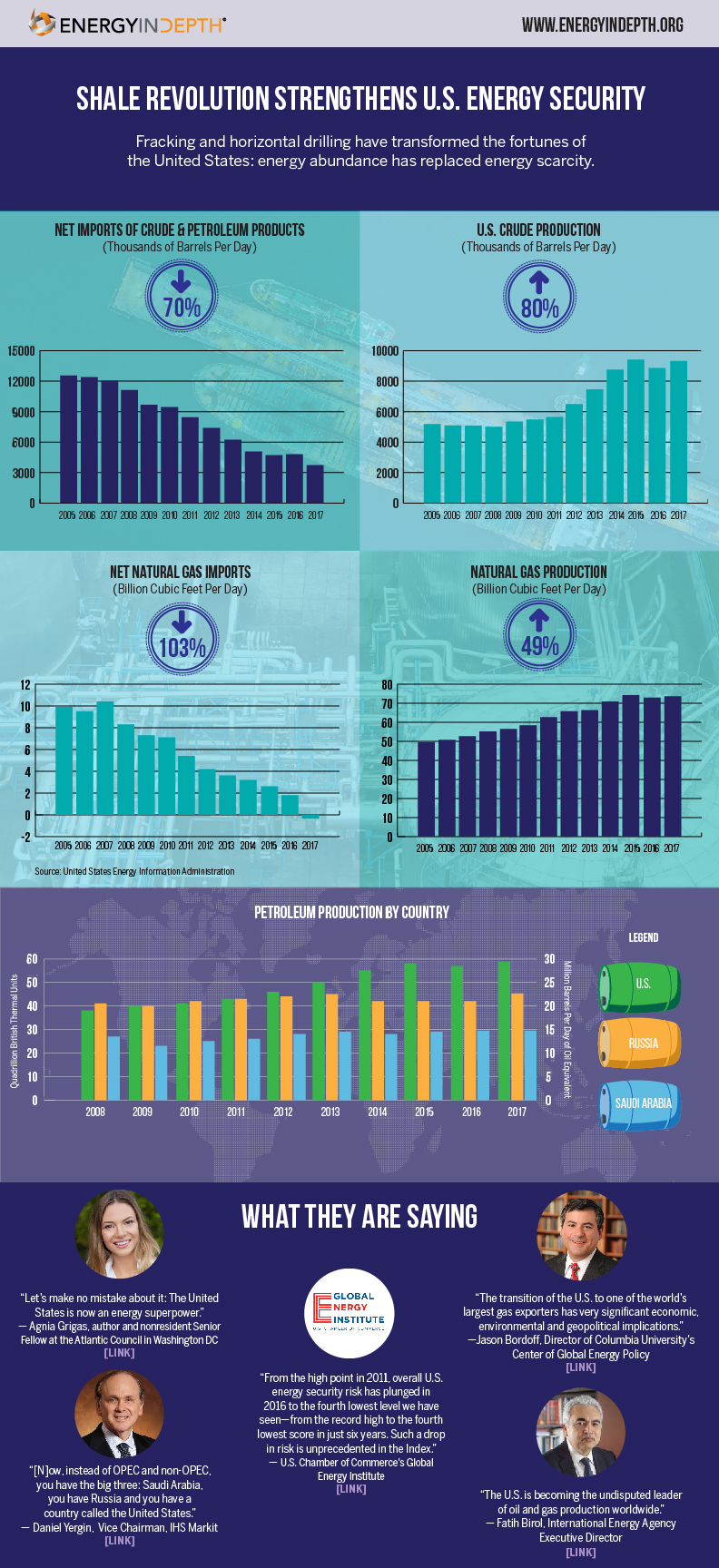
- Popular Mechanics: False. In fact, “of the 9.5 billion gallons of water used daily in Pennsylvania, natural gas development consumes 1.9 million gallons a day (mgd); livestock use 62 mgd; mining, 96 mgd; and industry, 770 mgd.”
- EID: Agreed with PM! While hydraulic fracturing does require a seemingly high volume of water, it’s comparatively small when put in context of broader public demands. The New York Department of Environmental Conservation (NY DEC), for example, concluded that high-volume hydraulic fracturing in New York, at the industry’s peak operating capacity, would increase fresh water demand in the state by only about 0.24%. Furthermore, tight regulations guarantee proper use and disposal of all water that is used, and operators particularly in the Marcellus are already recycling large quantities of water used for hydraulic fracturing.
CLAIM 3: “Natural gas is cleaner, cheaper, domestic, and it’s viable now.” –T. Boone Pickens, September 2009
- Popular Mechanics: Natural gas is the cleanest burning fossil fuel, but PM unfortunately references Cornell Professor Robert Howarth’s “data” on the loss of methane during production and transport to suggest its clean reputation isn’t all it’s cracked up to be.
- EID: Unfortunately, PM did not get the memo that the Cornell Study by Robert Howarth has been panned by the scientific community. Howarth’s colleague at Cornell, atmospheric sciences professor Lawrence Cathles, referred to the study in a paper submitted for publication as “seriously flawed,” while John Hanger, former head of the Pennsylvania Department of Environmental Protection stated that “Professor Howarth’s conclusion that gas emits more heat trapping gas than carbon flies in the face of numerous life cycle studies done around the world.” Hanger continued: “Bit by bit the Howarth study is being consigned to the junk heap.” See EID’s full debunking of Howarth’s study here.
CLAIM 4: “There’s never been one case—documented case—of groundwater contamination in the history of the thousands and thousands of hydraulic fracturing [wells].” –Sen. James Inhofe, R-Okla., April 2011
- Popular Mechanics: The claim is true; basic geology prevents the potential of groundwater contamination. Unfortunately, PM also toys with some sketchy facts related to the town of Pavillion, WY, and surface contamination to dilute the facts.
- EID: There are zero confirmed cases of the process of hydraulic fracturing affecting groundwater. Fluid use and transportation are highly regulated processes, and any potential cases of harm to surface waters related to accidental spills are rectified and proper fines are levied. As for Pavillion, Wyoming: chemicals found in three of thirty nine wells tested are also found in common cleaning materials. While methane was found in eight water wells, previous records indicate the presence of methane in the groundwater prior to natural gas drilling in the area. See Encana’s letter to the residents of Pavillion here.
CLAIM 5: “The Gas era is coming, and the landscape north and west of (New York City) will inevitably be transformed as a result. When the valves start opening next year, a lot of poor farm folk may become Texas rich. And a lot of other people—especially the ecosensistive New York City crowd that has settled among them—will be apoplectic as their pristine weekend sanctuary is converted into an industrial zone, criss crossed with drill pads, pipelines, and access roads.” –New York magazine, Sept. 21, 2008
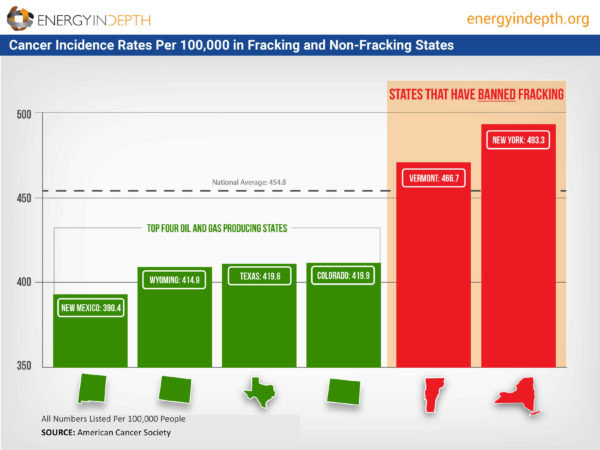
- Popular Mechanics: PM notes the concern surrounding the pace of natural gas development and whether regulation can keep up. The article also suggests a strong discrepancy in opinions between upstate and downstate New Yorkers.
- EID: The truth is that the oil and gas industry is regulated from initial paperwork to the final plugging of the well; no action can be taken without proper permitting and clearance. The impressive safety record of the industry should also give further comfort that all drilling action is occurring appropriately. As for the difference in opinion: A recent Quinnipiac poll found that among voters in the upstate region and in the state’s suburbs, natural gas production enjoys majority support, with 75% saying drilling will produce much-needed jobs. As the NY DEC concluded in its assessment of hydraulic fracturing, gas production could create more than 46,000 jobs (17K direct + 29K indirect) statewide.
CLAIM 6: “Natural gas is affordable, abundant and American. It costs one-third less to fill up with natural gas than traditional gasoline.” –Rep. John Larson, D-Conn., March 2011
- Popular Mechanics: Probably true. “In fact, buses in several cities now rely on it, getting around the lack of widespread refueling opportunities by returning to a central terminal for a fill-up. The same could be done for local truck fleets. But perhaps the biggest contribution natural gas could make to America’s transportation picture would be more indirect—as a fuel for electric-generation plants that will power the increasingly popular plug-in hybrid vehicles.”
- EID: Economical, domestic, clean, abundant — Natural gas has the potential to provide domestic energy for the next 100 years.
CLAIM 7: “Do not drink this water.” –Handwritten sign in the film GasLand, 2010
- Popular Mechanics: False. “A Colorado man holds a flame to his kitchen faucet and turns on the water…But Colorado officials determined the gas wells weren’t to blame; instead, the homeowner’s own water well had been drilled into a naturally occurring pocket of methane.”
- EID: Methane migration often occurs naturally, and such was the case in this instance. Anywhere biogenic processes are occurring, methane is being created. While improper cementing of a well could lead to methane migration, it is imperative to understand the origin of the methane before assuming that the drilling process is to blame. Interestingly enough, GasLand producer Josh Fox was well aware that methane occurs naturally, but he deliberately withheld that information in his film, leaving viewers with the impression that gas drilling could be the only culprit. More on debunking GasLand here.
CLAIM 8: ”As New York gears up for a massive expansion of gas drilling in the Marcellus shale, state officials have made a potentially troubling discovery about the wastewater created by the process: It’s radioactive.” –ProPublica, 2009
- Popular Mechanics: False. “Tests conducted earlier this year in Pennsylvania waterways that had received treated water—both produced water (the fracking fluid that returns to the surface) and brine (naturally occurring water that contains radioactive elements, as well as other toxins and heavy metals from the shale)—found no evidence of elevated radiation levels.”
- EID: As PM duly notes, shale has a radioactive signature which is used by geologists to understand the organic content and gas potential available in the formation. This does not mean, however, that the generated flow back water is “radioactive” like the green ooze at Homer Simpson’s nuclear plant. The NY DEC has concluded that the radioactivity of produced water “does not present a risk” because the radiation levels are so low. Nonetheless, continual testing of flow back water to determine any risk ensures proper treatment is carried out.
CLAIM 9: “Claiming that the information is proprietary, drilling companies have still not come out and full disclosed what fracking fluid is made of.” –Vanity Fair, June 2010
- Popular Mechanics: “Under mounting pressure, companies such as Schlumberger and Range Resources have posted the chemical compounds used in some of their wells, and in June, Texas became the first state to pass a law requiring full public disclosure.”
- EID: A simple Internet search will yield the composition of fracturing fluid. States like Pennsylvania, West Virginia, and New York, along with the U.S. Department of Energy (and Energy in Depth) maintain these listings, and they have been publicly available for some time. It’s also important to note that 99.5% of the fluid used in hydraulic fracturing consists of water and sand. The majority of the chemicals used are benign and necessary as antibacterials and lubricants. Some harsher chemicals are involved in the process, however, and are regulated thoroughly. For more disclosure on fracturing fluid see www.FracFocus.org.
CLAIM 10: “The increasing abundance of cheap natural gas, coupled with rising demand for the fuel from China and the fall-out from the fukushima nuclear disaster in Japan, may have set the stage for a Golden Age of gas.” –Wall Street Journal, Summarizing an International Energy Agency Report, June 6, 2011.
- Popular Mechanics: “There’s little question that the United States, with 110 years’ worth of natural gas (at the 2009 rate of consumption), is destined to play a major role in the fuel’s development.”
- EID: Natural gas has the potential to meet America’s energy needs while creating jobs and economic growth today, and through the safe and continued use of hydraulic fracturing, these enormous opportunities will only grow. As new discoveries are made and technology advances, U.S. natural gas supplies will only increase, and allowing responsible production will unlock additional opportunities and provide numerous benefits for decades to come.
EID Fact Check: Center for American Progress Weighs in on Hydraulic Fracturing
Earlier today, the Center for American Progress (CAP), an influential, left-of-center public policy organization based in Washington, D.C., posted a memo on its website in support of the FRAC Act of 2009 – legislation that seeks to impede the development of America’s abundant shale gas resources bytargeting the critical tools needed to bring those resources to market.
Keep Reading »