
Winter Storm Fern Hit, Natural Gas Delivered
A new report from the Natural Gas Council confirmed U.S. natural gas system performed reliably during Winter Storm Fern, a nearly two-week Arctic outbreak that impacted an estimated 230 million people across North America.
For more than 10 consecutive days, prolonged freezing temperatures drove energy demand to near record levels across the Central and Eastern United States. Electricity demand exceeded 450 gigawatts on numerous occasions and topped 500 gigawatts three separate times during the storm. Simultaneously, natural gas demand climbed to 167 billion cubic feet per day on January 24, the fifth highest single day demand level ever recorded in the United States.
Despite prolonged freezing temperatures, ice accumulation, and widespread power outages, the U.S. natural gas system maintained strong production, transportation, storage, and delivery performance throughout the event. In many regions, natural gas infrastructure helped absorb the strain of sustained cold weather, helping keep homes heated and the electric grid operating reliably.
Natural Gas Powered the Grid During Peak Demand
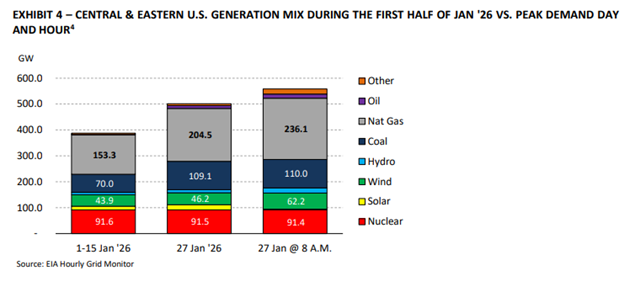
Natural gas proved it’s the backbone of the electric system during Winter Storm Fern, providing the largest share of additional power generation across every affected region.
As electricity demand surged during the storm, natural gas generation ramped up quickly to keep the grid reliable. At the peak demand hour on January 27, natural gas generation climbed to 236 gigawatts, a 54 percent increase above average January levels. To meet this skyrocketing demand across impacted regions, natural gas output increased by roughly one third compared to the first half of January.
Source: Natural Gas Council
That performance was especially important because demand remained elevated for days, not just hours, during the prolonged cold snap. As the report noted:
“Natural gas infrastructure performed effectively during Winter Storm Fern, enabling the delivery of critical energy supplies under sustained cold weather conditions.”
The report also highlighted major reliability improvements since Winter Storm Uri and Winter Storm Elliott due to market driven winterization investments. During Winter Storm Elliott, Appalachian production, the largest contributor to Eastern gas supply, fell by nearly 30 percent under comparable conditions. However, during this cold peak, Appalachian natural gas production remained within 10 percent of recent production highs.
More Capacity, Lower Costs
Winter Storm Fern highlighted the important role pipelines play in keeping energy affordable during periods of extreme demand, particularly in the Northeast and Mid-Atlantic where infrastructure constraints remain a challenge.
During the storm, constrained pipeline capacity contributed to major price spikes across parts of the Northeast even though the region did not experience an actual fuel shortage. In other words, the issue was not a lack of natural gas supply, but limits on the infrastructure needed to move that supply where it was needed most.
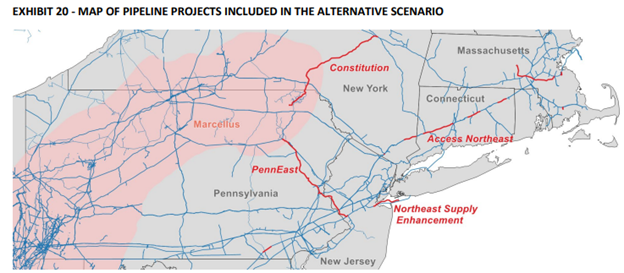
The report examined several major pipeline projects that were designed to expand capacity into constrained Northeast markets, including:
Source: Natural Gas Council
According to the analysis, these projects could have eased congestion and reduced natural gas prices during the storm, especially in the Northeast’s most constrained markets. Modeling showed nearly all of the projects would have operated above 99 percent utilization during January 2026 conditions, underscoring strong demand for additional pipeline capacity.
As electricity demand continues growing from industrial development, electrification and AI-driven data center expansion, the storm reinforced how additional pipeline infrastructure can strengthen reliability and help protect consumers from price spikes during extreme weather.
What the Report Recommends
To strengthen energy reliability during future winter storms and periods of peak demand, the report recommends:
- Accelerating permitting and development of natural gas pipeline and storage projects, particularly in regions where infrastructure constraints increase consumer costs and reliability risks.
- Expanding storage capacity and associated transportation infrastructure near major demand centers in the Northeast and Mid-Atlantic to improve system flexibility during extreme weather events.
- Protecting critical natural gas infrastructure from electric load shedding during grid emergencies to prevent disruptions across the broader energy system.
- Continuing weatherization investments across production regions to strengthen resilience during future winter events.
Bottom Line: Winter Storm Fern tested the U.S. natural gas system under prolonged extreme winter conditions and the system delivered. Natural gas met near record electricity demand, supported grid reliability across major power markets, and maintained service to customers throughout the event. The storm reinforced the importance of continued investment in pipelines, storage, and winterization to keep energy reliable and affordable as demand continues to grow.
No Comments