
IEA: Data Centers and LNG Drive Natural Gas Investment to 10-year High
Natural gas will remain a critical component of the global energy system, enabling national energy security and capacity for AI innovation, says the latest World Energy Investment report from the International Energy Agency (IEA). The report projects a decade-high of $330 billion in natural gas development for 2026.
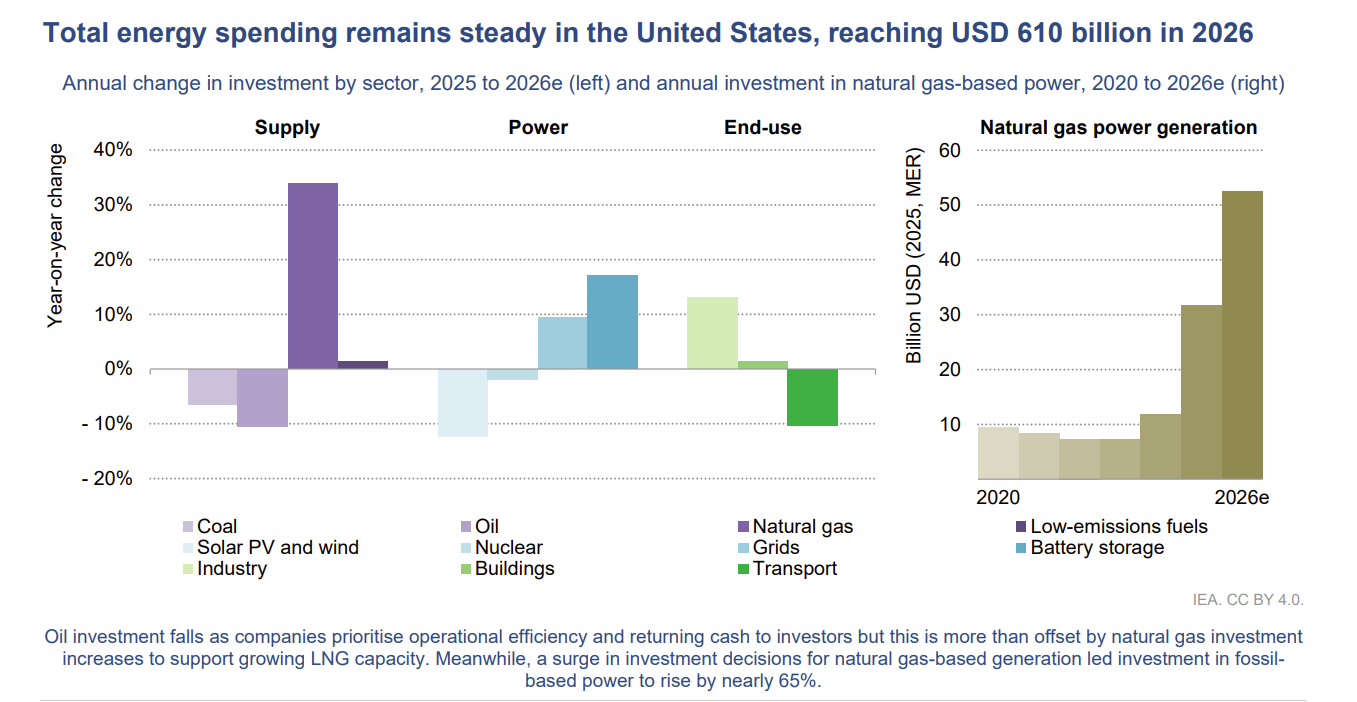
Much of this growth is driven by two major trends: expanding liquefied natural gas (LNG) export capacity and rapidly rising electricity demand from the technology sector. U.S. production sits at the center of both developments, accounting for a significant share of planned investment and future capacity growth. Overall energy spending in the United States will reach $610 billion in 2026, with nearly 65 percent of that investment in fossil fuel generation, particularly natural gas.
Source: International Energy Agency, World Energy Investment 2026
U.S. Producers Drive LNG Expansion
2025 was a record year for LNG project Final Investment Decisions (FIDs), with more than 100 billion cubic meters (bcm) of capacity approved, 90 percent of that in the United States. Projects like NextDecade’s Rio Grande LNG hit important FID milestones, with this momentum continuing into 2026. Venture Global’s CP2 Phase 2 development and Commonwealth LNG have reached major investment breakthroughs, adding to a growing pipeline of American export infrastructure.
Meanwhile, shale plays in the Permian Basin and Marcellus Shale continue to drive natural gas growth, fueling energy security and abundance at home and abroad.
The scale of planned investment reflects growing global demand for natural gas and the expanding role of the United States in supplying that demand. By 2030, the IEA projects that the United States will account for nearly half of global LNG export capacity, significantly increasing the volume of American natural gas available to international markets and allies.
The United States leads the way in LNG project development, with new infrastructure already being built, and even more on the way. Globally, roughly 700 bcm of LNG projects are currently seeking FIDs, while about 100 bcm of projects in the United States have already received regulatory approval.
The disparity between approved projects and those actively seeking investment highlights one of the industry’s ongoing challenges: the bottleneck from abundant natural gas supply to consumer delivery. While IEA’s data shows that investment remains strong, project timelines can be delayed by cumbersome project reviews and overlapping requirements across the Marine Mammal Protection Act, the Endangered Species Act and the National Environmental Policy Act. This permitting maze creates unnecessary delays and uncertainty that can prevent approved projects from moving forward in a timely manner.
Natural Gas Needed to Win the AI Race
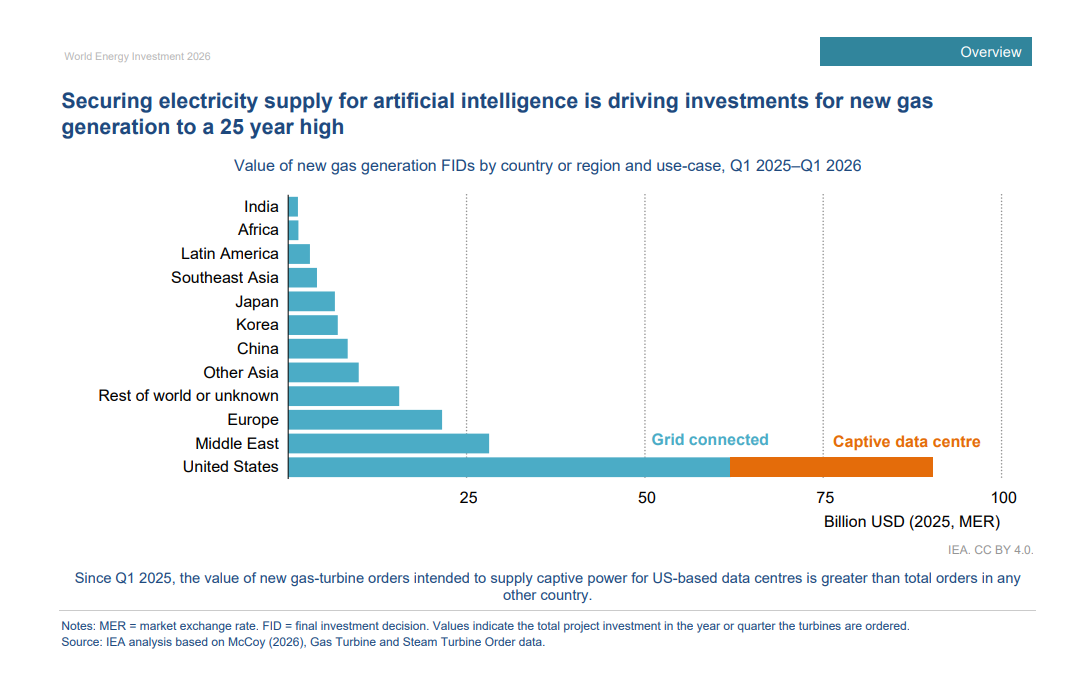
At the same time, financing from the tech sector is accelerating energy development at an unprecedented rate, with technology companies emerging as major project investors. In 2025, the tech sector accounted for approximately 40 percent of all corporate power purchase agreements signed globally. Unsurprisingly, data center build-out is a major part of this investment. In 2025, an estimated $100 billion was spent on data center infrastructure worldwide.
As Energy In Depth has previously discussed, natural gas has emerged as the fuel of choice for data center developers because of its affordability, reliability, and abundance.
Source: International Energy Agency, World Energy Investment 2026
Access to natural gas abundance will be essential to drive American innovation in the global AI race, as IEA explained in their report:
“Energy investment trends and the availability of reliable, low cost electricity will help determine which countries lead in artificial intelligence.”
The IEA’s analysis highlights how access to affordable and dependable electricity is becoming the determining factor in AI innovation. Because data centers require large amounts of electricity around the clock, developers are increasingly focused on energy sources that can provide reliable, dispatchable power – like natural gas. As demand for computing power continues to grow, so too will the need for infrastructure to get abundant energy supply where it needs to go.
Bottom Line: With LNG exports expanding and data centers driving unprecedented electricity demand, natural gas is increasingly positioned at the center of both energy and technology investment. The challenge is no longer a lack of capital or demand, but how quickly infrastructure can be built to meet it.
No Comments