
What Energy Company Earnings Really Mean
Record earnings from American energy companies make headlines and draw critics, but there’s a lot more behind the large fluctuations in global energy prices.
Here’s a look at how global markets and blue-state policies have contributed to higher prices, what comes next, and why efforts to tax windfall profits are counterproductive.
Global Markets Set Prices
Global energy markets are complex, constantly responding to changing supply and demand, geopolitical events, and a range of economic conditions. Earnings from companies that produce oil and gas are highly dependent on the global market.
This means that oil companies do not set the price of gasoline. Hundreds of investigations including ones by the Federal Trade Commission in 2006, 2011, and 2021 have determined the exact same thing: allegations of price gouging have been debunked for decades. As the Federal Reserve Bank of Dallas stated:
“U.S. oil producers are in no position to control retail gasoline prices.”
Investing in American Energy Dominance
When American energy companies earn more, they invest more in the products we rely on every day. Many of these are long-term projects that require sustained investment before they ever pay off.
As the American Petroleum Institute explains:
“A significant portion of earnings is reinvested into developing new oil and natural gas supplies, maintaining infrastructure, and improving efficiency. These investments often take years to plan and complete and depend on confidence that market conditions will remain supportive.” (emphasis added)
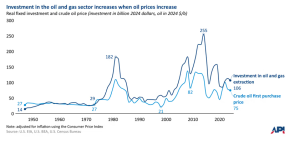
Source: American Petroleum Institute
Investments like these have helped the United States become the largest exporter of oil in the world.
As Ed Longanecker, president of the Texas Independent Producers and Royalty Owners Association told the Midland Reporter-Telegram, periods of higher earnings help ensure future production:
“Strong quarterly results generate the cash flow required to sustain investment, maintain production, and develop additional supply. That investment is what ultimately expands available energy and supports more stable prices for consumers. New taxes or forced redistribution of earnings would reduce capital available for those purposes and discourage the production the market needs.” (emphasis added)
In addition to future production that can help lower energy prices and ensure American energy security, many Americans directly benefit from a successful energy industry through jobs, pension plans, and the other sectors that rely on fuel. As the U.S. Chamber of Commerce recently outlined:
“[the energy industry] supports workers, communities, and energy-intensive sectors such as manufacturing, agriculture, transportation, and healthcare. It contributes to local tax bases and economic development. It also supports retirement savings through 401(k)s, pensions, mutual funds, and other investment vehicles that hold shares in publicly traded energy companies.”
Refineries Are a Bottleneck
Prices at the pump don’t always match the global crude oil markets perfectly, in part because refineries that process crude can’t scale production indefinitely. At some point, they have to be taken offline for maintenance in order to keep workers safe. As Semafor’s Climate and Energy Editor Tim McDonnell explains:
“Retail fuel prices are a product of complex physical trading and manufacturing realities. US refineries have already been running full-blast for months to offset the loss of products moving out of Gulf refineries, and won’t be able to keep that up much longer without needing to come offline for maintenance…
“Last week, the spread between crude and gasoline prices hit its highest point since the war started, a sign that there’s far from enough refining capacity to keep up with demand.” (emphasis added)
Refineries are a bottleneck in the U.S. energy system, and decades of counterproductive energy policies from blue states like California have made it worse. According to data from API, the number of refineries in California has fallen from 23 in 2000 to an expected 11 by the end of 2026.
Instead, California has outsourced some of that fuel supply to China. In 2024, the majority of California’s imported jet fuel came from China as California has abandoned its own production and refining. Now, as China restricts fuel exports, who could have guessed that outsourcing America’s energy needs to other countries could cause problems down the line?
What Doesn’t Work
Every time energy prices rise, politicians in Washington return to the repeatedly debunked idea of windfall profits tax on energy companies. As Energy Secretary Chris Wright told Sen. Blumenthal while explaining basic economics: “if you tax something, you get less of it.”
Efforts to impose a windfall profits tax don’t lower prices at the pump. Instead, they discourage investment in the energy America desperately needs.
BOTTOM LINE: Gas prices and energy company earnings are largely driven by global energy markets and geopolitical events. When the cyclical energy industry is in a boom period, companies reinvest, benefiting U.S. jobs and American energy security.
No Comments