
Treasury Extends 45Q Safe Harbor, Giving Carbon Capture Projects a Clearer Path Forward
The U.S. Department of the Treasury and Internal Revenue Service recently extended and expanded its Section 45Q safe harbor guidance, giving carbon capture and storage (CCS) projects greater certainty as they advance.
First established in 2008, 45Q provides a federal tax incentive for capturing carbon dioxide (CO2) from industrial facilities and power plants and safely storing or using it. Administrations of both parties have maintained and expanded the credit, helping attract private investment in projects that can take years to develop and operate for decades.
Carbon Capture Impact’s director of government affairs, Madelyn Morrison, commented on the extension of the safe harbor saying:
“This is a significant step forward in providing the long-term certainty the investor community needs to reach final investment decisions on the more than 250 announced carbon management projects across the nation.”
That investment is important because CCS reduces emissions and can boost the economy while building on capabilities the United States has developed across its energy and industrial sectors.
Why 45Q Matters
CCS projects require long-term planning and supporting infrastructure, making a durable financial incentive crucial. 45Q helps sustain that investment while enabling companies to reduce emissions and continue producing the energy and products the economy depends on.
Cement is a clear example. Cement production accounts for roughly seven to eight percent of CO2 global emissions, and a significant share of those emissions comes directly from the chemical process used to make it.
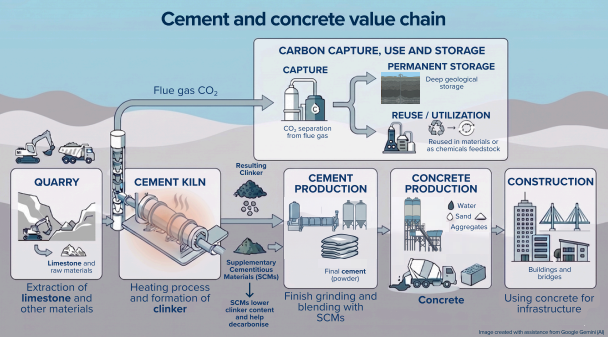
Efficiency improvements, alternative fuels, and other measures can reduce fuel-related emissions, but they cannot eliminate process emissions. Carbon capture can address both, with capture rates of roughly 90 percent to 95 percent possible, depending on the technology and facility.
The need for CCS extends well beyond cement. Nearly 34 percent of global energy-related CO2 emissions come from industrial processes including cement, steel, chemicals, and pulp and paper. For these industries, CCS can cut emissions at the source while allowing facilities to keep producing the materials and products the economy relies on.
For the oil and natural gas industry, carbon capture offers another way to improve the environmental performance of existing operations and infrastructure. Companies can deploy it alongside natural gas power generation, industrial facilities and other large emissions sources, allowing them to continue producing reliable energy while pursuing additional emissions reductions.
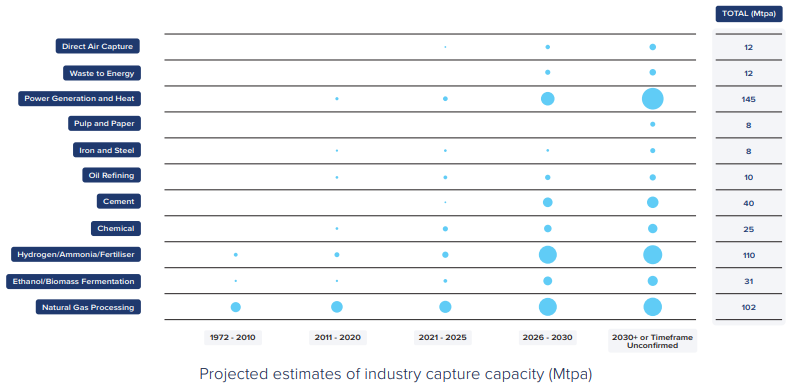
The opportunity is also expanding. Global carbon capture capacity in operation or development reached 513 million metric tons per year in 2025, a 23 percent increase from the previous year. By providing a predictable financial incentive, 45Q can help move projects from development to construction and support the infrastructure needed to expand CCS across industries.
Why This Opportunity Fits America
The United States has been building the capabilities behind carbon capture for decades. A federal policy framework that has evolved alongside the technology has reinforced that foundation, with 45Q expanded several times since its creation to support a broader range of CCS projects.
American energy companies have deep experience capturing, transporting, and injecting CO2 underground, particularly through enhanced oil recovery. The United States also has extensive CO2 pipeline infrastructure and large areas with geological formations capable of securely storing CO2 underground.
Several states have secured federal authority, known as Class VI primacy, to oversee underground injection programs and streamline permitting for qualifying storage wells. State-led oversight can give developers a more direct regulatory pathway for evaluating and permitting storage projects, adding another advantage as CCS infrastructure expands.
This combination sets the United States apart. America has developed the energy infrastructure, industrial expertise, regulatory framework, and underground injection experience needed to advance CCS, while its geology provides the capacity to permanently store CO2.
Carbon capture does not require the country to move away from its existing energy and industrial base. Instead, CCS can work alongside the resources and infrastructure already powering the American economy.
As Energy In Depth has previously analyzed, pairing CCS with natural gas can help meet growing electricity demand while reducing emissions. Together, abundant natural gas, geologic storage and expanding CCS technology give American producers and manufacturers another tool to provide affordable, reliable energy while cutting emissions and enhancing the economy.
Bottom Line
CCS is becoming an increasingly important tool for reducing emissions across America’s energy and industrial sectors. With the resources and capabilities to deploy the technology at scale, the United States is well positioned to turn announced CCS projects into long-term investments and economic engines. 45Q can help provide the certainty needed to keep that progress moving forward.
No Comments