
U.S. Outpaces China in Natural Gas Capacity to Fuel AI Data Center Growth
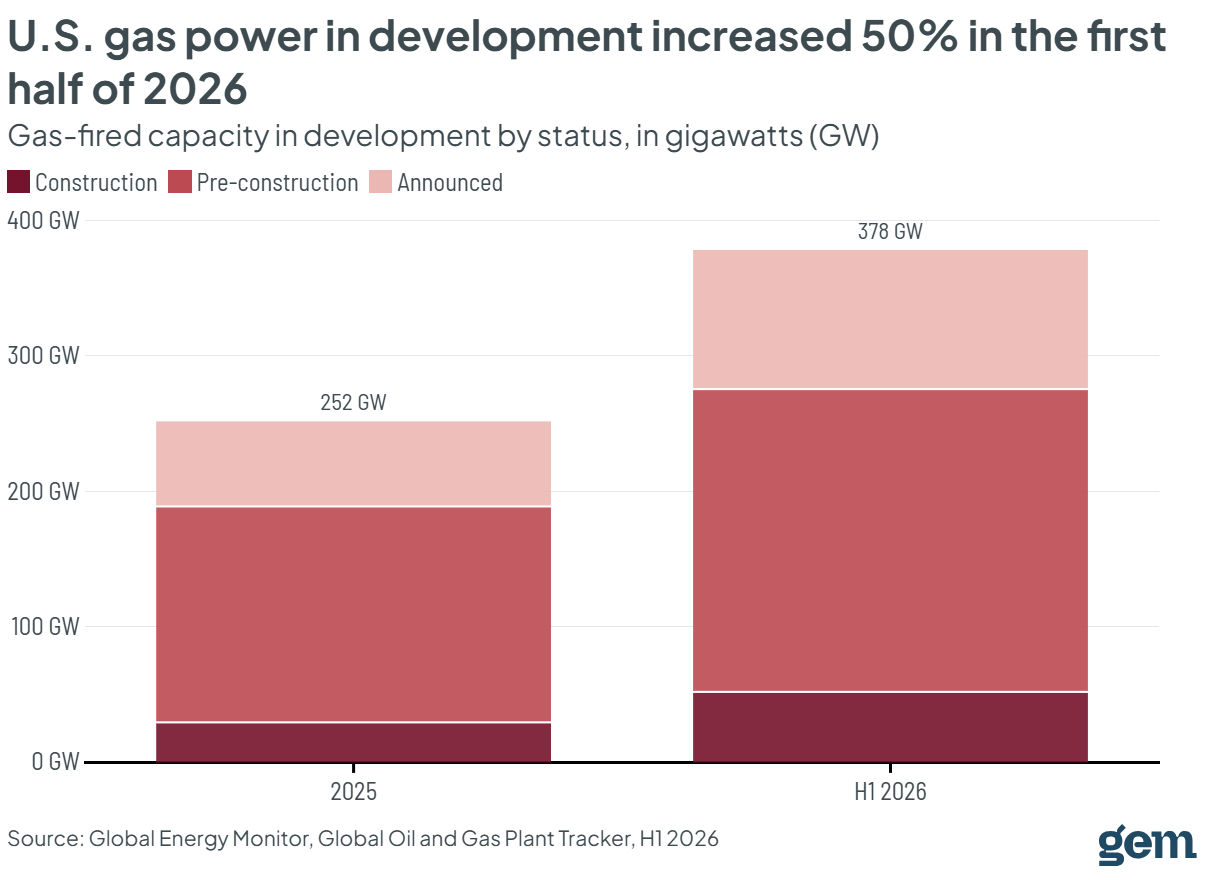
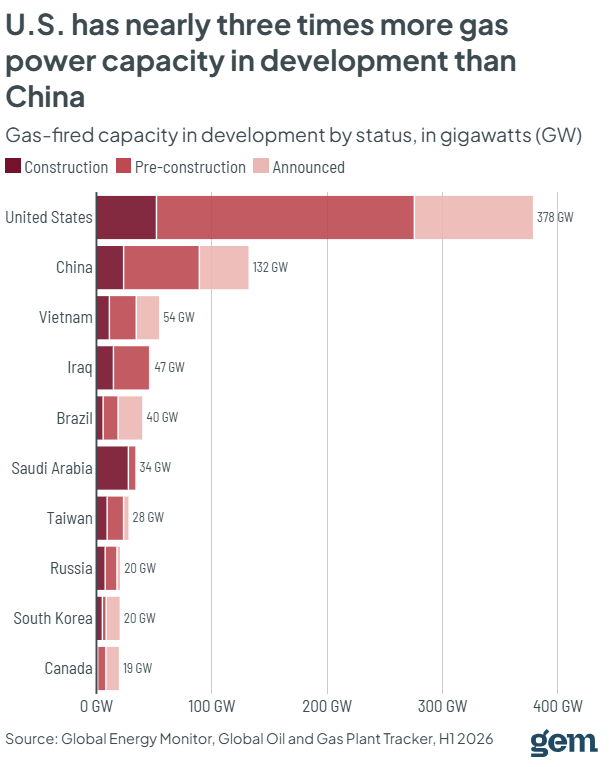
Data center development is driving a historic buildout of natural gas-fired power generation, with the United States building twice as much natural gas as China. A new report from Global Energy Monitor (GEM) shows the United States has 378 gigawatts (GW) of gas-fired generation announced, in pre-construction, or under construction: up 50 percent in six months and far outpacing competitors like China. Half of that capacity, 189 GW, is planned specifically to power data centers, nearly double the total at the end of last year.
Combined with record U.S. natural gas production, the findings underscore how domestic energy abundance is becoming a decisive advantage in the global competition for AI leadership.
Record Gas-Fired Capacity Outpaces Competitors
According to GEM, planned U.S. gas-fired generation capacity has increased by roughly 50 percent since January. If built, these projects would increase America’s current gas-fired fleet by roughly two-thirds. These are not just paper proposals; capacity under construction rose 76 percent in the first half of the year, to 52 GW.
The primary drivers of natural gas demand are large-load customers like data centers, which need an abundant supply of reliable power. As utilities and project developers look for ways to meet that demand, natural gas continues to be the go-to source.
States with large natural gas reserves are leading the buildout. Texas, fueled by Permian Basin supply, accounts for nearly one-third of U.S. gas-fired capacity in development (122 GW), more than any country outside the United States. Nearly two-thirds of that capacity (77 GW) is planned to directly power data centers, underscoring the link between natural gas abundance and AI leadership.
The report also highlights America’s growing advantage over international competitors. GEM found the United States is currently building roughly twice as much gas-fired generation as China (52 GW versus 24 GW) and has nearly three times as much capacity in development.
The Constraint is Turbines, Not Natural Gas
GEM acknowledges that challenges remain for many of these projects, citing turbine supply backlogs and the regulatory uncertainty caused by local data center moratoriums and pushback.
Developers are turning to alternative pathways for turbine supply, such as reciprocating engines and smaller aeroderivative turbines, which can be manufactured and installed far faster than large combined-cycle units. Engine capacity in development nationwide more than doubled in six months, from 31 GW to 67 GW, and engine capacity tied specifically to data centers more than tripled, to 45 GW, nearly a quarter of the data center pipeline.
The Case for Natural Gas Keeps Growing
But the AI race is increasingly becoming an energy race. Right now, America’s natural gas advantage is helping ensure the United States remains ahead of the competition.
Developers are proposing nearly 380 GW of new gas-fired generation because electricity demand is growing rapidly and both the American public and large-load consumers need power. The United States has the natural gas resources to meet that challenge. What developers need is the turbines, pipelines, and regulatory certainty to bring these projects to fruition.
Bottom Line: The growth of new capacity reflects a simple reality: developers need reliable energy to meet rising demand from data centers and win the global AI race, and natural gas is best positioned to provide it.
No Comments