
Michigan Joins Growing Push for State Control of Carbon Capture Permitting
As states across the country race to attract carbon capture investment, Michigan wants a seat at the table. Recently, members of the Michigan House Energy Committee introduced legislation that would transfer oversight of Class VI underground carbon storage wells from federal regulators to the state. The move would give Michigan greater authority over carbon capture and storage (CCS) development and position the state to compete for investment and jobs tied to the emerging CCS industry.
The legislative package, House Bills 6247, 6248, and 6249 would establish a state-level regulatory framework for CCS projects and allow the Michigan Department of Environment, Great Lakes, and Energy (EGLE) to oversee Class VI wells. The effort follows bipartisan action in the Michigan Senate last year and reflects a growing recognition that regulatory certainty can help determine where major energy and manufacturing investments ultimately land.
Six states currently hold primacy—North Dakota, Wyoming, Louisiana, West Virginia, Arizona and Texas— with eight more in the pre-application phase. Earlier this year, EPA proposed approval of Colorado’s primacy application and Ohio established a regulatory and legal plan for CCS development. The trend is national: red and blue states alike are seeking greater authority over CCS development to accelerate project deployment and attract investment.
Michigan’s CCS Opportunity
Michigan is particularly well-positioned to benefit from expanded CCS development. Research from the Clean Air Task Force found that CCS could help decarbonize the state’s hard-to-abate industrial sectors while preserving high-wage manufacturing and energy jobs.
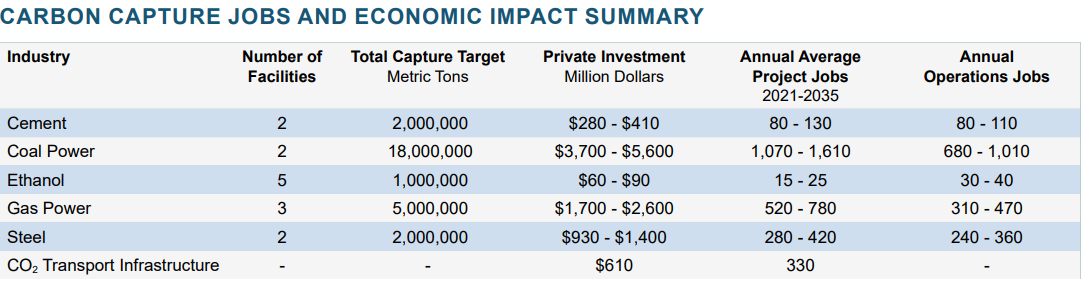
According to the Rhodium Group, CCS deployment could support between 1,340 and 1,990 permanent jobs operating carbon capture facilities, along with roughly 330 transportation infrastructure jobs annually during a 15-year buildout period.
Michigan’s network of cement, steel, ethanol, and power generation facilities represent a significant opportunity for emissions reductions and economic growth through carbon capture retrofits, with the Great Plains Institute projecting the industry could attract as much as $10.7 billion in private investment statewide.
Source: Great Plains Institute
The state also has a strong natural advantage when it comes to carbon storage. The U.S. Department of Energy estimates Michigan has the geologic capacity to store more than 45 billion metric tons of carbon dioxide underground, making it one of the nation’s most promising locations for CCS deployment. Michigan is not starting from scratch, either. Core Energy has operated a commercial CCS project in the state since 2013, and four additional commercial projects have been announced since 2018. Together, these advantages position Michigan to become a regional leader in carbon capture investment if policymakers can provide a predictable and efficient permitting framework.
Why States Want Primacy
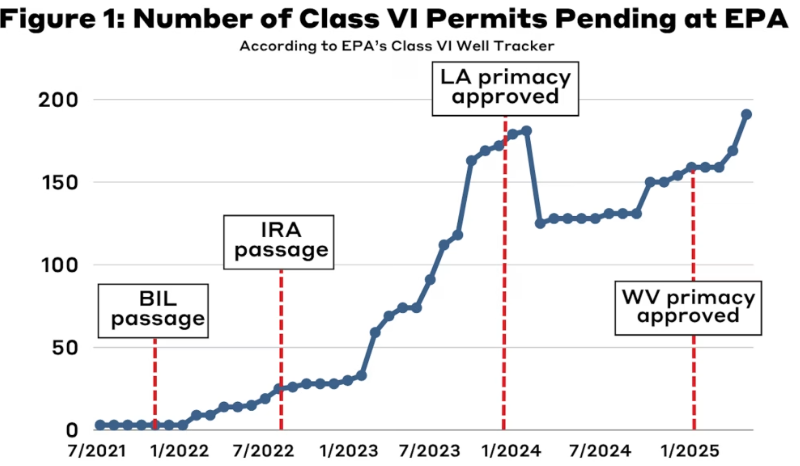
Placing primacy in state hands provides greater regulatory certainty and can significantly accelerate project approvals. States with Class VI primacy have issued nearly three times as many carbon storage permits as EPA has issued since the program began in 2011. According to the Bipartisan Policy Center, permit approvals in primacy states can take less than a year, compared to 24 months or longer under EPA review.
Source: Bipartisan Policy Center
For states, the stakes extend well beyond permitting. CCS projects represent billions of dollars in potential investment, support high-paying jobs, generate local tax revenue, and help manufacturers and other industrial facilities remain competitive. As companies increasingly evaluate where to build carbon capture and storage infrastructure, states with efficient and predictable permitting systems are better positioned to attract those projects. The race for Class VI primacy is a race for industrial growth and investment.
CCS Helps States Balance Climate Ambitions and Industrial Growth
The timing is no coincidence. In 2023, Governor Gretchen Whitmer committed Michigan’s utilities to achieving 80 percent clean energy by 2035 and 100 percent clean energy by 2040. Policymakers increasingly view CCS as a way to help state’s energy and industrial sectors remain competitive while adapting to changing regulatory and market demands. Michigan’s proposal highlights how states with ambitious climate goals are turning to carbon capture to help reduce emissions in hard-to-abate sectors. For states with large manufacturing sectors such as Michigan, CCS offers a pragmatic pathway to cut emissions at these facilities while maintaining economic growth.
Colorado provides another example. The state has committed to 100 percent net-zero greenhouse gas emissions by 2050, while also prioritizing the long-term viability of key industrial sectors. Earlier this year, the EPA proposed granting Colorado Class VI primacy, and state leaders have made carbon capture a core component of their broader industrial and environmental strategy, including investing $32.8 million in technologies that reduce emissions from industrial processes.
States now treat CCS as an economic competitiveness strategy as much as an environmental one. Policymakers recognize that industries such as steel, cement, chemicals, refining, and manufacturing will continue to play an essential role in their economies. Rather than forcing a choice between industrial growth and environmental goals, CCS offers a way to pursue both.
Bottom Line: Michigan’s proposal reflects a broader national shift—carbon capture and storage has transformed to essential state industrial policy. State leaders across geographies are seeking control over CCS permitting to attract investment and industrial growth while advancing energy and emissions goals.
No Comments