
New EIA Analysis: The United States Produced More Crude Oil in 2025 Than Any Other Country in History
The United States produced more crude oil in 2025 than any other country, and more than any country in history, according to new data from the U.S. Energy Information Administration (EIA). U.S. crude oil production, including lease condensate, averaged a record 13.6 million barrels per day (b/d), breaking the previous U.S. and global record of 13.2 million b/d set in 2024.
America has led the world every year since 2018, when it overtook Russia. In 2025, it widened the gap. Russia produced 9.9 million (b/d), essentially flat from 2024, and Saudi Arabia produced 9.6 million (b/d), making American production approximately 40 percent above that of the next two largest producers.
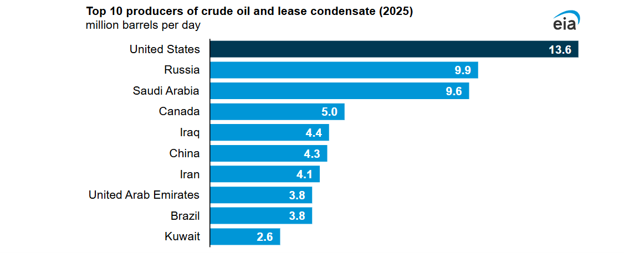
Source: U.S. Energy Information Administration
The consistently strong production numbers are the latest result of the U.S. shale revolution, which reversed a multidecade decline in U.S. crude oil production starting in 2008. Record production is part of a broader story of American energy leadership and the oil and gas industry’s ability to meet growing domestic and global demand. As Forbes recently noted, the United States is also the world’s largest oil consumer, averaging 19.4 million barrels per day (b/d) in 2025, underscoring the scale of the domestic demand American producers help meet.
More Oil, Fewer Rigs
How producers got there matters as much as the number itself. U.S. crude oil production increased by three percent, or 350,000 b/d in 2025 while operators ran five percent fewer rigs across the Lower 48, and drilled one percent fewer wells than in 2024.
Prices fell too. West Texas Intermediate averaged $65 per barrel in 2025, down from $77 in 2024. The increase in productivity demonstrates the efficiency and innovation U.S. oil producers brought to their operations.
Much of that growth came from the Permian Basin, where crude oil production increased by 280,000 b/d to 6.6 million b/d. The basin accounted for approximately 48 percent of total U.S. production output in 2025.
As Energy in Depth has previously noted, independent producers accounted for more than 85 percent of U.S. onshore crude oil and condensate output between 2022 and 2024.
Innovation is how the industry keeps production growing. For example, Chevron’s chemical innovation has increased first-year output from new wells by up to 20 percent and slowed shale decline rates at existing wells by five to eight percent. Chief Technology and Engineering Officer Ryder Booth said the move is “a way that we can answer the call to help boost production.”
The significant increase in domestic oil production can be expected to help energy affordability in the United States. U.S. production alone does not determine gasoline prices because oil trades in a global market and refining costs and regional market conditions also shape what drivers pay. Even so, abundant domestic production gives consumers an important layer of protection when overseas supplies are disrupted. That advantage can be seen amid renewed conflict involving Iran and the Strait of Hormuz, where threats to a major global oil route have pushed prices higher. As Energy in Depth recently explained, American producers can respond to tighter markets by bringing additional barrels forward, reducing the country’s exposure to sudden supply shocks. Robust domestic production equates to energy independence in times of crisis. EIA has likewise found that growing U.S. production has helped slow increases in oil and gasoline prices in recent years.
The Oil Record Is Also a Natural Gas Story
Permian oil wells produce natural gas, too. Marketed natural gas production in the basin grew from 17.2 billion cubic feet per day (Bcf/d) in 2021 to 27.6 Bcf/d in 2025, an increase of 60 percent that outpaced the basin’s 39 percent crude oil growth over the same stretch.
That abundance has tangible implications for affordability. As EIA recently explained:
“Record U.S. natural gas production helps meet rising demand, putting moderate downward pressure on natural gas prices.”
Natural gas supplied approximately 40 percent of U.S. electricity generation in 2025, more than any other source, and dry natural gas production hit a record 39 trillion cubic feet. As Energy in Depth previously analyzed, that supply keeps flexible, around-the-clock power on the grid while meeting rising demand from homes, businesses, manufacturers and data centers.
Bottom line: The United States produced more crude oil in 2025 than any other country ever has, with fewer rigs and fewer wells. That is a story about American innovation paired with productivity, not just geology. With the Strait of Hormuz unsettled and global supply uncertain, that domestic base is what stands between affordability and a crisis.
No Comments