
New S&P Global Study: U.S. LNG Set to Become America’s Second Largest Net Export Industry – Without Raising Energy Costs
Liquified natural gas (LNG) exports are expected to be the second-largest net export industry in the United States within five years, according to a new S&P Global report. LNG demand is anticipated to double to 36 billion cubic feet per day (bcf/d): 25 percent higher than S&P had previously projected.
Not only will this increase in exports benefit the U.S. economy by creating jobs and boosting GDP, but it will do so without raising consumer electricity costs. Even as LNG exports continue to grow, S&P Global projects average household gas costs will increase a negligible 1.6 percent between 2026 and 2031, underscoring the minimal impact on American consumers.
The data proves that there is no trade-off between energy dominance and affordability and directly rebuts one of the most common arguments against expanding U.S. LNG exports – that growing exports come at the expense of American consumers. Instead, S&P concludes the United States can expand LNG exports while maintaining some of the lowest natural gas prices in the world.
As Daniel Yergin, Vice Chairman, S&P Global and study chair explains:
“The economic gains in terms of jobs, GDP and labor income are on track to surpass all prior expectations, while the abundance of U.S. gas resources means that domestic prices remain among the lowest in the world. The economic benefits and low domestic prices, along with significant contributions to global energy security and the influence that comes from being the world’s largest supplier add up to the benefit of the United States.”
The message is clear: the United States has both the resource base and the market opportunity to expand LNG exports – and policymakers should not stand in the way.
Increased LNG Permitting Delivers Economic Benefits
The lifting of the U.S. LNG permitting pause has been the catalyst for project growth domestically. Since the end of the pause in January 2025, seven new projects have reached Final Investment Decision, with more to be expected.
But that is only if progress continues.
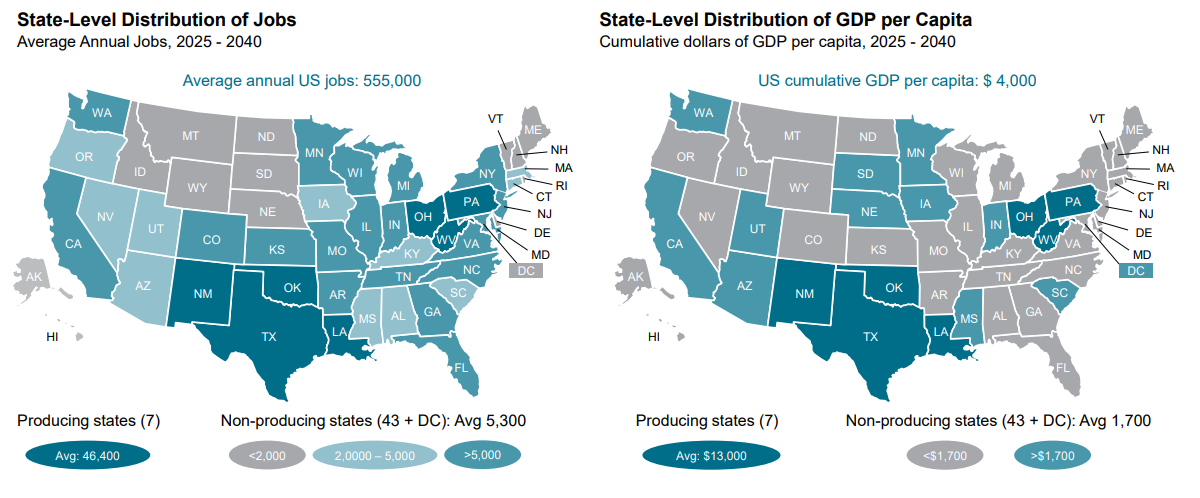
If permitting processes are not derailed, LNG exports will be on track to support 550,000 jobs annually and contribute $1.4 trillion to U.S. GDP through 2040. These benefits expand across the supply chain, generating more than $2.9 trillion in business revenues, $206 billion in federal and state tax revenue, and nearly $630 billion in labor income.
What’s more, these benefits extend beyond natural gas producing states. S&P research finds that 42 percent of jobs and 33 percent of GDP impacts occur in non-gas-producing regions, underscoring a ripple of economic impact.
U.S. LNG Strengthens Energy Security
Beyond economic gains, U.S. LNG plays an increasingly important stabilizing role both at home and abroad. During Winter Storm Fern, up to 9 bcf/d of export gas was redirected to domestic consumers. During the Iran conflict, global LNG spot prices doubled, yet U.S. Henry Hub prices remained flat and ultimately declined.
Without U.S. LNG, American allies would be increasingly dependent on energy supply from less clean, less secure sources. S&P Global estimates that curtailing U.S. LNG growth could effectively transfer up to $76 billion annually to competing suppliers such as Russia, due to its significant underutilized export capacity connected to European markets.
Christopher Guith, Senior Vice President of the U.S. Chamber’s Global Energy Institute, which helped support the S&P study, emphasized this point:
“The latest S&P Global Energy study makes clear just how essential U.S. LNG exports are not only to our own economy, but to geopolitical stability. American LNG will supply 30% of the global LNG market by 2030 and is poised to become our second largest national export, providing a critical alternative to Russian gas while maintaining affordability for U.S. consumers.”
Permitting Reform Is the Remaining Challenge
One of the study’s clearest policy takeaways is that America’s greatest obstacle isn’t geology or demand, but infrastructure. As Eric Eyberg, Vice President, Gas and LNG, S&P Global Energy explains:
“Since 2010, domestic gas production has been able to grow three times the amount of U.S. LNG exports. Infrastructure constraints and imbalances are what drive higher regional prices and volatility. The ability to build pipelines is the main challenge.” (emphasis added)
Regions such as the Northeast continue to experience winter price volatility because of years of permitting delays and political opposition have blocked pipeline projects. Critical projects like Access Northeast and the Constitution pipeline have been repeatedly halted by environmentalists seeking to stop pragmatic solutions to energy affordability concerns.
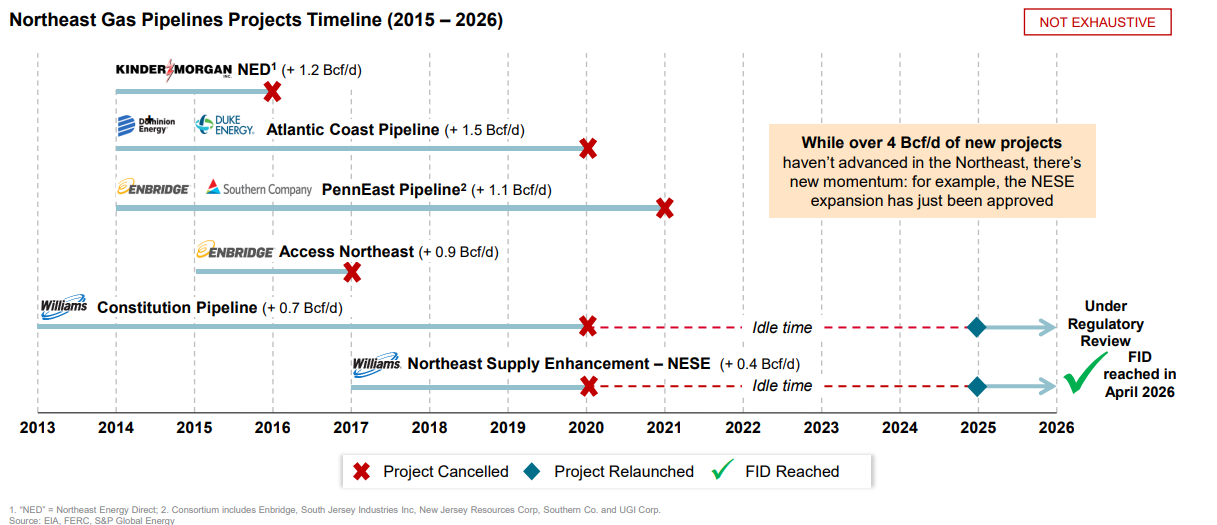
The consequences are measurable. S&P estimates that expanding pipeline capacity into New York and New England could reduce peak winter natural gas prices by more than 20 percent between 2028 and 2031.
The United States has the resource base to support both growing exports and affordable domestic energy. The challenge is ensuring pipelines and related infrastructure can be permitted and built efficiently.
Bottom Line: The latest S&P Global analysis adds to a growing body of evidence that expanding U.S. LNG exports strengthens the economy, supports hundreds of thousands of jobs, enhances energy security for allies, and keeps domestic energy affordable. Unlocking future opportunities will require continued, stable energy policy as well as permitting reform that allows critical energy infrastructure to move from approval to construction.
This study is the next phase of S&P Global Energy’s reports studying the overall economic benefits of U.S. LNG exports. View Phase 1 and Phase 2 here.
No Comments