
New Study: Data Centers Are Lowering American’s Electricity Bills and Natural Gas Is Powering the Boom
Data centers have not been driving up electricity bills, according to a new working paper from researchers at the Electric Power Research Initiative (EPRI). In fact, EPRI estimates that data centers pushed average U.S. residential electricity rates down between 2015 and 2024.
As data centers have multiplied, some communities have raised concerns that the new demand could raise household bills, but the data tells a more encouraging story, one with real life implications for how the country powers the AI boom.
How Data Centers Are Driving Bills Down
According to EPRI’s study, for every 10 percent increase in data center capacity there was a 0.4 percent drop in residential electricity rates. However, the study’s causal estimate runs larger, meaning that for the average residential customer who lived in a state where data center capacity grew 160 percent from 2019 to 2024, rates fell about 6 percent.
The reason is straightforward. The power system carries enormous fixed costs, so spreading those costs across more electricity sales lowers the average price per kilowatt-hour. Data centers supply large, steady, long-term demand. That demand also anchors investment in new transmission, distribution, and generation, and because newer equipment runs cheaper and more efficiently than the aging assets it replaces, the whole system becomes more affordable.
At the same time, data centers are helping to build a smarter, more reliable grid. Many major operators have committed to financing and accelerating major grid modernization with new substations, transmission upgrades, and more. This benefits entire communities and helps bring down costs across the board.
The states hosting the most load bear this out. In Virginia, where data centers now draw over 20 percent of the state’s electricity, rate increases tracked right in line with the national average. California, by contrast, saw prices climb nearly 40 percent, driven largely by wildfire costs, infrastructure constraints, and state policies, rather than data center farms.
The U.S. Chamber of Commerce recently found the same conclusion in an analysis of recent 2025 electricity prices. While rapid growth in data centers and manufacturing has increased electricity demand, the state data shows that this increased demand does not equate to higher prices, rather individual policy and access to infrastructure are the driving forces behind regional price disparities.
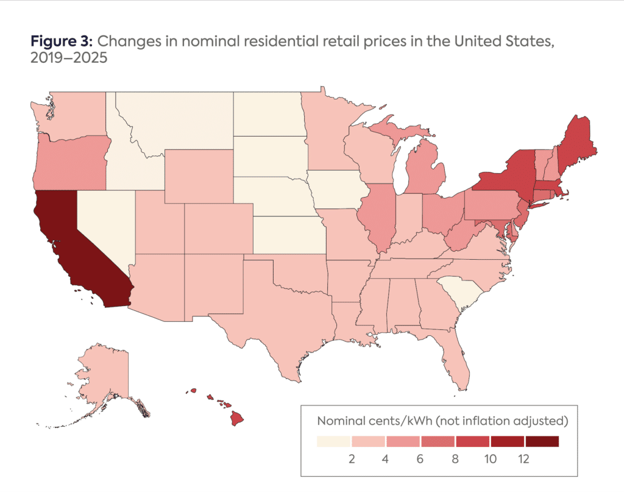
Source: Lawrence Berkeley National Laboratory
Regulators Are Clearing the Way
Policymakers are moving to get this new demand onto the grid quickly, while keeping costs fair for families. On June 18, Federal Energy Regulatory Commission (FERC) Chairman Laura Swett directed six regional grid operators to justify or update their rules for how data centers and other large loads connect. Swett framed the action around “fair cost allocation, unprecedented transparency for the American ratepayer and speed to power.”
Former FERC Chairman Neil Chatterjee explained that the order creates a better regulatory environment for data centers:
“[The order] sent a very clear signal that large load interconnections need to be treated differently from typical retail loads, that I think had a huge impact on investors, and just folks that are tracking this space.”
Chatterjee added that by leaving grid operators to address the changes they need to speed up interconnections in their own regions; the resulting impact will be:
“Faster and more legally durable than a nation-wide rule.”
Natural Gas is Powering the Boom
Keeping bills low as demand climbs comes down to one thing: new supply has to keep pace. That’s where natural gas shines. Gas already generates about 41 percent of U.S. electricity, the single largest source on the grid, and it is dispatchable, reliable and affordable, making it the natural choice to power the AI boom.
As Energy in Depth has previously analyzed, a recent International Energy Agency study found that for the United States to be able to host a majority (75 percent) of AI computing domestically, it will need to make around 51 gigawatts of electricity available to data centers by 2027. Natural gas, sourced from Appalachia, the Permian and Haynesville regions, can scale quickly and affordably to keep durable new supply flowing to the grid as data centers grow.
Bottom line: Data centers have been bringing down household energy costs because of their ability to serve as anchor customers and their investments to help modernize the grid. At the same time, affordable natural gas is the engine keeping that progress going. EPRI’s data underscores that the United States can power the AI boom while protecting ratepayers at the same time.
No Comments