
Out-of-State Billionaires Take Aim at Louisiana’s Carbon Capture Opportunity
Out of state, anti-energy billionaires are dumping millions of dollars to manufacture opposition to carbon capture in Louisiana. According to research by the Pelican Institute, out-of-state donors, led by Bloomberg Philanthropies and the Bezos Earth Fund, have funneled more than $115.5 million into Louisiana groups working to shut down the state’s energy industry. The report estimates that litigation and regulatory risks have cost Louisiana more than $600 billion in economic growth between 2009 and 2024.
For example, in 2022 Bloomberg Philanthropies launched Beyond Petrochemicals, an $85 million campaign to block more than 120 proposed petrochemical and plastics projects across Louisiana, Texas and the Ohio River Valley. This campaign has taken roots in Louisiana through sponsorship of local organizations such as the Bucket Brigade and Rise St. James, and has begun targeting carbon capture and storage (CCS) under the incorrect premise that is a “false solution” to reducing greenhouse gas emissions (GHG).
The “Energy Transition” Irony
An active player in this campaign is Louisiana Against False Solutions (LAFS), a coalition of organizations opposed to CCS projects in the state. Affiliated groups include Healthy Gulf and the 350.org New Orleans chapter, which received $1 million and $1.25 million ($750,000 in 2021, $500,000 in 2020), respectively, from Bloomberg Philanthropies between 2021 and 2022 to “accelerate [the] transition to clean energy.”
It is ironic that the organizations allegedly working to “accelerate” the energy transition are fighting directly against a technology specifically designed to reduce greenhouse gas emissions. Delays in investment and innovation in CCS technologies have been proven by the International Energy Agency to have a lasting detrimental impact on future emissions trajectories and the pace at which net-zero emissions can be achieved.
Additionally, so-called “environmental” organizations that celebrated the passage of clean energy tax credits under the Inflation Reduction Act (IRA) are now actively opposing one of the very technologies the law was designed to support. The IRA significantly expanded federal tax credits for carbon capture and sequestration projects because many industries, particularly heavy manufacturing, require carbon management technologies to tackle hard to reduce emissions. Opposing investment in CCS directly contradicts these organizations’ stated goal of lowering emissions by roadblocking the only viable technology available for many industries to do so.
Louisiana’s Economic Growth Is On The Line
Not only is this opposition dangerous for overall emission reductions, blocking CCS deployment will have a direct negative impact on Louisiana’s economy. Louisiana’s own economic development agency estimates the backlash threatens more than $57 billion in proposed industrial investments tied to CCS, as reported by the Financial Times.
Companies ranging from ExxonMobil to CF Industries are making multibillion-dollar investments based on the assumption that carbon capture infrastructure will be available to support lower carbon manufacturing, ammonia production, hydrogen development, and other emerging industries. Company executives have warned that continued political and activist opposition could ultimately force companies to direct investment elsewhere. As Exxon senior vice president Dominic Genetti told the Financial Times, blocking CCS projects in Louisiana could prove “detrimental to the economy” by pushing future projects to competing states or nations.
Carbon capture has the potential to be an economic boon for the people of Louisiana. In a recent analysis, LSU identified 13 announced projects with a carbon capture component representing approximately $48 billion in total investment. The study also found that 33 existing industrial facilities employing roughly 4,200 workers could become viable candidates for carbon capture if sequestration infrastructure is developed, further strengthening Louisiana’s position as a leader in energy.
In Greater Baton Rouge alone, the Greater Baton Rouge Economic Partnership (BRAC) counted 45 prospective projects in development as of August 2025. Roughly half carry carbon capture, utilization, and storage (CCUS) components, yet those projects account for more than 90 percent of the pipeline’s potential capital investment and nearly 80 percent of its direct jobs. The investment Louisiana stands to gain or lose is overwhelmingly tied to whether carbon capture can move forward.
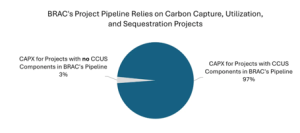
Source: Greater Baton Rouge Economic Partnership
The irony is difficult to ignore. While environmental organizations argue they support climate action and emissions reductions, many are still opposing one of the few technologies capable of preserving Louisiana’s industrial base while helping companies meet increasingly stringent carbon requirements. The result could be that Louisiana forfeits a generational economic opportunity as companies begin to direct investment to states and countries more willing to support carbon capture infrastructure.
Louisiana Isn’t the Only Target
The same network is running the same playbook across the country. In the Midwest, the Bold Alliance has spearheaded the campaign to kill Summit Carbon Solutions’ multi-state CO2 pipeline. Jane Kleeb founded and leads the group, and she simultaneously chairs the Nebraska Democratic Party and serves as a vice-chair of the Democratic National Committee. Bold’s “Pipeline Fighters Hub” coordinates landowner opposition across Iowa, Nebraska, and the Dakotas, and the Sierra Club led the litigation against the project.
That campaign runs on national climate money. Kleeb won a 2023 Climate Breakthrough Award, one of the largest individual climate-funding prizes, and her past pipeline campaigns have drawn support connected to billionaire Tom Steyer’s NextGen network that has also been pushing for climate litigation. This is the same model now playing out in Louisiana: nationally connected, ideologically driven organizations are pouring outside resources into stalling the energy infrastructure that rural communities and industrial workers depend on.
Bottom Line: CCS represents a major economic opportunity for Louisiana, with tens of billions of dollars in investment and thousands of jobs on the line. Continued opposition from well-funded, out-of-state activist groups risks undermining both Louisiana’s economic growth and the deployment of a key technology for reducing emissions.
No Comments