
The Activist Playbook: Using Litigation to Slow America’s Energy Infrastructure
A coalition of environmental groups has launched another legal challenge aimed at a key federal permitting tool used for pipeline water crossings. But the latest lawsuit is about more than Nationwide Permit 12 itself. It reflects a broader strategy activists have increasingly used to delay energy infrastructure: challenge the rules that enable projects to move forward, seek sweeping court remedies, and force developers into longer, more costly permitting processes.
On July 22, the Center for Biological Diversity, Sierra Club, Friends of the Earth U.S., Waterkeeper Alliance and Montana Environmental Information Center filed suit against the Army Corps of Engineers’ 2026 Nationwide Permit 12. The groups argue the permit violates federal environmental laws and are asking the court to eliminate it entirely.
The case follows a familiar pattern. When agencies create pathways to efficiently review and approve infrastructure projects, opponents increasingly turn to litigation—not necessarily to address a single project impact, but to challenge the permitting framework itself.
What Nationwide Permit 12 Actually Does
Nationwide Permit 12 is a useful target for activists because it sits at the intersection of two competing priorities: protecting waterways while allowing critical infrastructure to be built efficiently.
The permit does not approve pipelines, waive environmental review, or allow unlimited impacts to waterways. Instead, it provides a streamlined pathway for qualifying, lower-impact water crossings associated with pipeline construction and maintenance while preserving additional review requirements for projects with greater impacts.
Rather than weakening environmental protections, it directs agency resources toward projects with the greatest potential impacts while allowing routine activities to move through a more efficient process.
New Permit, Same Courtroom Playbook
The latest lawsuit follows a familiar pattern as this is not the first time Permit 12 has been targeted. In 2020, a federal court ruled that the Corps’ 2017 version of Nationwide Permit 12 did not comply with the Endangered Species Act. Several of the same organizations later challenged the 2021 permit. After the Corps revised the permit and issued a new version in 2026, the earlier case was dismissed. Three months later, many of those same groups returned to court to challenge the replacement permit.
The pattern is clear: even when agencies respond to litigation by revising permitting requirements, opponents continue pursuing broader legal challenges aimed at removing the permitting framework altogether.
Delay Is the Strategy
The impact of this approach is not limited to courtroom arguments. Even when projects ultimately prevail, years of litigation can create uncertainty, increase costs, and delay infrastructure that communities and consumers rely on.
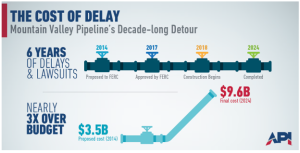
The Mountain Valley Pipeline offers a clear example of what can happen when infrastructure projects become trapped in years of litigation and regulatory uncertainty.
Source: American Petroleum Institute
Mountain Valley entered FERC’s pre-filing process in 2014 and received federal approval in 2017, but the pipeline did not enter service until 2024. During that period, legal challenges affected several permits, including authorizations for hundreds of water and wetland crossings under Nationwide Permit 12. The developer ultimately sought individual permits for more than 500 crossings after the streamlined authorizations were blocked.
Mountain Valley is not the subject of the new lawsuit, but its history illustrates the broader consequences of using litigation to delay infrastructure projects.
Vacating Nationwide Permit 12 would not eliminate the need for pipeline construction and maintenance. Instead, eliminating Nationwide Permit 12 would shift qualifying water crossings into a slower, more resource-intensive permitting pathway, increasing costs and extending timelines before construction or maintenance work can move forward.
The Corps estimates Nationwide Permit 12 will be used about 3,700 times each year. The agency has said the permit encourages developers to limit water impacts while allowing agency staff to focus more attention on projects that present greater environmental concerns.
If activists succeed in eliminating the permit, the need for pipeline crossings will not go away. The result would simply be a more cumbersome permitting process for projects that still must be built to deliver energy to homes, businesses and communities.
More uncertainty, longer timelines and higher costs ultimately affect the ability to expand the infrastructure needed to support reliable and affordable energy. The EIA identifies pipeline availability and capacity as factors affecting retail natural gas prices. America can produce abundant energy, but consumers benefit only when the infrastructure exists to deliver it.
Bottom Line: The latest lawsuit is about more than a single permit. It reflects a broader strategy of using litigation to delay U.S. energy infrastructure, even after agencies revise permits in response to earlier court challenges. Vacating Nationwide Permit 12 would push more qualifying projects into a slower permitting process, increasing costs, extending timelines and making it harder to deliver affordable energy to American consumers.
No Comments