
World Bank: U.S. Achieves the Largest Absolute Reduction in Flare Volumes
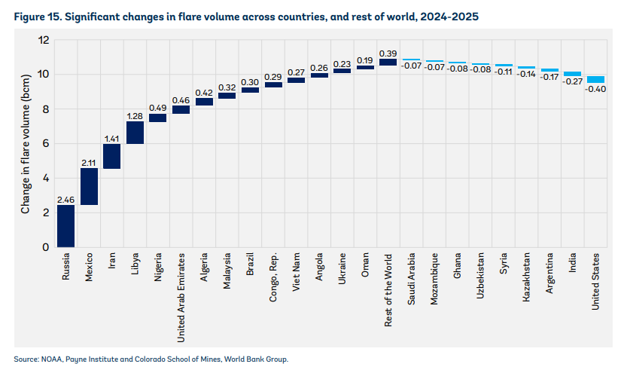
As global flaring rose for a third straight year in 2025, the United States went against the grain, posting the largest reductions of any country, per the World Bank’s latest Global Gas Flaring Tracker Report.
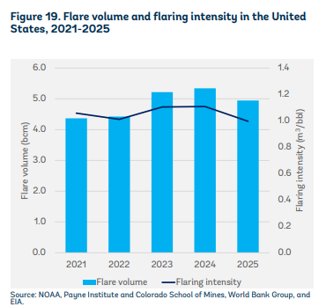
The report found that the United States achieved the “largest drop in flare volumes globally” in 2025. American flare volumes fell by 400 million cubic meters (mcm), or 7 percent, even as domestic oil production increased by 3 percent. Flaring intensity, which measures the amount of gas flared for every barrel of oil produced, also fell by 10 percent, from 1.1 cubic meters per barrel (m/bbl) in 2024 to 1.0 m/bbl in 2025. World Bank further notes that the United States now has one of the lowest flaring intensities in the world.
Source: World Bank Global Gas Flaring Tracker Report
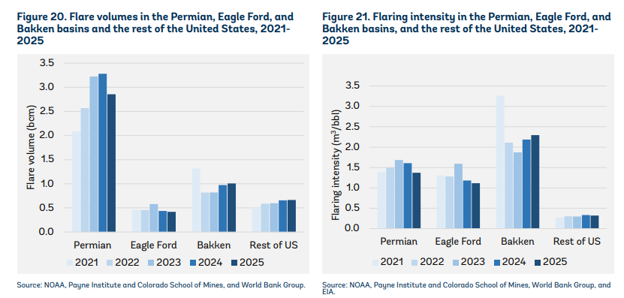
The country’s largest oil and gas basins show the same trend, with both the Permian Basin and the Eagle Ford Shale cutting flaring. As Ed Longanecker, president of the Texas Independent Producers & Royalty Owners Association, explained earlier this year:
“The level of flaring reductions the industry has been able to accomplish over the past five years is very significant, in some regions it’s been nearly halved. Achievements to that degree don’t just happen. It’s proof that the industry’s commitment to the environment wasn’t just a talking point, but rather clear action in the way it operates and invests in its business.”
This progress did not happen in isolation. It builds on years of industry-led efforts to reduce emissions and improve operations across the oil and natural gas supply chain. A 2023 report from The Environmental Partnership, a voluntary initiative representing nearly 70 percent of the U.S. onshore oil and gas operations, found that participating companies reduced total flare volumes by 14 percent and flare intensity by over 2 percent from the previous year. The partnership is just one example of how industry innovation and strategic collaboration enable reductions in emissions, even in times of increasing production to meet growing energy demand.
U.S. Achieves Reductions in Flaring, Even When Producing More Energy
The analysis found that in 2025, both total flare volume and flaring intensity in the United States decreased. And those gains did not come from pumping less oil. The United States increased oil production and still reduced both total flaring and flaring per barrel.
Source: World Bank Global Gas Flaring Tracker Report
The United States is not simply lowering flaring by slowing energy production. Instead, operators are capturing more associated natural gas – the natural gas that comes to the surface alongside oil – and moving it into the energy system, allowing consumers to enjoy more of the benefits of reliable, affordable natural gas.
The Permian Shows Why Infrastructure Matters
The strongest improvement in flaring came from the Permian Basin in Texas and New Mexico, where flare volumes fell by 13 percent and flaring intensity declined by 15 percent. The Eagle Ford in Texas also cut flare volumes by 4 percent. Together with the Bakken Formation in North Dakota, these major shale basins account for most U.S. flaring, which makes their progress especially important.
Source: World Bank Global Gas Flaring Tracker Report
A key driver of reductions was the Matterhorn Express Pipeline, which entered service at the end of 2024 and created a new route for Permian associated gas. Before the Matterhorn came online, limited takeaway capacity across Texas and New Mexico left producers with fewer options when associated gas production outpaced available infrastructure. Once that bottleneck eased, more associated gas could move to market instead of being flared, emphasizing how investments in domestic energy infrastructure can enable reductions in flaring.
The report’s findings further strengthen the need for permitting reform. As Energy in Depth has previously analyzed, support for permitting reform is growing in Congress – with the wider message centering on infrastructure being essential to affordability and reliability. What’s more, when infrastructure is available, more natural gas can reach the market instead of being flared.
Reducing Flaring Supports Affordability and Reliability
Flaring is also an energy affordability issue. When there is not adequate infrastructure to move associated gas to market, the only safe way to manage it is to flare it. Capturing that gas instead puts it to work. There is great potential to use this associated gas to heat homes, power businesses, supply manufacturers, and feed the electric grid. At a time of rising electricity demand from manufacturing, electrification, and data centers, every additional unit of reliable energy supply matters. As the World Bank explains:
“Associated gas can help with the availability, affordability, and reliability of electricity.”
Bottom line: The U.S. natural gas and oil industry continues to be a world leader in reducing flaring, even amidst rising energy production. As energy costs remain prominent heading into the midterms, U.S. flaring reductions show companies remain committed to deploying solutions that will both reduce flaring and continue to provide affordable energy to the country.
No Comments