Hydraulic Fracturing: Read (And Watch) All About It
Shale gas, hydraulic fracturing, jobs, revenues, energy security. There’s a lot of chatter these days about these important issues — especially just over the past few days.
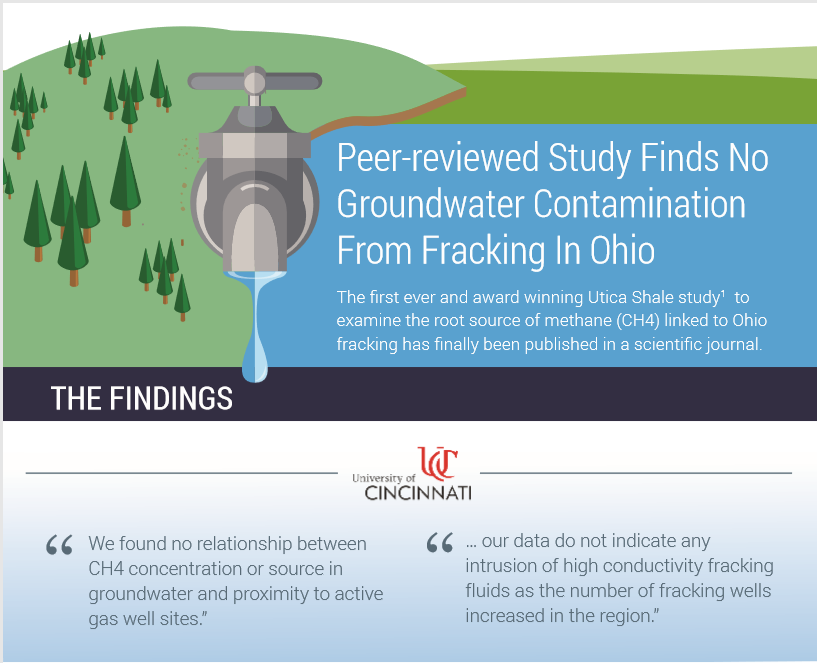
While some maintain that hydraulic fracturing is a new technology and is not effectively regulated (or regulated at all), such claims are unsupported by the facts. Energy-producing states closely and tightly regulate this technology, which has been in use for more than 60 years. In fact, 9 out of 10 wells produced nationwide use this technology. And it’s never – not once – contaminated groundwater.
But what exactly is hydraulic fracturing and why is to so important to America’s long-term energy and economic security? Great question.
Are you a “visual” learner, or just interested in seeing exactly how the fracturing process actually works? Well, you’re in luck. Chesapeake Energy has produce an informative web video about this critical process. And the American Petroleum Institute (API) also has an excellent web video explaining the fracturing process, and the steps taken to ensure minimal environmental and land disturbance occurs. Both videos, and other helpful resources, are available on Energy In Depth’s multimedia page.
But despite this technology’s long and clear record of effectiveness and environmental safety, some in Washington are working to impede the production of homegrown, job-creating energy.
Fortunately, many leaders in Washington appreciate how vital fracturing is to the nation, how it’s well regulated by the states, and how it’s helping to create jobs and economic activity throughout the country. And they’re fighting hard to see that Washington does not strip states of their ability to manage and regulate this technology, knowing that jobs, economic growth and energy security are at risk.
In a recent Shreveport Times op-ed (which was cross-posted on EID’s blog) entitled “Misguided policies threaten job creation,” Louisiana Congressman Steve Scalise – a member of the House Energy and Commerce – writes this:
“Thanks to fracturing, which has been safely used for 60 years, Louisiana’s energy industry created almost 33,000 jobs and generated $3.2 billion into our state’s economy.
“Some in Washington are even working to strip energy-producing states of their ability to regulate fracturing. Turning this authority over to the Environmental Protection Agency (EPA) would threaten energy production altogether and could severely hurt job creation and economic activity at a time when we absolutely need it.
“Fracturing is not only a safe way of increasing our nation’s domestic energy supply, but it is a proven way to reduce our dependence on Middle Eastern oil, create good American jobs and keep energy prices stable for struggling families, senior citizens and small businesses.”
Congressman Scalise has a strong congressional delegation partner in Congressman John Fleming, who’s be a fierce supporter of shale gas development enabled by hydraulic fracturing. The folks at The Hayride, a Louisiana policy and politics blog, noticed this strong partnership, too.
Under the headline “Scalise, Fleming, La. House To Waxman, Markey: Go Away And Leave Us Alone,” The Hayride reports:
While the U.S. House Committee on Energy and Commerce awaits responses to letters it sent to natural gas producers as a precursor to hearings later this month on whether federal regulation is warranted on hydraulic fracturing, Louisiana’s congressional delegation and state legislators are taking a very vigorous and aggressive stance in fighting Washington’s attempts to interfere with the promise of the mammoth Haynesville Shale natural gas play and the coming energy boom it can mean for the state.
Experts Fact Check Recent Round of Scurrilous Claims Targeting Fracturing
EID’s Lee Fuller: “Plain Dealer readers should also be aware that earlier this week, a top EPA drinking-water official stated the same thing — suggesting further that states, and not the federal government, are best positioned to regulate this critical technology in a way that balances the imperative of responsible energy exploration with the safeguarding of our environment. … The fluids used in the process are made of 99.5 percent water and sand — with the slight remainder comprised of household materials you’re just as likely to find in the kitchen cupboard and beneath the kitchen sink.” (Cleveland Plain Dealer, 2/20/10)
EID’s Jeff Eshelman: “Pennsylvania saw an increase of nearly 50,000 jobs last year alone thanks to safe, responsible, well-regulated natural gas production in the Marcellus Shale. Unfortunately, when it comes to hydraulic fracturing – the 60-year old energy production technology used in nine out of 10 wells in America – the congressman’s claims are simply unsupported by the facts. Fracturing has never been regulated by the federal government. … Instead, ground water protection has been effectively regulated by the state government. The bipartisan 2005 energy bill – which was supported by then-Sen. Barack Obama – simply clarified Congress’ intent of the Safe Drinking Water Act. So how could something earn an exemption, or a “loophole,” from a law that it was never regulated by?” (The Daily Local, 2/27/10)
LOGA’s Don Briggs: “For decades this process has been effectively regulated by the states. In 2009, the Groundwater Protection Council released a study on the regulation of oil and gas field activities saying, “The regulation of oil and gas field activities, including hydraulic fracturing, is best accomplished at the state level where regional and local conditions are best understood. …” If hydraulic fracturing were to be regulated by the EPA, President Obama could easily shut down the development of the Haynesville Shale, resulting in the loss of thousands of jobs and billions of dollars in investment.” (The Daily Advertiser, 2/21/10)
Okla. Independent Petroleum Assoc.’s Mike Terry: “The major components of hydraulic fracturing fluid are well-known, with water and sand accounting for up to 99 percent of the solution. The remaining additives are the same compounds found in soaps, detergents, cosmetics, medications and chemicals commonly found in households. … Hydraulic fracturing has been used commercially since 1949, and there have been no known cases of drinking water contamination. … Increased regulations will lead to a decrease in competition.” (The Oklahoman, 2/23/10)
Chesapeake’s Aubrey McClendon: “McClendon defended the process, saying that … Chesapeake Energy has employed hydraulic fracturing more than 25,000 times since the company started in 1989, including 1,000 wells drilled inside Fort Worth’s city limits, with no ill effects on groundwater.” (Harvard University Gazette, 2/25/10)
Institute for Energy Research: “Hydraulic fracturing has been in use for more than 60 years and has been deployed more than a million times without contaminating drinking water. This is possible for a few reasons. Energy-producing states heavily regulate the practice, employing teams of qualified professionals that monitor, inspect, and enforce state law to ensure the public’s safety. In addition, the fracturing of these wells occurs 6,000 to 9,000 feet below our feet and thousands of layers of impermeable rock.” (Boston Globe, 2/19/10)
Lenape Resources’ John Holko: “According to Penn State University, more than 48,000 high-wage jobs were created in Pennsylvania in 2009 alone as a direct result of Marcellus exploration. Total economic output tied to this work topped $3.8 billion. And more than $400 million was sent to state and local governments in the form of taxes and revenues — again, just in a single year.” (Times Union, 2/11/10)
Newspapers Speak Out: Waxman’s Latest “Inquiry” on Hydraulic Fracturing Could be a “Witch Hunt”
The Oklahoman: “Yet they seem to have bought into the fear-mongering extant over fracturing. The technique involves injecting water, sand and chemicals into shale formations. This cracks open the shale and facilitates natural gas production. … This could be a responsible, objective examination. Or it could be a witch hunt. The Environmental Protection Agency, which said six years ago that hydraulic fracturing doesn’t threaten the water supply, wants to spend more than $4 million to study fracturing. … If America is to move toward greater energy independence, natural gas is a key component. And hydraulic fracturing is a key method for making that happen.” (Editorial, 2/23/10)
Washington Examiner’s Mark Tapscott: “Already the initial drilling of Marcellus Shale in Pennsylvania is causing an economic boom in small Pennsylvania towns that have been in dire economic straits for decades. Public support for expanding Marcellus Shale exploration and production is growing there, as well as in New York. But that’s exactly why environmentalists and their liberal Democrat allies in Congress, the media, the non-profit advocacy communities, and the universities are targeting hydraulic fracturing for elimination, seeking to turn it into the next hook for nationwide environmental fear-mongering. They claim – with virtually no credible evidence to back it up – that hydraulic fracturing represents a dire threat to the drinking water millions of Americans in places like New York City and Philadelphia must depend upon every day.” (Editorial, 2/20/10)
The Washington Observer-Reporter: “Natural gas drilling in the Marcellus Shale could provide an economic shot in the arm for this region and Pennsylvania as a whole. … Natural gas has potential as an energy source and a jobs-provider, no doubt about it.” (Editorial, 3/2/10)
Washington Post: “The resurgence of gas comes through the discovery of massive deposits in Appalachian shale formations and elsewhere — a reserve that offers the prospect of stable domestic supplies and relatively low prices.” (Editorial, 2/28/10)
Academics Confirm Critical Role that Hydraulic Fracturing Will Play in Long-Term U.S. Energy Security
Univ. of Mich.-Flint Prof. Mark Perry: “Thanks to a breakthrough in drilling technology, involving the use of three-dimensional seismic imaging and hydraulic fracturing of shale rock, huge amounts of natural gas are being produced in New York, Pennsylvania, Texas, Louisiana and other states. Instead of declining, domestic natural gas production is booming to record-high levels. … But these exciting energy developments may not last if natural gas companies are burdened by excessive regulation and heavy taxes. Environmental groups are lobbying Congress to shift regulation of hydraulic fracturing from state governments to the Environmental Protection Agency, claiming that the process poses a risk to groundwater supplies. But the fact is, hydraulic fracturing is done about 1,000 feet below underground aquifers and separated from the water supply by thick rock.” (Investor’s Business Daily, 2/19/10)
Members of Congress, State Legislators Continue to Weigh-In: Fracutring is Safe, Effectively Regulated by States
Congressman John Fleming (LA):
- “He said the extra federal regulation would increase costs, reduce production and eliminate jobs.”Production would essentially grind to a halt, and billions of dollars in federal and state tax revenue would be at risk.” (Alexandria Town Talk, 3/1/10)
- “This action would have a far-reaching negative impact on energy producers and consumers alike, particularly in formations such as the Haynesville Shale in my district which depend on hydraulic fracturing to produce. In 2008, production in the Haynesville Shale pumped $4.5 billion into Louisiana’s economy and created over 32,000 jobs. Adding additional layers of regulations to hydraulic fracturing would not only result in a sharp increase in costs to small and independent producers, it would dramatically decrease output and job creation.” (Bossier Press-Tribune, 2/26/10)
- “If Congress is serious about tackling this country’s energy crisis and ending our dependence on foreign oil then it is crucial they recognize what resources, such as the Haynesville Shale, will play in our long-term economic and national security. More burdensome federal regulation will only serve to hinder production and feed this country’s addiction to foreign energy.” (Bossier Press-Tribune, 2/26/10)
Okla. state Rep. Mike Thompson: “Hydraulic fracturing is a safe and successful drilling method in which water, sand and chemicals are injected at high speeds into a well to fracture rock and free up natural gas. This is a method that has increasingly been used in many shale formations across the country and has led to the discovery of increased levels of domestic natural gas. … The Interstate Oil and Gas Compact Commission conducted a survey that found there were no known cases of groundwater contamination associated with hydraulic fracturing.” (The Oklahoman, 2/27/10)
Rust Belt No More: Shale Gas Exploration Powers Economic Growth in OH, PA
Manufacturing Jobs Coming to Ohio:
- “Pipe Dreams Come True Thanks to Marcellus Shale … After years of incentives, tireless work, political pressure, and labor concessions, what is bringing heavy steel manufacturing back to the Valley is a layer of rock deep beneath our feet. It’s called the Marcellus Shale, named after the town of Marcellus, New York, where there is an exposed outcropping. …This is creating the demand for high-quality steel pipe used to punch through the shale and into the gas deposits that is enticing V&M and TMK IPSCO to build or expand facilities here.” (WYTV-OH, 2/25/10)
- “An oil-and-gas pipe maker says it plans to open a new facility in Brookfield. TMK IPSCO said Tuesday it has signed a lease on a building where it plans to produce up to 100,000 tons of threaded pipe annually. The company said it expects to begin operations in the township in the coming months; up to 120 people could eventually be employed there. President and CEO Vicki Avril says the new facility is in direct response to the growing demand for infrastructure at Marcellus Shale well sites that are located under parts of Ohio and Pennsylvania.” (Tribune Chronicle, 2/23/10)
Tens of Thousands of Jobs Being Created in Pennsylvania:
- “New ventures in natural gas may take Tioga County from ‘rags to riches’ … “I think the fastest growing areas of the county are going to be Mansfield, Wellsboro and Lawrenceville,” he said, adding that he thinks the valley between Mansfield and Covington will “fill in” in the next few years, mainly because of the discovery of gas within the Marcellus Shale. … With that, jobs will come, and plenty of them, he said. Some of those jobs will be filled by local people, while others will move here with their families. … Before the natural gas industry discovered the gas trapped in the shale beneath Tioga County, it was considered to be a “slowly dying” county, Trask said.” (Williamsport Sun-Gazette, 2/18/10)
- “With the expansion, TMK IPSCO plans to take advantage of increased demand for pipe to be used for drilling in the Marcellus Shale formation. … “This is a move we’re taking to be more responsive to our clients who are flocking to Marcellus Shale,” Galitzine said. He said IPSCO has seen increased interest in possible Marcellus-related pipeline orders since 2008, and the company has refitted its lines in Ambridge and Koppel to manufacture 5.5-inch-wide pipe, an ideal width for use in the shale fields. … But the Marcellus field has changed the prospects, Galitzine said, both for IPSCO and its employees. The Brookfield plant is expected to immediately employ 50 people, which will increase to 120 employees.” (Beaver Co. Times, 2/25/10)
- “It’s one business. It’s 50 jobs. And they are almost all going to local people. Those are the pertinent details regarding approval last week by Montoursville Borough Council allowing Sooner Pipe to operate a pipe storage facility on the industrial section of the Williamsport-Lycoming County Airport. … And the best part is that this is probably just the tip of the proverbial gas industry iceberg. As the industry settles into the region, there will be needs for pipe manufacturing, cutting and storage, equipment providers, freight storage and other offshoot businesses and industries. They all will be employing people, often with unique, high-paying skills. Those people will be spending money on food, clothing and shelter. That is the root definition of economic development, private enterprise style. It’s the best kind of economic development.” (Williamsport Sun-Gazette, Editorial, 2/25/10)
- “Fracturing is an old technology already regulated by states. … A July 2009 study by Pennsylvania State University estimates developing the Marcellus shale basin added more than 48,000 jobs in the state last year” (Wall Street Journal, 2/27/10)
State Regulators Speak Out: List of Chemicals “Available on DEP’s Website”
PA DEP Water Management Chief: “Our job is to produce gas and protect the future,” said John Hines, deputy secretary for water management from DEP. He explained the Marcellus shale gas reserve could potentially hold “enough gas to fully supply the nation for 10 or more years.” Hines added producing that gas could create new wealth as well as new jobs, “but not at the sacrifice of our water resources.” … During his testimony, Hines attempted to dispel rumors that certain “secret” chemicals were used in the fracing process. He said that DEP distributed a list to the public of all the chemicals that were used. Hines said the Material Safety Data Sheets were also distributed to local emergency responders. The list is available on DEP’s Web site.” (Clearfield Progress, 2/19/10)
Press Release: EID Statement on House Inquiry into Safe, Responsible Use of Hydraulic Fracturing
“Fracturing is safe, effective and very much needed in the context of today’s enormous challenges
related to energy, the economy, and the environment”
WASHINGTON – Energy In Depth executive director Lee Fuller issued the following statement today subsequent to news from the House Energy & Commerce Committee that the panel is interested in learning more about a critical, 60-year-old energy technology known as hydraulic fracturing:
“Hydraulic fracturing is an essential component of producing clean-burning energy in America today, and to the extent the committee’s inquiry into this process helps clear up some of the misconceptions that have come to be associated with the technology, it’s a study we look forward to contributing to. In our view, the committee will benefit enormously from learning more about the procedures, practices and regulations in place to safeguard underground sources of drinking water – and in particular, the steps that are taken at every wellsite in America to ensure the proper casing and cementing acts as an effective barrier between the inside of the wellbore and the environment outside it.
“If the responsible development of shale gas represents a potential game-changer for the United States, hydraulic fracturing represents a non-negotiable tool needed to leverage that potential into reality – and the jobs, revenue and opportunity that come with it.
“It’s understandable that lawmakers would take an interest in learning more about this critical technology moving forward. But as they begin their latest study of the fracturing process, we’d also commend to their attention the various statements, studies and testimonials by and from organizations like EPA, the Department of Energy, and the Ground Water Protection Council – all of which have found, and consistently so, that fracturing is safe, effective and very much needed in the context of today’s enormous challenges related to energy, the economy and the environment.”
READ MORE
- Frac In Depth: For more than 60 years, America’s energy producers have relied on an innovative technique known as hydraulic fracturing, used more than 1 million times
- Top EPA Water Official: No “documented cases that the hydro-fracking process was contaminating water supplies”
- EPA Report on HF: “No credible evidence” that hydraulic fracturing endangers groundwater
- Senate Hearing: Top Brass from Obama Admin Tell Congress They’re “Not Aware” of Even “One Case” of HF-Related Contamination
- Fact Sheet: HF Opponents Say the Darndest Things
- Issue Alert: When Gummy Bears Attack
- Graphic: What’s In Frac Fluids?
- Browner Memo: Letter of Support for Hydraulic Fracturing from Carol Browner, Fmr. EPA Administrator
GUEST BLOG: An Open Letter to the Citizens of New York State
To my friends in New York: With all of the recent discussion about development of the Marcellus Shale gas, and the idea that this will lead to dire environmental consequences in your state, realize the true discussion should be about energy consumption versus production in the Northeast. And the question you should be asking is, where is the origin of the energy you are consuming … your state … another state … a foreign country? Where do you want to spend your energy dollars – boosting New York State’s economy or that of Texas?
We will get to the environment question in a minute. But first let’s take a look at sources of electricity generation in New York State. My assumption is all of you use electricity in some form: at home, work, school etc.; for lighting, heat, traffic signals, phones, TV, cooking, computers, life support; and on and on and on — a form of energy which is familiar to all of us.
Take a look at the electric energy generated in your state and where it comes from.
The following information is from the Energy Information Administration (EIA) Annual Electric Power Generation by Primary Energy Source Report for 2007, the most recent year reported. We also assume that most of this generated electricity is utilized in-state, though some obviously moves across state lines in both directions. The EIA information goes back years, and the 2007 numbers are representative of the trend of the past decade. The percent numbers total more than 100%, but .5%, as pumped storage, is a negative number that makes the total = 100%.
|
I can hear you asking: what’s the point? Well, let’s see. The number one source for electric power generation in New York State is natural gas … natural gas that has been produced outside the state of New York. According to the New York State Department of Environmental Conservation (DEC), geologists estimate that the entire Marcellus Shale formation contains between 168 trillion to 516 trillion cubic feet of natural gas throughout its entire extent. Other experts have estimated as high as 1,300 trillion cubic feet (tcf). Although it’s not yet known how much gas will be commercially recoverable from the Marcellus in New York, the state ranks about third in the amount of acreage underlain by the formation. To put this into context, New York State uses about 1.1 trillion cubic feet of natural gas a year.
Yet there is currently a raging debate in New York about the safety of developing a significant source of natural gas within your state.
You, no doubt, have heard that there are hundreds, if not thousands, of drinking water contamination cases across the country. A claim of contamination is not proof of contamination.
In every instance, state and federal regulatory agencies investigate the claim and utilize the power of state and federal laws to ensure any problem has been addressed and is not a risk to human health and the environment. Numerous studies have been conducted. To date, the processes of horizontal drilling and hydraulic fracturing have not been proved to have resulted in contaminating an underground source of drinking water.
Make no mistake, oil and gas drilling and production are industrial operations and accidents can and do occur. The question is, just like with any other industrial operation, are sufficient safeguards already in place to protect health and the environment?
New Yorkers: ask those of us living in the states where thousands of gas wells have been drilled, if we are being harmed by the development of the resource. Ask us if our water is safe to drink. Ask us if our children live normal healthy lives or are somehow adversely affected by natural gas. Ask us if our rivers, streams, forests, farms, ranches or urban areas have been decimated by the drilling and production of natural gas. Ask how many of us have heard of, or been adversely affected by, the drilling, fracturing and completion of a natural gas well. Ask us “regular Americans” — not representatives of some group that is anti-development, or paid consultants involved in law suits.
Let’s be honest. Looking at the numbers from EIA, are you guys building any new nuclear plants? Didn’t think so. How about new dams for hydro? Nope? Well, shucks. Want more coal and oil-fired plants? You’ve got lots of coal close by.
Ahh … renewables!
You could burn a bunch more trees (I mean a big bunch). Put up more wind and solar, right? Let’s be generous and say the entire 2% of renewable electricity generated currently in New York is all wind and solar. Can you double the number of windmills and solar panels? Heck let’s quadruple the number of windmills and solar panels in place today. How long will that take? You are now at 8% of your electric generation needs, and I hope the sun shines and the wind blows non-stop — otherwise you will need a back up for that 8% (most likely using fossil fuels) or a mega storage system that does not yet exist.
As you can see, in electricity generation alone, New Yorkers manage to use more than a little fossil fuel energy. Think of your total energy usage when you include transportation fuels, industrial processes, etc., that are not electric. By the way, if everyone in New York had electric cars, about 50% of the electricity used to recharge their batteries would come from fossil fuels.
In the end, as its citizens debate development of New York shale gas, it might be prudent and practical to cut through the environmental scare rhetoric and renewable energy dreams not yet achievable, to consider the following: Do you want to have responsible development of an available and valuable New York natural resource; collect the associated taxes; employ New York people and keep the lights on if there’s a disruption in supply?
Or, if you prefer, your state can continue to use gas from elsewhere and let others benefit from the production revenue, employment and taxes. We don’t really care what you decide. We have been supplying your energy needs for decades and those northeast dollars sure do bolster our economies in the “Oil Patch.”
Mr. Simmons is the executive director of the Tulsa, Oklahoma-based National Association of Royalty Owners, Inc. (NARO). Visit www.naro-us.org to learn more.
Energy In Depth: “Fracturing is safe, effective and very much needed in the context of today’s enormous challenges related to energy, the economy, and the environment”
EPA Officials Confirm Fracturing’s Safety
Steve Heare, director of EPA’s Drinking Water Protection Division: “State regulators are doing a good job overseeing a key natural gas production technique called hydrofracking and there’s no evidence the process causes water contamination, a senior federal environment official said Monday. … I have no information that states aren’t doing a good job already. He also said despite claims by environmental organizations, he hadn’t seen any documented cases that the hydro-fracking process was contaminating water supplies.” (Dow Jones, 2/15/10)
EPA Water Chief Peter Silva, EPA Compliance Administrator Cynthia Giles, and Assoc. EPA Water Director Matthew Larsen were asked the following straightforward question at a recent Senate hearing:
- “Do any one of you know of one case of ground water contamination that has resulted from hydraulic fracturing?”
Their answer?
- “Not that I’m aware of, no.”
Fmr. EPA administrator and current White House energy czar Carol Browner: “EPA does not regulate – and does not believe it is legally required to regulate – the hydraulic fracturing of methane production wells … Moreover, given the horizontal and vertical distance between the drinking water well and the closest methane gas production wells, the possibility of contamination or endangerment of [drinking water] in the area is extremely remote.” (5/30/95)
EPA Study: “EPA found no confirmed cases that are linked to fracturing fluid injection into CBM wells or subsequent underground movement of fracturing fluids.” (2004)
U.S. House Members
Congressman Ed Markey (Mass.): “Ninety percent of all new electrical capacity in America since 1990 has been natural gas, and it’s going to continue on that way as a base load with the new mandates for renewable electricity in the states having a higher percentage increasingly coming from that source. But natural gas is going to do very well in the future, and the discoveries from the Marcellus Shale all the way through Barnett, that is all the way from New York down to Texas, are going to be big source of new electrical generation.” (12/2/09)
Congressman Doug Lamborn (Colo.): “Shale gas and other unconventional natural gas sources such as tight sands and coal bed methane provide more than 47 percent of the natural gas consumed in the U.S. annually. According to the Energy Information Administration, by 2030 these unconventional natural gas resources will provide 56 percent of the natural gas consumed by the United States. All of this was made possible through development of the Barnett Shale in Texas in the 1980s and 1990s, where innovative drilling techniques, horizontal drilling, combined with the safe long-standing practice of hydraulic fracturing, demonstrated that this unconventional fuel could be economically produced on a large scale.” (Roll Call, 2/8/10)
Congressman Dan Boren (Okla.): “Boren said he is working with Rep. Diana DeGette, D-Colo., to tone down her bill to regulate hydraulic fracturing of oil- and gas-bearing formations. The legislation was introduced to protect water supplies from the contamination, but Boren said the procedure is already safe. ‘If you shut down fracking, you shut down the industry,’ he said.” (Tulsa World, 7/21/09)
Congressman John Sullivan (Okla.): “Hydraulic fracking is one of the ways that we’ve been able to get these 120 year reserves. … For 60 years, they’ve been using. There’s not one – not one instance – that it’s leaked into groundwater. … There’s not one instance of it. … It’s going to create jobs in America.” (CNBC’s Mad Money, 2/8/10)
Congressman John Fleming (La.): “For years this process has been safely and effectively regulated by individual States; and of the more than 1 million wells fractured, not a single case of drinking water contamination has ever been recorded. … The casing, cement specifications and cementing process are governed by state and federal regulations as well as industry standards. In every case this process is supervised by state agency officials. Federal regulation of “hydrofracking” under the EPA would result in a sharp increase in costs to small and independent producers, as well as a dramatic decrease in output and job creation.” (Floor remarks, 6/23/09)
Congressman Earl Pomeroy (N.D.): “The [FRAC Act] is potentially very threatening to the oil exploration and recovery activity underway in North Dakota. It’s one of these pieces of legislation that is a solution in search of a problem.” (Dickinson Press, 7/17/09)
Congressman Cliff Stearns (Fla.): “Since the 1940s, hydraulic fracturing has helped to produce more than 7 billion barrels of oil and 600 trillion cubic feet of natural gas in the United States. … Hydraulic fracturing is essential to produce more of the oil and natural gas that the U.S. will consume in the next decades ahead. … Without [fracturing] most of our country’s abundant natural gas resources cannot be produced.” (Committee remarks, 1/20/10)
Congressman Glenn Thompson (Pa.): “Despite its clear record of environmental safety (a million wells drilled, not a single documented case of contamination) and stringent regulation by the states, a bill introduced earlier this summer would hand the regulatory reins over fracking to the Environmental Protection Agency in Washington. … In hydraulic fracturing, we now have the tools we need to confront these challenges in a safe and effective way. And if history is a guide, you can bet that’s exactly what we’ll do.” (Washington Examiner, 9/20/09)
Congressman Gene Greene (Texas): “Hydraulic fracturing is a well-tested technology that has been used to develop energy for over 60 years. … Hydraulic fracturing, as used to produce natural gas from shale formations, has created new opportunities for clean energy and employment without causing environmental damage. Recent studies on fracturing conducted by the Environmental Protection Agency in 2004 found no confirmed evidence of contamination of drinking water. …. Congress should not restrict a technology that plays such an integral part of our nation’s energy strategy.” (Floor remarks, 6/25/09)
“With recent advances in technology to extract more natural gas from unconventional gas resources, such as extended reach, horizontal drilling or hydraulic fracturing, we can unlock America’s 100 years’ supply of natural gas. This hydrofracking, U.S.?developed technology, is being exported to Europe and China.” (Committee remarks, 1/20/10)
Congressman John Shadegg (Ariz.): “A vast majority of our domestic supply is accessible only through hydraulic fracturing, a technique that has been used to extract gasoline or oil for more than 50 years. The EPA itself found, quote, “no confirmed cases that are linked to fracturing fluid injection into CBM wells or subsequent underground movement of fracturing.” … EPA did not find confirmed evidence that drinking water wells have been contaminated by hydraulic fracturing. … If we ban hydraulic fracturing, either outright or through the unintended consequences of legislation we pass, then all of these numbers that we have been talking about ?? the 100?year supply, the reasonable price that you just talked about ?? you would tell me are gone.” (Committee remarks, 1/20/10)
Congressman Fred Upton (Mich.): “The oil and natural gas industry supports more than 9 million American jobs and adds more than $1 trillion to the national economy. I hope I don’t need to remind our colleagues about the state of our economy, that unemployment is still in double digits nationally and 15 percent in Michigan. … Without that hydraulic fracturing, you wouldn’t be able to get, what, 20 percent, maybe out of these fields?” (Committee remarks, 1/20/10)
Congressman Mike Doyle (Pa.): “Last year alone Pennsylvania could attribute nearly 50,000 jobs to environmentally safe natural gas production.” (Committee remarks, 1/20/10)
Congressman Greg Walden (Ore.): “It looks to me like if we can invest in our own resources using new technologies in environmentally safe ways, we can generate revenues to the government and create jobs in our hometowns. (Committee remarks, 1/20/10)
Congressman Steve Scalise (La,): “So this really has nothing to do with safety. It is about a policy decision we are going to make, and do we really want to utilize the resource that this country has and the ability that we have to make our country independent of especially Middle Eastern oil, countries that don’t necessarily want to do good things with the money that they are getting to our country.” (Committee remarks, 1/20/10)
U.S. Senators
Senator Dorgan Byron Dorgan (N.D.): “Decade after decade, no one has found any evidence that there is any contamination with hydraulic fracturing. … I am not aware of any evidence that there is any contamination of groundwater with hydraulic fracturing when companies have followed the appropriate guidelines and regulations.” (Floor remarks, 7/27/09)
Senator Sen. Jim Inhofe (Okla.): “America has tremendous natural gas reserves. The exploration and production of these reserves using hydraulic fracturing has been regulated by the States and conducted safely for 60 years.” (Floor remarks, 7/27/09)
READ MORE
- Release: EID Statement on House Inquiry into Safe, Responsible Use of Hydraulic Fracturing
- Frac In Depth: For more than 60 years, America’s energy producers have relied on an innovative technique known as hydraulic fracturing, used more than 1 million times
- Fact Sheet: HF Opponents Say the Darndest Things
- Issue Alert: When Gummy Bears Attack
- GWPC Study: State Oil and Natural Gas Regulations Designed to Protect Water Resources
- Graphic: What’s In Frac Fluids?
Seven Questions for the Mayor of DISH
In advance of Mayor Tillman’s trip to New York next week, EID poses a series of questions residents should ask while he’s there
Keep Reading »
WHAT THEY’RE SAYING: Hydraulic Fracturing Creating an “Economic Explosion,” Changing “The Landscape”
Landowners, State and Federal Leaders: “No cases of groundwater contamination documented anywhere”
Jerry Simmons, National Association of Royalty Owners executive director: “There are no cases of groundwater contamination documented anywhere in the country, by state or federal regulatory agencies. It’s just scare tactics to get the development stopped. … We have appropriate state and federal regulations in place to ensure this is being done in an environmentally safe and prudent manner.” (The Oklahoman, 2/9/10)
Congressman Doug Lamborn (Colo.): “Shale gas and other unconventional natural gas sources such as tight sands and coal bed methane provide more than 47 percent of the natural gas consumed in the U.S. annually. According to the Energy Information Administration, by 2030 these unconventional natural gas resources will provide 56 percent of the natural gas consumed by the United States. All of this was made possible through development of the Barnett Shale in Texas in the 1980s and 1990s, where innovative drilling techniques, horizontal drilling, combined with the safe long-standing practice of hydraulic fracturing, demonstrated that this unconventional fuel could be economically produced on a large scale.” (Roll Call, 2/8/10)
PA State Rep. Jim Christiana: “We deploy a 60-year-old technology, hydraulic fracturing, that’s used today in nine out of every 10 energy wells in America. And despite claims by opponents of affordable energy, not a single case of drinking water contamination has ever been tied to the process. Not one. Even though it’s been used nationwide more than 1.1 million times.” (Wilkes Barre Times-Leader, 2/8/10)
Congressman John Sullivan (Okla.): “Hydraulic fracking is one of the ways that we’ve been able to get these 120 year reserves. … For 60 years, they’ve been using. There’s not one – not one instance – that it’s leaked into groundwater. … There’s not one instance of it. … It’s going to create jobs in America.” (CNBC’s Mad Money, 2/8/10)
Natural gas is solution to our economic woes: “We have massive reserves of it in this country, enough to meet our energy needs for 100 years. What Saudi Arabia is to oil, the United States is to natural gas. … Recent technological advances in drilling and completion methods have made it possible to retrieve natural gas from geological formations called shale.” (San Angelo Standard-Times, Op-Ed, 2/3/10)
Safe, Well-Regulated Shale Gas Production Generating Jobs, “Created an economic explosion”
Training for Natural Gas Industry Jobs: “Jerry Cochenour of Wellsboro is getting a safety lesson while operating a piece of machinery near Williamsport. Like the other 14 students from Tioga County in the class, Cochenour is out of work and decided to find a job in the natural gas industry. “A lot of us are looking for employment due to the economy and what not. This seems like a sure-fire thing.” … “Many of these people have suffered those job losses and this is an opportunity for them to get into a growing field,” said Lorson.” (WNEP-TV, 2/8/10)
Dan Juneau, Louisiana Association of Business and Industry president: “Natural gas production in the Haynesville Shale has created an economic explosion in northwest Louisiana, just as it has in other regions of the country which have shale formations. Production of clean-burning natural gas must be the “clean energy” of the next decade, allowing a gradual transition to other forms of energy.” (Opelousas Daily World, 2/9/10)
Gas market goes global: “[U.S.] shale gas revolution changed the landscape.” (Calgary Herald, 2/9/10)
Natural gas is solution to our economic woes: “If you are of sound mind and body and have a willingness to work, you can make $65,000 to $100,000 per year with just a high school education. I met people from all over the country there. Welders, mechanics, truck drivers, roughnecks, electricians, engineers, waitresses, blackjack dealers — the list goes on and on, hardworking people who were all making good money. The same story could be played out all over the country if we drill for and produce natural gas.” (San Angelo Standard-Times, Op-Ed, 2/3/10)
Academics Weigh In on the Potentials of Shale Gas
Michael Economides, University of Houston Chemical and Biomolecular Engineering Professor: “The answer is staring us in the eye … The shale gas story in the United States, in addition to all other issues, is a spectacular display of technological deployment and the intimate connection with what confuses the public more than any other: the transition from resources to recoverable reserves. … It will be gas, gas and more gas not many years from now. In this context, talking about wind and solar is nothing short of ridiculous.” (Houston Chronicle, 2/7/10)
Comments by EPA’s Steve Heare aligns with past statements from agency, directly contradicts arguments in support of FRAC Act
WASHINGTON – States are doing “a good job already” when it comes to regulating a 61-year-old energy technology known as hydraulic fracturing, a top EPA water official said yesterday – directly contradicting those who support re-writing the Safe Drinking Water Act to impose EPA regulation over the process for the first time in the agency’s (or Act’s) history. Following comments made yesterday from Steve Heare, EPA’s director of EPA’s drinking water protection office, Energy In Depth executive director Lee Fuller issued the following statement:
“These comments from a key EPA drinking water protection official underscore the tremendous work that state regulators have done for decades, and continue to do today, to ensure the proper balance between responsible energy exploration and the safeguarding of our land, air and water. They also align seamlessly with every single official pronouncement that EPA has ever made on hydraulic fracturing; namely, that fracturing technology is safe, it’s incredibly effective, and that it poses no risk to drinking water supplies as currently regulated.”
In particular, Fuller pointed to testimony offered in December by several EPA water and compliance officials to a committee of the U.S. Senate, a hearing in which EPA’s Peter Silva, Cynthia Giles and Matthew Larsen were asked if they were aware of a single instance of water contamination tied to hydraulic fracturing. None were able to identify a single such case, according to the hearing transcript – a reality confirmed by EPA itself in 2004 when it found “no evidence” of alleged contamination after conducting an exhaustive study of the issue over the course of nearly five years.
Fuller also noted that EPA’s latest comments on hydraulic fracturing present a direct challenge to those who support the so-called FRAC Act currently being considered in Congress – legislation that would fundamentally re-write the 36-year-old Safe Drinking Water Act (SDWA) with an eye on shoehorning hydraulic fracturing into a potentially unworkable federal regulatory regime. Sponsors of the FRAC Act premise their support for the bill on the assertion that states cannot effectively regulate the fracturing process as currently constituted – a notion that stands in direct contradiction to comments made by Mr. Heare yesterday.
“It seems we have a bit of a disagreement to resolve here,” Fuller added. “If supporters of the FRAC Act believe that EPA’s drinking water official is wrong, they should say so – and be ready to defend that assertion. Alternatively, if they think he may right, they ought to take a second look at the legislation they’re trying to pass, and perhaps do a bit more research into how their individual states are effectively handling this important responsibility. I think they’ll be pleasantly surprised by how aggressively this process is being managed by experts on the ground and in the community.”
READ MORE
- EPA Report on HF: “No credible evidence” that hydraulic fracturing endangers groundwater
- Senate Hearing: Top Brass from Obama Admin Tell Congress They’re “Not Aware” of Even “One Case” of HF-Related Contamination
- Fact Sheet: HF Opponents Say the Darndest Things
- Issue Alert: When Gummy Bears Attack
- Graphic: What’s In Frac Fluids?
- Browner Memo: Letter of Support for Hydraulic Fracturing from Carol Browner, Fmr. EPA Administrator
Should state officials remain in charge of regulating fracturing activity in their communities? Yes. And EID counts the reasons why
Keep Reading »
NY Economic Development Leaders Talk Responsible Shale Gas Development, Job Potentials
Earlier this week, hundreds of concerned New Yorkers made the trek to Albany to tell state leaders the time is now to move forward with responsible, 21st century shale gas production in the state. Cold weather and a driving rain didn’t deter the scores of landowners, county and state legislators and everyday working families who are committed to strengthening New York’s economy.
And building on Monday’s groundswell of support, yesterday the Greater Binghamton Chamber of Commerce met to discuss the economic potentials presented by responsibly developing natural gas in the Marcellus shale. The economic impact – as we’ve both written and reported – would be staggering. Here are a few highlights from the event that were covered by the local media.
WICZ-TV reports this under the headline “Marcellus Shale Could Be a Gold Mine”:
Natural Gas supporters say the Southern Tier is sitting on a gold mine … in the form of the Marcellus Shale.
“In terms of the world, resources for oil or natural gas, this is second only to the middle east,” said Rayola Dougher, Senior Economic Advisor for the American Petroleum Institute. The formation is 10 times larger than the Barnett Shale in Texas. Supporters say drilling there increased jobs in the area by about 100,000… and they insist those jobs won’t go away after the wells are drilled.
“With more money coming into the community, more people will be eating out, going out for entertainment and recreation,” said Terry Stark of Broome-Tioga Workforce. “Jobs are leaving our area, our children are leaving our area. We need to bring this opportunity here and really capitalize on it.”
WBNG-TV went with the headline “Gas Drilling Could Mean Economic Opportunity.” Key excerpts from their report:
If New York State gives companies the green light to begin drilling, the natural gas industry could help bring about an economic revival in Broome County. The Greater Binghamton Chamber of Commerce examined the possibilities today during an economic development forum.
A panel of gas drilling experts say hundreds of jobs would stimulate Broome’s economy, but that’s only if New York State allows natural gas drilling to move forward.
“The Marcellus Shale is going to be a real game changer in the United States and especially for this region of the country. It’s going to mean economic growth, it’s going to mean new jobs, it’s going to attract manufacturing jobs to the area,” said Rayola Dougher, Senior Economic Advisor from the American Petroleum Institute.
Panelists claim more than 1,000 local jobs will be created in Greater Binghamton.
The Binghamton Press & Bulletin reports this under the headline “Chamber forum argues in favor of gas drilling”:
The panel — made up of representatives from county government and work force development, the American Petroleum Institute and Chesapeake Energy — touted new jobs, both direct and indirect, and other economic benefits that would come from any local drilling for natural gas in the Marcellus Shale.
“The Greater Binghamton Chamber of Commerce strongly supports natural gas exploration as long as adequate policies are developed to protect our environment and infrastructure,” said Lou Santoni, president and CEO of the chamber, which presented the forum, held Tuesday at the Binghamton Regency Hotel and Conference Center. “We believe that the county and DEC are ready to do that.”
“This is a major job creation opportunity and probably the largest job creation catalyst by one industry,” Deputy County Executive Darcy Fauci said.
And News 10 Now reports this a segmented entitled “Business-friendly forum supports gas drilling”:
“I’d like to see this get moving,” said Chris Ostrowsky, a Conklin landowner. “New York is in dire need of something to go on here and it’s right under our feet, literally.”
A series of speakers at Tuesday’s forum said this is the area’s best hope for a bright economic tomorrow.
“We’re talking billions of dollars of economic activity, you’re talking millions in state and local revenue. I think it’s going to transform the region,” said Rayola Dougher, a senior economic advisor with the American Petroleum Institute, an industry trade group.
STAFFIN’ UP: PA Gas Producers Welcome Guv’s New Regs, Battalion of Bureaucrats
In a press release yesterday, Pennsylvania Gov. Ed Rendell announced a host of new regulations for Marcellus shale gas development. He is also directing the Department of Environmental Protection (DEP) to hire 68 (we’re not sure where he got this number either) new employees to oversee and enforce shale gas and environmental regulations and laws, according to the statement.
Safe, responsible shale gas production helped create 50,000 jobs in Pennsylvania last year alone, and Rendell highlights this significant economic impact:
“As I’ve said all along, we want to encourage the development of this resource because it’s a tremendous economic opportunity for the state, but we will not allow that to happen at the expense of our environment.”
Here are the specific new regulations that Rendell laid out:
• Require the casings of Marcellus Shale and other high-pressure wells to be tested and constructed with specific, oilfield-grade cement;
• Clarify the drilling industry’s responsibility to restore or replace water supplies affected by drilling;
• Establish procedures for operators to identify and correct gas migration problems without waiting for direction from DEP;
• Require drilling operators to notify DEP and local emergency responders immediately of gas migration problems;
• Require well operators to inspect every existing well quarterly to ensure each well is structurally sound, and report the results of those inspections to DEP annually; and
• Require well operators to notify DEP immediately if problems such as over-pressurized wells and defective casings are found during inspections.
The governor’s announcement was welcomed with opened arms from the Marcellus Shale Coalition (MSC). In a release, MSC President and Executive Director Kathryn Klaber says:
“The Marcellus Shale Coalition has consistently supported the hiring of additional DEP staff to monitor natural gas wells in the commonwealth, as reflected in its proactive endorsement of permit fee increases in 2009 to add and train new inspectors. Our support continues with today’s announcement of an additional 68 DEP staff dedicated to the oil and gas program. This sustainable approach is working and will help to ensure the continued responsible development of the Marcellus Shale in Pennsylvania.”
MSC also underscores the fact that shale gas producers in Pennsylvania have a remarkable environmental safety record, thanks in large part to the sensible state regulations coupled with efforts by the industry to ensure that every aspect of production is done responsibly. This from their release:
•Inspections: A total of 14,000 field inspections, including shallow well locations, were made by DEP in 2009, with enforcement action resulting from Marcellus Shale drilling activity accounting for only 1.1 percent of the state’s total actions. Often times, those findings were easily and quickly corrected.
Only 1.1 percent of the state’s total enforcement actions were associated with Marcellus shale gas production. An awfully insignificant amount of cases by any metric. Agreed? Well, if you were fair-minded, sensible and make informed decisions based on facts, then the answer would most likely be yes.
But if one opposes safe, well-regulated, environmentally-sound shale gas production – which is helping to create tens of thousands of good-paying jobs and delivering affordable energy to struggling families and small businesses – one may choose to disregard such facts and cherry-pick isolated cases to help build a presupposed narrative.
Enter ProPublica, a mouthpiece for out-of-the-mainstream environmental zealots cloaked as “journalists”. Under the headline “Pennsylvania’s Gas Wells Booming–But So Are Spills,” ProPublica’s Sabrina Shankman reports this earlier in the week:
As more gas wells are drilled in Pennsylvania’s Marcellus Shale, more cases of toxic spills are being reported.
Ms. Shankman highlights several uncommon incidents that have occurred in Pennsylvania associated with shale gas production in her “article.” One “spill” that she hand-picked to showcase was caused by vandalism.
Any mention of the fact that 1 percent of the energy-related incidents that occurred in Pennsylvania last year were related to Marcellus shale gas production, helping to provide adequate context for readers? Of course not. How silly would that be?
Landowners, Local Leaders Say Fracturing Is Safe, Will Create Jobs, Economic Opportunity
Mike White of the Twin Tiers Landowners Coalition: “Marcellus will be huge. I don’t think people understand how big economically this will be for the area. From what I can see, it’s the single biggest thing that’s ever happened to this area, ever – certainly in our lifetime.” (1/23/10)
Robert Moore of Broome Co., NY: “Natural gas exploration using horizontal wells and a process called hydraulic fracturing, or ‘fracking’, is safe and the economic development benefit would be great. The jobs would be astronomical. Without it, we’re done.” (1/25/10)
Randall Slimak of Chemung Co., NY: “I support natural gas exploration. It’s a source of jobs and revenue.” (1/25/10)
Marie Lusins of the Unatego Area Landowners Assoc.: “People who don’t want drilling don’t have the facts on how safe it is. There never has been one instance in New York of fracking fluid contaminating someone’s water.” (1/26/10)
Steven Palamatier of Chemung Co., NY: “If they don’t pass this law [allowing Marcellus development to take place in New York] hundreds of thousands of jobs will be lost to Pennsylvania.” (1/25/10)
Joe Axtell of Broome Co., NY: “In our area, there used to be tons of dairy farmers. Now, they can’t pay their taxes, and you can count the number of farms on one hand. This would help them, help the state.” (1/25/10)
Douglas Lee of Sullivan Co., NY: “It would be the biggest thing, bigger than casinos. The jobs and money could solve economic problems.” (1/26/10)
NY Assemblyman William Parment (D-North Harmony): “It’s proven and safe.” (1/26/10)
Hydraulic Fracturing “Could Fundamentally Reshape the Whole World Gas Market”
AFP: “If several years ago not a single organisation known to us was forecasting the rapid growth of gas extraction in the United States, today practically all companies are discussing the prospects of shale gas extraction, which could fundamentally reshape the whole world gas market. … The improvements [in extraction techniques] have opened up reserves of gas embedded in shale rock that were previously too costly to extract, leading energy companies to snap up drilling rights in unlikely places such as New York state.” (1/26/10)
Bloomberg: “The sort of technology improvements you as a consumer see in the iPod are also happening in the oil and gas industry to help production,” said Nansen Saleri, chief executive officer at advisory firm Quantum Reservoir Impact in Houston. “It’s a different picture than people were projecting five years ago.” (1/22/10)
Those Who Actually Study This Technology – Not Just Blog About It – Recognize its Safety
PSU Geoscience Prof. and Marcellus Shale Expert Terry Engelder: “The Marcellus Shale lies more than a mile beneath the earth. That’s the equivalent of ‘seven Empire State buildings stacked end on end’ between the shale and the surface. … There is so much rock between where the fractures are taking place and the surface that chances of anything down there disturbing the surface is geographically as close to zero as you can possibly get.” (1/25/10)
Independent Petroleum Association of America: “Industry’s case is well presented at the website, Energy in Depth, sponsored by the Independent Petroleum Association of America. You’ll find there a regulatory timeline, IPAA’s Open Letter to Congress, and some interesting animations which depict the process of drilling and completing a well.” (1/23/10)
Industry Expert: “Lowry, like most who support the practice, argued that ‘fracking’ has never been credibly tied to water pollution. Yet his company – which opened an office in Binghamton – had to shut down that office about a year ago because of a drilling moratorium imposed by the state. ‘It’s about rights being taken away – rights of the people. These people – the landowners – stand to gain something from this, and environmentalists are trying to take away these people’s rights.’” (1/25/10)
Creating Jobs, Economic Activity and Even Saving Schools
Pittsburgh Post-Gazette: “Some experts estimate that development of the natural gas contained in the shale — a geological formation that stretches from West Virginia and eastern Ohio through Western Pennsylvania to the New York state border — could result in a $14 billion boost to Pennsylvania’s economy this year and create more than 176,000 new jobs by 2020.” (1/24/10)
NY’s News 10 Now: “The gas drilling industry hasn’t just helped the fate of the school, it’s also had a positive economic impact on the community. … The community says they’re ready to reap the benefits. ‘Especially with the Marcellus Shale play, we’re really focusing now on showing how Blossburg is a great place to live,’ said Nickerson. ‘I’m sure there’s always somebody somewhere that’s going to find something wrong, but again, the economy, it’s going to be just great for this area.” (1/26/10)
Marcellus Shale Coalition: “[The economic impact] doesn’t stop with the natural gas companies. There are law firms, accounting firms, small town grocers and dry cleaners all starting to realize — in the areas where this is happening — that there is business to be had and economic opportunities throughout the supply chain.” (1/24/10)
PA’s WJAC-TV: “Halliburton is planning to add jobs at its facility in Indiana County. … Officials didn’t have an exact count of how many jobs are available. People packed the Indiana County PA Careerlink office Thursday to learn about the jobs. Halliburton is involved in servicing of gas wells, including Marcellus shale gas wells. Company officials said a wide variety of jobs are available, including jobs for equipment operators. They’re planning several more job fairs in February and March.” (1/21/10)
Newspapers Back Safe, Responsible Shale Gas Production
Houston Chronicle: “When coupled with discoveries of huge new reserves of natural gas across Texas, Arkansas and Louisiana, and in Colorado and Pennsylvania and West Virginia, this latest projected Gulf find makes natural gas a truly abundant fuel for this country. … Domestically produced natural gas, whether from Gulf waters or Texas shale — or for that matter from coal-rich Pennsylvania and West Virginia — can help make that bridge a sturdy and clean one.” (Editorial, 1/12/10)
Washington Examiner: “Key to unlocking energy resources like the Marcellus Shale deposit is a process known as hydraulic fracturing. Drillers inject fluid — 99.5 percent of which is water — into wells to create horizontal fractures, which enable recovery of trillions of cubic feet of natural gas and billions of barrels of oil that would otherwise be inaccessible. Hydraulic fracturing has been widely used for 60 years, especially in Texas, Oklahoma and Louisiana. But now, as energy companies greatly expand the use of hydraulic fracturing in other areas of the nation, environmental extremists see an opportunity to mount a new national scare campaign. … studies by multiple reputable organizations, including the EPA in 2004, concluded that hydraulic fracturing poses no danger to drinking water after being used more than 1.1 million times in the U.S.” (Editorial, 1/20/10)
Top Energy Leaders in Washington Weigh-In
Congressman Cliff Stearns (FL): “Since the 1940s, hydraulic fracturing has helped to produce more than 7 billion barrels of oil and 600 trillion cubic feet of natural gas in the United States. … Hydraulic fracturing is essential to produce more of the oil and natural gas that the U.S. will consume in the next decades ahead. … Without [fracturing] most of our country’s abundant natural gas resources cannot be produced.” (Energy & Commerce Committee remarks, 1/20/10)
Congressman John Shadegg (AZ): “A vast majority of our domestic supply is accessible only through hydraulic fracturing, a technique that has been used to extract gasoline or oil for more than 50 years. The EPA itself found, quote, “no confirmed cases that are linked to fracturing fluid injection into CBM wells or subsequent underground movement of fracturing.” … EPA did not find confirmed evidence that drinking water wells have been contaminated by hydraulic fracturing. … If we ban hydraulic fracturing, either outright or through the unintended consequences of legislation we pass, then all of these numbers that we have been talking about ?? the 100?year supply, the reasonable price that you just talked about ?? you would tell me are gone.” (Energy & Commerce Committee remarks, 1/20/10)
Congressman Gene Green (TX): “With recent advances in technology to extract more natural gas from unconventional gas resources, such as extended reach, horizontal drilling or hydraulic fracturing, we can unlock America’s 100 years’ supply of natural gas. This hydrofracking, U.S.?developed technology, is being exported to Europe and China.” (Energy & Commerce Committee remarks, 1/20/10)
Congressman Fred Upton (MI): “The oil and natural gas industry supports more than 9 million American jobs and adds more than $1 trillion to the national economy. I hope I don’t need to remind our colleagues about the state of our economy, that unemployment is still in double digits nationally and 15 percent in Michigan. … Without that hydraulic fracturing, you wouldn’t be able to get, what, 20 percent, maybe out of these fields?” (Energy & Commerce Committee remarks, 1/20/10)
Congressman Mike Doyle (PA): “Last year alone Pennsylvania could attribute nearly 50,000 jobs to environmentally safe natural gas production.” (Energy & Commerce Committee remarks, 1/20/10)
Congressman Greg Walden (WA): “It looks to me like if we can invest in our own resources using new technologies in environmentally safe ways, we can generate revenues to the government and create jobs in our hometowns. (Energy & Commerce Committee remarks, 1/20/10)
Congressman John Sullivan (OK): “One of the reasons we have gotten so much of that [energy] is because of the drilling techniques, the horizontal drilling and the hydraulic fracking. I read a report, and you guys would know more, but I hear like 60 to 80 percent of the wells drilled in the next 10 years are going to have to use hydraulic fracking, so I think it is horrible, it would be detrimental to this country if they outlaw that practice.” (Energy & Commerce Committee remarks, 1/20/10)
Congressman Steve Scalise (LA): “So this really has nothing to do with safety. It is about a policy decision we are going to make, and do we really want to utilize the resource that this country has and the ability that we have to make our country independent of especially Middle Eastern oil, countries that don’t necessarily want to do good things with the money that they are getting to our country.” (Energy & Commerce Committee remarks, 1/20/10)
Left, Right, Center: Members of All Stripes Cite Shale Gas as Key to Energy Future
House panel examines unique role that shale gas, hydraulic fracturing can play in delivering Americans clean, secure and affordable energy future
WASHINGTON – America’s abundant reserves of clean-burning, shale-derived natural gas have the potential to create thousands of high-wage jobs and billions in new revenue, all while helping our nation pursue a clean, affordable, and secure energy future. That’s the message that members of the House Energy and Commerce subcommittee on energy and the environment heard today, as the panel sought to gain additional information on the proposed merger of ExxonMobil and XTO Energy – a leading independent producer of shale gas resources.
Subsequent to the hearing, Energy In Depth executive director Lee Fuller issued the following statement:
“Certainly today’s hearing considered a range of topics that extended well beyond hydraulic fracturing’s remarkable record of safety and performance, but when those issues came up, it was clear that support for this commonly used technology was not limited to one end of the dais.
“While different members approached the issue from several unique perspectives, the points on which everyone seemed to agree are that natural gas is critical to our energy future, critical to our economic future, and critical as a means of significantly reducing our dependence on foreign energy. Thanks to the technology available to us today, each and every one of those objectives is well within our reach.”
Among other key elements included in its legislative portfolio, the subcommittee on energy and the environment maintains jurisdiction over the federal Safe Drinking Water Act (SDWA) of 1974, a statute that some lawmakers would like to re-write with an eye on handing EPA regulatory authority over hydraulic fracturing – a process that has been aggressively and successfully regulated by states for the 60 years in which it has been in commercial use.
Although not a member of the subcommittee, Rep. Diana DeGette (D-Colo.) appeared at the hearing today for the purpose of defending her effort to amend SDWA, assuring members of the panel that the FRAC Act would not have the effect of impeding the safe and responsible use of fracturing technology.
Rep. DeGette characterized the bill as a measure that would promote the additional reporting of chemicals. Unfortunately, the actual text of her bill suggests a very different outcome – potentially creating a situation whereby the fracturing process is shut down for several years while EPA develops the regulations needed to execute its new and potentially onerous mandates.
ICYMI: House Panel Gets Firsthand Insights on Massive Potential of Shale Gas
Bloomberg News
January 20, 2009
“Tillerson told the House subcommittee that the deal [with XTO] will expand natural gas production without harming the environment.”
Tillerson:
“With recent advances in extended-reach horizontal drilling, combined with the time tested technology of hydraulic fracturing – a process in use for more than 60 years – we can now find and produce unconventional natural gas supplies miles below the surface in a safe, efficient, and environmentally responsible manner.”
NOTE: To view this full segment, click HERE.
***
CNBC’s “Squawk Box”
January 20, 2009
“What Exxon gets as part of this deal is a huge new stake — 8 million acres in unconventional natural gas. And at the heart of how they’re going to develop that … is a technique called hydraulic fracturing and its possible effect on drinking water supplies.”
“There is legislation pending to have the EPA study [the effects of hydraulic fracturing]. At the same time, Exxon has filed or is lobbying for contingency legislation so it wouldn’t impact the merger…”
NOTE: To view this full segment, click HERE.
As Congress examines critical role that shale gas can play in securing America’s energy future, U.S. Energy Secretary renders his scientific judgment on key technology needed to produce it
Keep Reading »
Rep. Hinchey publishes detailed list of additions to draft DEC Marcellus regs; turns out most are already in the DEC document
Keep Reading »
EPA vs. EPA: The More Things Stay the Same, the More They Change
EPA VS. EPA
Keep Reading »
ICYMI: PA Marcellus Shale Development, Job Creation Featured on Fox
Fox News and Fox Business
January 5, 2009
“The largest, fastest, richest shale formation is the Marcellus, 95,000 square miles stretching from New York to Tennessee and through this suddenly booming state of Pennsylvania. I am telling you, it is a gold rush.
“Towns left for dead are now seeing rural landowners pull down recent contracts worth $5,500 an acre; 20 percent royalty fees on the gas extracted from their overgrown brush lands.
“A study by Penn State University concludes shale exploration created 29,000 jobs in Pennsylvania last year; another 98,000 expected in 2010. Another study found 70,000 jobs were created in Texas through exploration of that state’s shale.”
“Only in the last six years or so have energy companies developed this new combination of horizontal drilling and hydraulic fracturing technologies and brought them to this area of the country. It involves drilling down a mile or two into shale formations of rock. Then using high pressure blasts of water, sand and chemicals to loosen up the natural gas buried in the shale rock. They then extend a horizontal drill a half mile east or west to extract the reservoirs of gas. Boy are there [natural gas] reservoirs.”
NOTE: To view these segments, click HERE, HERE and HERE. This story will continue throughout the day on Fox.
CNBC’s “Mad Money”
January 4, 2009
Anadarko CEO Jim Hackett:
“These shale plays are important they’re bringing new resources to the economy, thereby driving prices down for consumers, providing more supply.”
“The Chinese get it, the Indians get it. They understand that natural resources are a very important part of the health and welfare of any country. And the less we focus on that, the more at risk we are. [We] have resources here in the United States that can be developed environmentally soundly today – we’ve had them for decades – and all we continue to do is put them more and more off limits and that’s a prescription for failure. We talk out of one side of our mouth, saying we want to be less dependent on countries that aren’t friendly to us and yet, we don’t fully develop the resources we have, particularly in natural gas, which is a cleaner burning, domestically-based fuel … That’s crazy.”
NOTE: To view this CNBC segment, click HERE.
Shale drilling risks minimal compared to economic benefits
Prof. Bernard L. Weinstein
Shreveport Times
January 3, 2010
“Fifteen years ago, no one in the United States, or north Texas for that matter, had ever heard of the Barnett Shale — except maybe a few geologists. Today, it’s the largest natural gas field in the U.S. producing four billion cubic feet a day. What’s more, the Barnett Shale has added a new dimension to the North Texas economy, supporting thousands of jobs and generating millions in tax revenue for local governments and school districts.
“Hydraulic fracturing has been used in nearly one million wells across the U.S. Nonetheless, careful studies by the Environmental Protection Agency and the Ground Water Protection Council haven’t revealed a single case of drinking water contamination from shale gas drilling. That’s because the fracturing occurs far below the location of drinking water, and the gas wells are encased in steel and concrete to ensure isolation from ground water. All but one percent of the fracturing mixture is made up of water and sand, so the small amount of chemicals and additives is well diluted.”
NOTE: Click HERE to view this op-ed online.
Energy In Depth digs deep into the substrata of U.S. code, separates fact from fiction in ProPublica’s latest dispatch
Keep Reading »
Lies, Damned Lies, and Walter Hang’s Statistics
Ithaca activist scores lots of coverage over claim of “270 oil and gas spills in New York” – but what do the data ACTUALLY say?
Keep Reading »
Unable to move the needle with conventional attacks, ProPublica digs deep for assault on Marcellus aimed explicitly at scaring the public
Keep Reading »
Flush with falsehoods and hyperbole, anti-energy activists promise to “overwhelm the DEC” at NY Marcellus hearings this week
Keep Reading »
NY Times – America’s “paper of record” – re-writes history of hydraulic fracturing, uses schoolyard attacks to defend endorsement of DeGette’s FRAC Act
Keep Reading »
Reel Slanted: Split Estate Movie Long on Anecdote, Hyperbole; Short on Facts, Evidence
Energy In Depth breaks down the anti-energy documentary, separates fact from fiction on history, performance of HF
“Split Estate,” an editorial in Colorado’s Grand Junction paper argued last week, “is a polemic, aimed at highlighting one side’s views … not at presenting a balanced picture of the arguments related to fracking.” But as we lay out in further detail below, “balance” isn’t the only component of responsible story-telling that was left on the cutting room floor by film director Debra Anderson.
Having been screened in near-empty theaters in New York and Los Angeles earlier this summer, and on satellite TV earlier this month, the producers of Split Estate appear now to be focused on advancing their message in a more targeted, overtly political way – asking supporters to demand the film be played at local county commission hearings, and sending out frequent calls-to-action requesting that letters of support for the FRAC Act be mailed to Washington, D.C.
Make no mistake: Every bit of Split Estate is directed at advocating a specific policy position as it relates to responsible energy development in the United States: Stop it. All of it. Smartly, the film’s supporters and director recognize the extent to which attacking hydraulic fracturing can be used to deliver the practical outcomes they seek.
Movies are fun to watch. This is a movie. But none of that should absolve those in positions of responsibility from checking up on some of these assertions for themselves, and perhaps even thinking critically about why they were made in the first place. The fact sheet provided below seeks, in the very least, to begin such a process.
What follows are a few of the most outrageous examples of distortion, disinformation, and outright dishonesty included in the film:
Movie Message #1: The process that led to hydraulic fracturing earning an “exemption” from federal law in 2005 was quite a scandal – and everyone, as it were, was in on it.
Narrator: “In 2004, the Bush-Cheney administration’s Environmental Protection Agency asserted that fracturing does not threaten drinking water.”EPA’s Weston Wilson: “Within a few months of coming into office, [the] vice president was pressuring the administrator of EPA, Christie Todd Whitman, to exempt hydraulic fracturing from Safe Drinking Water Act regulation.”Narrator: “Because of its high cost, [hydraulic fracturing] was not widely used until recently, in the 1990s, when the price of natural gas shot up high enough to make it affordable.”
Fact Check:
- Interestingly, the 2004 EPA report that found hydraulic fracturing to be a safe and effective energy technology was initiated not by the “Bush-Cheney” EPA, but by EPA administrator Carol Browner during the Clinton administration. This fact is directly at odds with several assertions made in the film.
- Currently serving in the White House as President Obama’s energy advisor, Ms. Browner wrote in 1995 that there was “no evidence” that hydraulic fracturing contributed to contamination, and that even the possibility of contamination happening in the future was “extremely remote.”
- Hydraulic fracturing did not earn an exemption to federal law under the Bush administration – it was never regulated under federal law to begin with. The 2005 energy bill, supported by then-Sen. Barack Obama (D-Ill.), simply clarified the reach of the existing statute, making clear that states – who have been regulating fracturing activities for more than a half century – were best-equipped to oversee this process.
- Fracturing first came into commercial use in the late 1940s, and has been used consistently and efficiently over the years not only to produce oil and natural gas, but to tap water wells and even by EPA to clean up Superfund sites. It is not a new technology.
- The EPA study demonstrating the safety of hydraulic fracturing is one of many – all of which conclude that fracturing is environmentally safe as currently regulated.
- It should also be noted that EPA is an independent agency of the federal government, one that exists outside the structure of existing executive departments. It’s an agency with more than 18,000 employees – only a handful of which must be confirmed by the Senate, and even fewer selected by the president.
- To refer to the agency circa 2004 as the “Bush-Cheney administration’s EPA” is an attempt to obfuscate this fact, and to insinuate (without evidence) that the president ordered EPA scientists to produce analysis favorable to hydraulic fracturing.
Message #2: Medical personnel, state regulators, the general public – no one has any way of knowing what sort of materials are used in the fracturing process.
EPA’s Weston Wilson: “We cannot know what the industry injects in our land. It is exempt from being reported.”Activist Theo Colborn: “You may only get five percent of what’s in that product, and the rest is proprietary or they just don’t give it – they don’t have to.”Ms. Colborn: “There is no way a physician can truly treat what he’s seeing. They have not been given a list of these chemicals that are being used.”
Fact Check:
- Mr. Wilson’s assertion (echoed by Ms. Colborn) that “we cannot know” what materials are involved in the fracturing process is demonstrably untrue.
- Mandated by the federal government, documents known as Material Safety Data Sheets (MSDS) are required to be kept on-hand at all well sites. These sheets contain full listings of the materials involved in the fracturing process, and are even available on the Internet. They are also readily available to all medical and emergency response personnel.
- States in which fracturing activities take place have required a complete list of materials used in the process be submitted to state agencies when they have found it necessary.
- Some states, such as Pennsylvania, post those material sheets online (available here). Additional sheets can be accessed from Energy In Depth and the Ground Water Protection Council.
Ms. Colborn: “For people who are telling you that these products are safe, first, ask them what they have been trained in; two, find out who’s paying their salary; and third, actually hand them a real glass full of something that you have taken from an evaporation well, and ask them to drink it.”
- Ms. Colborn, a former zoology professor at the University of Florida, previously drew a salary from the professional environmental interest group WWF.
- Groundwater is not the same thing as drinking water, nor is it similar to the liquids involved in the fracturing of a well. The Safe Drinking Water Act requires groundwater to be treated to meet federal standards before it can be used in public water supplies. One of the treatment chemicals used in public water management is – and has been for over a hundred years – chlorine. It destroys water-borne bacteria; but no one would suggest drinking concentrated chlorine.
- Water residing thousands of feet underground (naturally) and brought to the surface following the fracturing process is called “produced water.” It must be managed to protect the environment under either the federal Clean Water Act or the Safe Drinking Water Act. No one suggests that it should be considered as drinking water.
- According to the Ground Water Protection Council, “[M]ost additives contained in fracture fluids including sodium chloride, potassium chloride, and diluted acids, present low to very low risks to human health and the environment.”
Message #3: The 2004 EPA study proving fracturing to be safe was “unsupportable” – EPA’s own experts said so.
Narrator: “[The 2004 EPA study] was challenged by a 30-year EPA environmental engineer Weston Wilson, acting under protected whistleblower status.”
Fact Check:
- Mr. Wilson does indeed work (to this day) for EPA’s regional office in Denver. His areas of expertise (as defined by himself) are in Clean Air Act and National Environmental Policy Act (NEPA) enforcement, not in the Safe Drinking Water Act or hydraulic fracturing. Consequently, Mr. Wilson was not part of the team of scientists and engineers that spent more than five years studying hydraulic fracturing for EPA.
- Wilson has a long and well-documented history of aggressive opposition to responsible resource and mineral development. Over his 35-year career, Mr. Wilson has invoked “whistleblower” status to fight dam construction in Colorado, oil and gas development in Montana, and the mining of gold in Wyoming.
- Wilson in his own words: “The American public would be shocked if they knew we make six figures and we basically sit around and do nothing.”
Message #4: Energy producers in America benefit from unprecedented exemptions to existing federal environmental laws.
Graphic box: “The oil and gas industry is exempt from sections of the following U.S. Laws: Clean Water Act, Safe Drinking Water Act, Clean Air Act, Resource Conservation and Recovery Act, CERCLA, and The Planning and Community Right-to-Know Act”NRDC’s Amy Mall: “What’s most important is for Congress to close these loopholes – and to hold the oil and gas industry to the same standards as other industries.”
Fact Check:
- Notice here the documentarian doesn’t say energy producers are exempt from these laws – they’re only exempt from “sections” of them. Obviously, not every section of every environmental law deals with oil and gas production.
- Whereas some sections of the environmental statutes identified by the film’s director do not cover oil and gas, other “sections” in those same laws do. And that’s true for every single one cited in this documentary.
- In fact, federal environmental laws include sections that distinguish between different dischargers – industries, municipalities, agriculture – because no law written can be applied identically to all situations and circumstances.
- The oil and gas industry is among the most heavily regulated sectors in the U.S. economy. Every stage – from the wellhead to the burner tip – is covered extensively by state, local and federal laws.
Message #5: The Amos Well case demonstrates clearly why Congress needs to act to restrict hydraulic fracturing.
Narrator: In 2004, some residents in Garfield County [Colo.] began to complain that they were getting sick as a result of the drilling activities … A young woman from Silt, Laura Amos, was one of the earliest and loudest voices.”
Fact Check:
- In 2001 (not 2004), Ms. Amos first complained to the Colorado Oil and Gas Conservation Commission (COGCC) about a variety of problems associated with her drinking water well, including reduced volume and the suspected presence of methane.
- According to Ms. Amos, these problems were caused by hydraulic fracturing operations conducted on gas wells approximately 1,000 feet from her home. Reports indicate that fracturing operations took place at depths of over 2,000 feet; the Amos well is 225-feet deep.
- COGCC undertook a thorough investigation of Ms. Amos’s complaints. On at least eight occasions between 2001 and 2005, the agency tested the Amos well for contaminants. Nothing of note was ever detected in any of these samples.
Message #6: America’s open spaces are currently under siege – the product of an unprecedented drilling boom initiated by President Bush, and surreptitiously aided by Vice President Cheney.
U.S. Sen. John Kerry (D-Mass): “The attitude of the previous administration was drill, drill, drill – and drill some more.”
Narrator: “Back in 2000, after the Bush-Cheney election, there was a dramatic acceleration in drilling activity.”
Fact Check:
- According to the Congressional Research Service, more federal acreage was offered for lease under the Clinton administration than under the Bush administration – 31.3 million acres more.
- While it’s true that more wells were developed during President Bush’s tenure, that increase reflects a change in the dynamics of price — not a change in national policy.
|
Administration |
Offshore Acreage |
Onshore Acreage |
Total Acreage |
| Clinton (1993-2000) | 420,277,357 | 46,427,365 | 466,704,722 |
| Bush (2001-2008) | 403,953,986 | 31,488,455 | 435,442,441 |
Source: Congressional Research Service (published Jan. 14, 2009)
Odds and Ends
Sen. Kerry: “Sixty-five percent of the current [federal] subsidies go to gas and oil, and you have this imbalance. We ought to have 65 percent or more – 80 percent – ought to be going to alternative, renewable technologies — to energy efficiency.”
Ms. Colborn: “Let’s work on alternatives. Let’s serve the country through alternative energy.”
Fact Check:
The Energy information Administration (EIA) estimates that total federal subsidies for electric production are $24.34 per megawatt hour for solar power and $23.37 for wind, compared to 25 cents per megawatt hour for natural gas and petroleum fueled technologies—98 times higher. Yet, even with these subsidies, solar generated only 0.02 percent of U.S. electricity in 2008. Wind barely delivered one percent.
* * *
Narrator: “Industry has brought jobs and money to the county, but for Gilbert Armenta, the price has been much too high.”
Mr. Armenta: “The industry has the mentality that, [the land] is all theirs and it don’t belong to nobody else.”
Fact Check:
Mr. Armenta is a fourth generation American who, by his own admission, owns “over 100,000 acres of ranchland” in Bloomfield, New Mexico. In his county, energy development accounts for more than eight percent of the total workforce. Perhaps it’s not unreasonable for residents in his community not fortunate enough to own 100,000 acres of ranchland to pursue high-wage, family-supporting employment opportunities in this field.
* * *
Narrator: “In an effort to convince authorities that the bubbling was not occurring naturally, Lisa [Bracken] and her family demonstrated that the gas would ignite.”
Fact: Gas ignites. That’s true whether the methane found in the Bracken stream arrived there through natural means or not. Once again, the director confuses a basic point of science in her rush to blame hydraulic fracturing for a phenomenon that occurs naturally every single day. This explains why public water systems de-gas their water during treatment; unfortunately, many private wells do not.
Additional resources available at Energy In Depth:
- Editorial: Gas documentary offers anecdotes, not evidence
- Press Release: Duplicative hydraulic fracturing rules could imperil U.S. economy
- Wyoming Memo: Mind the O-Gap
- GWPC Study: State Oil and Natural Gas Regulations Designed to Protect Water Resources
- Graphic: How Far Down Do We Frac?
- Graphic: What’s In Frac Fluids?
- Fact Sheet: New Federal Regulations Will Cost Americans Jobs, Revenue, and Security
- EPA Study: Study to Evaluate the Impacts to USDWs by Hydraulic Fracturing of Coalbed Methane Reservoirs
- Browner Memo: Letter of Support for Hydraulic Fracturing from Carol Browner, Fmr. EPA Administrator
EID Fact Check: Center for American Progress Weighs in on Hydraulic Fracturing
Earlier today, the Center for American Progress (CAP), an influential, left-of-center public policy organization based in Washington, D.C., posted a memo on its website in support of the FRAC Act of 2009 – legislation that seeks to impede the development of America’s abundant shale gas resources bytargeting the critical tools needed to bring those resources to market.
Keep Reading »
Energy in Depth Issue Alert: Rep. Hinchey, EPA Administrator Jackson, HF, SDWA
On Tuesday, May 19, the office of U.S. Rep. Maurice Hinchey (D-N.Y.) issued a press release subsequent to a hearing of the House Interior Appropriations Subcommittee suggesting the congressman had gotten EPA administrator Lisa Jackson to “acknowledge” the need for her agency “to reexamine the Bush administration’s misguided views on the risks associated with hydraulic fracturing.”
Context
In 2005, Congress passed (with the vote of then-Sen. Barack Obama) the Energy Policy Act, a key provision of which sought to clarify Congress’s historical intent on whether the Safe Drinking Water Act (SDWA) of 1974 was ever designed to regulate hydraulic fracturing.
The answer was no, and in this case, history proved an effective guide: When SDWA was passed in 1974, hydraulic fracturing had already been in use for 25 years. Hydraulic fracturing was never considered for inclusion under SDWA jurisdiction at the time. The Act was amended in 1986, and then again in 1996. At no point in the process was the concept of SDWA regulation over fracturing ever considered a necessity – or even a possibility.
Subtext
Hydraulic fracturing is a commonly used, and increasingly critical, technology for finding and developing oil and gas resources trapped below rock that would otherwise be too deep, too hard and too expensive to access. The technique has been deployed more than a million times over the past 60 years, delivering to the American people more than 600 trillion cubic feet of American natural gas and seven billions barrels of American oil.
In 2008, a report issued by professors from Pennsylvania and New York suggested that the Marcellus Shale formation, a unit of sedimentary rock spread across much of the Appalachian Basin, could contain 516 trillion cubic feet of natural gas – enough to heat more than 60 million homes for 160 years. Without hydraulic fracturing, these resources cannot be feasibly or economically produced.
Politics
Those who oppose the responsible development of American energy have seized on hydraulic fracturing as a means of blocking reasonable access to, and production of, domestic energy resources. The centerpiece of their campaign appears to be focused on blaming hydraulic fracturing for everything from exploding houses in Ohio, to flammable water in Colorado, to hard water deposits in New York (each of these accusations, and others, are debunked here).
Despite these claims, hydraulic fracturing continues to be aggressively regulated by the states, and has compiled an unparalleled record of safety over the 60 years since its first commercial use.
Economic Impacts
More recently, legislation co-sponsored by Rep. Hinchey has sought to destroy this existing state-federal regulatory partnership in favor of an EPA-only approach. Were this and other restrictive regulatory measures to come to pass, a recent analysis showed it could result in the forced closure of more than half of America’s oil wells, a third of its gas wells, cost the federal government $4 billion in lost revenue, slash American oil production by 183,000 barrels per day, and natural gas by 245 billion cubic feet per year.
EPA on Record
In 1995, then-EPA administrator Carol Browner (currently the president’s energy and environment czar) wrote that that her agency saw “no evidence” that hydraulic fracturing “has resulted in any contamination or endangerment of underground sources of drinking water (USDW).”
“Moreover,” she added, “given the horizontal and vertical distance between the drinking water well and the closest gas production wells, the possibility of contamination or endangerment of USDWs in the area is extremely remote.”
In 2004, EPA issued a landmark report examining the question of safety as it relates to hydraulic fracturing, finding “the injection of hydraulic fracturing fluids” poses “minimal threat to USDWs.” In arriving at that conclusion, EPA stated it had “reviewed more than 200 peer-reviewed publications, other research, and public comments.”
States on Record
Recognizing that hydraulic fracturing is both a safe technology and a key driver of local economic development, states such as Alabama, Louisiana, North Dakota, Utah, Wyoming, Oklahoma and Texas have recently taken up or passed resolutions informing Congress and EPA that the current regulatory relationship is working well, and that efforts to disrupt it could produce serious and long-term consequences.
In New Mexico, former U.S. Energy Secretary and current Governor Bill Richardson introduced a plan in February aimed at easing unnecessary compliance burdens, recognizing that thousands of jobs and millions in potential revenue were tied to safe, responsible, state-regulated natural gas and oil production.
Statement from Lee Fuller, policy director for Energy In Depth
“Those familiar with the history surrounding the passage and amendment of the Safe Drinking Water Act understand what this measure was intended to do, and what it clearly was not. Unfortunately, instead of taking on the issue of responsible energy development candidly and on its merits, opponents of natural resource development have decided to target the essential tools needed to safely and efficiently bring this energy to market.”
States to U.S. Congress: Hands Off Hydraulic Fracturing
As Waxman, DeGette consider handing regulatory reins over to EPA,state legislatures speak up in support for maintaining,strengthening current state-federal partnership
WASHINGTON, DC – As their federal counterparts in Washington, D.C. look for new and creative ways to restrict the responsible use of a critical natural gas and oil extraction technique known as hydraulic fracturing, states with decades of experience in regulating the technology are not taking the effort lying down.
Earlier this week, the Louisiana House became the latest in a string of legislatures where resolutions affirming the chamber’s support for hydraulic fracturing – or opposition to Congress’s effort to disrupt the current partnership – were either formally filed or broadly approved. Many of these states have effectively regulated fracturing activities for more than a half century, and stand to lose the most – in jobs, revenue, royalties and energy output – should EPA be given regulatory authority over the proven technology. To learn more specifics about hydraulic fracturing technology, click here.
“If hydraulic fracturing were unsafe, unregulated, and largely unnecessary as a tool of producing American energy, Congress would have a good reason to step in, and states would have an even better one to step out,” said Lee Fuller, a spokesman for Energy In Depth, a new coalition of American oil and natural gas trade groups. “Clearly, that is not the case. And that’s why you’ve seen states from the Southeast to the Intermountain West stand up, shoulder-to-shoulder, and affirm their support for this safe, critical and increasingly valuable well stimulation technology”.
The latest effort out of Baton Rouge, La. was introduced by Rep. Joe Harrison, R-Napoleonville, and calls on Congress to maintain a provision in existing federal law preserving Congress’s intent not to regulate hydraulic fracturing under the Safe Drinking Water Act (SDWA) of 1974, legislation designed to protect public water supplies. In 1974, hydraulic fracturing had already been in commercial use for 25 years. At no time during its deliberation, nor in subsequent debates on amendments to SDWA in 1986 and 1996, was the concept of regulating hydraulic fracturing under SDWA ever a consideration.
The reason? Hydraulic fracturing was then, and continues to be now, aggressively regulated by the states, compiling an impressive record of safety and performance over that time. More than 60 years after its first commercial use, not a single case of hydraulic fracturing-related contamination has been documented by the federal government. In fact, a landmark 2004 study conducted by EPA found that hydraulic fracturing posed “no threat” to underground drinking water supplies.
Because of that, other states – such as Alabama, North Dakota, Utah, Wyoming, Oklahomaand Texas – have taken up or passed resolutions similar to the one being considered in Louisiana. In New Mexico, former U.S. Energy Secretary and current Governor Bill Richardson introduced a plan in February aimed at easing unnecessary compliance burdens, recognizing that thousands of jobs and millions in potential revenue were tied to safe, responsible, state-regulated natural gas and oil production.
Those conclusions are supported in full by a recent set of studies known collectively as Project BRIEF (Bringing Real Information on Energy Forward), commissioned by the Energy in Depth coalition. In particular, BRIEF found that proposed changes to federal regulations, including those related to hydraulic fracturing, could result in:
- The forced closure of more than half of America’s oil wells, and a third of its gas wells
- $4 billion in lost revenue to the federal government; state treasuries would lose $785 million
- Domestic oil production slashed by 183,000 barrels per day; natural gas by 245 billion cubic feet per year
Natural Gas Production Brings Jobs, Growth and Revenue to Northwest Louisiana
Sometimes numbers help put things in perspective. A new report prepared for the Louisiana Natural Resources Department, “Economic Impact of the Haynesville Shale on the Louisiana Economy in 2008,” found that energy development in Northwest Louisiana is having providing some pretty serious economic growth.
The Shreveport Times reports the study found that as a result of those activities:
- About $2.4 billion in business sales have been created in the state;
- Nearly $3.9 billion in household earnings were created, including almost $3.2 billion in lease and royalty payments to private landowners. The figure represents about 70 percent of the total expenditures associated with extraction activity in northwest Louisiana natural gas formation and is mostly in the form of mineral lease and royalty payments.
- About 32,742 jobs were created, equal to slightly more than the total employment of all of Louisiana’s banks and credit unions.
- State and local sales tax revenue increased by at least $153.3 million, with Red River Parish reporting tax collections up 300 percent in the first quarter of this year.
Natural Resources Secretary Scott Angelle said: the “study indicates that the Haynesville Shale may be every bit the game changer for our state that we all hoped it might be…I think we are entering the golden age of natural gas. And Louisiana has the opportunity to take the lead in supplying it and showing the rest of the nation how to make the best use of it.”
The article goes on to say that the Haynesville Shale play has “somewhat insulated the local economy from the national doldrums.”
Other states-New York, Pennsylvania and West Virginia, to name a few-have vast natural gas resources, just like Louisiana. In the coming years, they have the chance to experience the same benefits of the folks in the Bayou State.
Potential Hydraulic Fracturing Legislation Now Has a Sponsor
Rumors are circling around Washington that an amendment seeking to give EPA authority over the regulation of hydraulic fracturing will soon be added to massive climate change legislation sponsored by Congressman Henry Waxman of California and Ed Markey of Massachusetts. It appears the amendment’s author will be Congresswoman Diana DeGette of Colorado, who sponsored similar legislation in the last Congress (H.R. 7231).
The Colorado Independent reports:
U.S. Rep. Diana DeGette is leading the charge to increase federal oversight of the nation’s natural gas industry, reintroducing a bill that specifically targets a process called hydraulic fracturing.
DeGette and hydraulic fracturing detractors claim the practice harms the environment and is damaging to public health. But Energy in Depth readers (and the EPA) know that’s not the case-and that states already effectively regulate hydraulic fracturing.
The fluids used in the process are more than 95 percent water, and fracturing activities take place thousands of feet below the water table. What’s more, extensive precautions are taken to case wells near the surface to prevent any leakage of fracturing fluid, oil or natural gas.
And while the Independent refers to highlighting the economic consequences of eliminating this safe engineering practice as an industry “tactic,” we’re sure the hundreds of thousands of Americans whose jobs rely on hydraulic fracturing might think differently.
Here are the facts:
- Hydraulic fracturing is responsible for 30 percent of our domestic recoverable oil and natural gas, and has aided in the extraction of more than seven billion barrels of oil and 600 trillion cubic feet of natural gas.
- Up to 90 percent of the wells currently operating today have been fraced, and in the future, 60 to 80 percent of new wells may have to undergo fracturing in order to remain viable.
- In 2007, $226 billion was invested in domestic exploration and production. Those investments drive economic growth, support local businesses and keep Americans working. Royalties paid by producers totaled $30 billion in 2007, and billions were paid to federal and local governments in the form of severance and income taxes.
- Hydraulic fracturing accounts for a significant portion of the total economic activity attributable to domestic energy production. More than 300,000 Americans are employed in the exploration and production of domestic oil and natural gas.
What’s more, regulating hydraulic fracturing out of existence would have disastrous economic consequences, including the loss of thousands of jobs, billions in government revenue and the closure of 150,000 natural gas wells.
America can’t afford to unnecessarily curb domestic energy production and destroy jobs-and the DeGette amendment would do just that.
Flashing Lights: Energy In Depth Hits The Big Apple
Hydraulic fracturing in the middle of Times Square? Not quite, but not far off either. Along with the national launch of EnergyInDepth.org, the site’s logo and ProjectBRIEF headline appeared on the infamous Reuters video board in Times Square. Fun fact: The Reuters Sign is the largest digital sign in the world.